Mapping Four Decades of AI Research: A UMAP Sculpture across Three Dædalus Issues

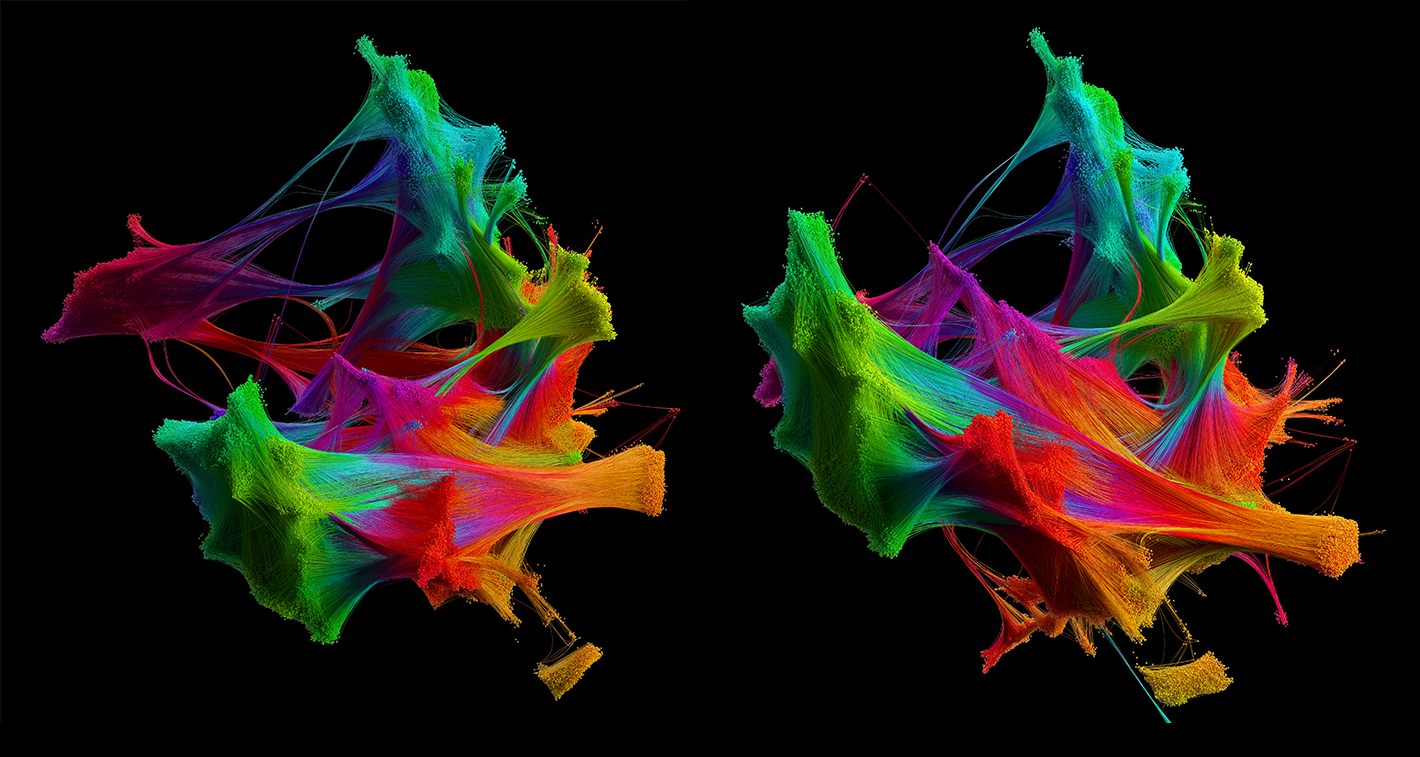
What does it look like when you compress nearly forty years of humanity’s most rigorous thinking about artificial intelligence into a single form?
This work is a UMAP (Uniform Manifold Approximation and Projection) rendering of every word across three landmark issues of Dædalus—winter 1988, “Artificial Intelligence”; spring 2022, “AI & Society”; and winter/spring 2026, “AI & Science”—based on similarity clustering (six-dimensional: x, y, z and red, green, blue colorizing).
Three distinct moments when the Academy convened leading minds to take stock of where AI stands and where it’s heading. The resulting image is not an illustration. It is a sculpture, shaped not by chisel or clay, but by the geometry of language itself, compressed through machine intelligence into visible form.
In 1988, the conversation was intimate and philosophical. Seymour Papert, Daniel Dennett, and Sherry Turkle debated whether machines could ever truly think. The vocabulary orbited the body: brains, neurons, perception, consciousness.
By 2022, the language had exploded outward. Fei-Fei Li, James Manyika, and Erik Brynjolfsson confronted what deep learning’s success meant for justice, labor, and democracy.
The 2026 issue reaches further still. Demis Hassabis describes AI as an instrument for understanding reality itself—from protein folding to the laws of physics. Yann LeCun argues for world models that move beyond language into abstract representation.
The UMAP reveals the filaments between these eras. Words like intelligence, learning, and human appear in all three, but their neighbors shift—from neuron in 1988, to equity in 2022, to prediction in 2026. The dense clusters are shared concerns; the long tendrils reaching into darkness are ideas unique to each moment.
When Brunelleschi carved perspective into architecture, or when Michelangelo released figures from marble, they were not simply making objects—they were making visible the invisible structures of their age. The Renaissance sculptors gave form to human proportion, divine geometry, and anatomical truth. Today, a parallel undertaking is quietly emerging: the sculpting of data itself into physical and immersive form, using machine intelligence as both material and collaborator.
This is what I have tried to pursue in my own practice—humbly, and with deep respect for what came before—treating vast archives of information not as abstract numbers but as raw matter waiting to reveal its hidden shape. It is, I believe, the beginning of a new sculptural movement: one in which the artist’s hand is guided by algorithms, in which the block of marble is replaced by multidimensional space, and in which what emerges is not a representation of the world but the actual structure of collective knowledge made tangible.
Three issues. Four decades. One continuous, expanding form.