Embed Mentoring Throughout High School, College, and Career
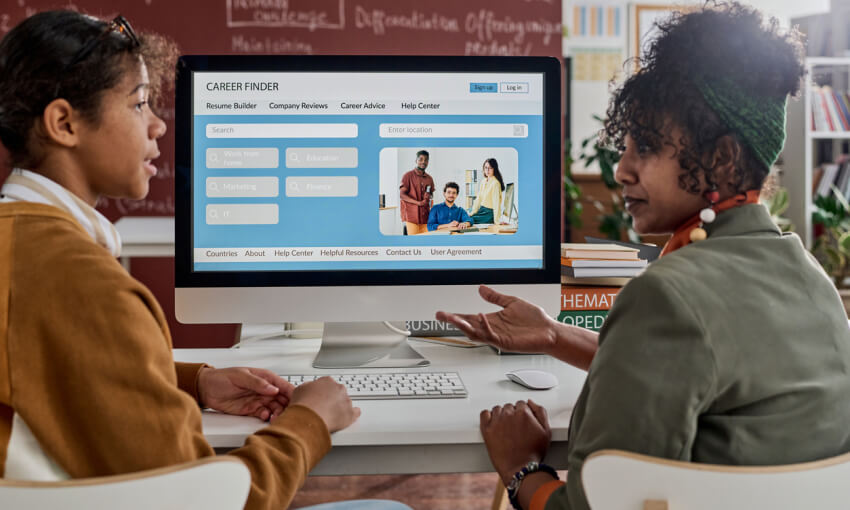
The Commission recommends that high schools, higher education institutions, service-year programs, and other programs for learners develop alumni cohorts that are supported by ongoing mentorship, the sharing of relevant information throughout transition points, and career coaching. The Commission also recommends that school districts and higher education institutions collaborate to create and expand mentorship, sponsorship, tutoring, and other programs that connect college learners to local K-12 students to foster near-peer relationships.
Extensive research illustrates the numerous benefits of having a coach or mentor in supporting learners’ career planning, job-search behaviors, and job-search self-efficacy.1 A central challenge in the U.S. education system is the many transition points as learners move from one school to another, build new relationships, and navigate disparate standards and funding opportunities. Many high school graduates would benefit from programming such as alumni cohorts, career coaching, and other support as they continue their postsecondary journeys.
College Track, one of the nation’s most comprehensive college completion programs, provides ten years of support to first-generation learners from underresourced communities in high school, through college, and after graduation. College Track continues to host regional events for alumni to connect to one another, to current learners, and to industry leaders.2 This example of a nonprofit organization bridging critical transition points for learners demonstrates the value of sustained, trusted relationships for advising learners as they make decisions about and navigate their postsecondary years.
Related Promising Practices
College Track
College Track equips first-generation scholars with academic, financial, and holistic support, opening pathways to college completion and meaningful careers.
- MD
- LA
- DC
- CO
- CA
- Early Exploration
- Advising and Mentoring
- Financial Aid
- Higher Education Leaders
- Philanthropists
The Math Corps at the University of Michigan, Ann Arbor
The Math Corps at the University of Michigan, Ann Arbor is a free summer camp for middle school students and high school mentors.
- MI
- Advising and Mentoring
- Higher Education Leaders
- K-12 Educators & Leaders
Several examples of programs that partner college learners with high school students, such as Math Corps, or campus programs that employ college learners to work with their peers, such as college writing centers, focus on tutoring, coaching, and advising.3 These types of “near-peer” programs provide dual benefits of short-term academic support for K-12 students, who may be struggling, and exposure to peers who have pursued various postsecondary education and career paths that may influence the learners’ own postsecondary choices, with long-term benefits.
Learner at a four-year public HBCU in Maryland
“I know that when it comes down to it, I do have a couple [resident advisors] that I can go to and talk to. And because they’re older, they do know places and programs that I can go to. And they’re also, when you’re close with them, they also look out for you.”
Related recommendation:
Embed Mentoring Throughout High School, College, and CareerHigh school student in Texas
“So, it’s like maybe if schools worked to have professionals have one-on-one relationships with students or being able to reach out to students so they can kind of see what the workforce is really like and find someone who has a similar experience of them and how they got out of that situation and kind of better themselves and their lives.”
Related recommendation:
Embed Mentoring Throughout High School, College, and CareerHigh school student in District of Columbia
“I am pretty well informed [because] our junior and senior class are really close with each other. So, we get to hear a lot about our current seniors and their process in terms of programs and also doing college visits and applying to programs in general.”
Related recommendation:
Advise and Mentor Learners, Alumni, and WorkersOutside classrooms, learners also benefit from sustained relationship building with mentors, personally through extracurricular activities in sports or the arts and professionally as they begin to explore their target industry of interest. Community-based organizations and extracurricular activities can be an important venue for building long-lasting relationships across school and life transitions. Having a mentor who encourages learners to pursue their goals is an important college experience linked to life preparedness.4 In the workplace, mentorship or, even better, sponsorship can greatly increase an employee’s motivation to navigate challenges and can develop into reciprocal growth for both the mentor and mentee over time.5
Related Promising Practices
EmployIndy’s Modern Apprenticeship Program
EmployIndy’s Modern Apprenticeship program gives high school students hands-on experience in fields like business, manufacturing, and technology.
- IN
- Education Benefits
- Durable Skills
- Early Exploration
- Advising and Mentoring
- K-12 Educators & Leaders
- Employers
Braven
Braven is a career-accelerating experience that prepares promising college learners to secure a strong first job after college graduation.
- CA
- DE
- GA
- IL
- MA
- NJ
- NY
- TX
- Durable Skills
- Early Exploration
- Advising and Mentoring
- Employers
- Higher Education Leaders
- Philanthropists
Endnotes
- 1
David Deming, Joseph B. Fuller, Rachel Lipson, et al., Delivering on the Degree: The College-to-Jobs Playbook (Harvard Kennedy School, 2023), https://files.eric.ed.gov/fulltext/ED636056.pdf.
- 2
College Track, “Alumni,” https://collegetrack.org/alumni.
- 3
Wayne State University, “Math Corps,” Center for Excellence and Equity in Mathematics, https://ceem.wayne.edu/math-corps.
- 4
Sean Seymour and Shane Lopez, “‘Big Six’ College Experiences Linked to Life Preparedness,” Gallup, April 8, 2015, https://news.gallup.com/poll/182306/big-six-college-experiences-linked-….
- 5
Olivia Gebreamlak, “Mentorship and Sponsorship: Core Tools for Talent Growth,” SHRM, October 10, 2025, https://www.shrm.org/topics-tools/news/linkage/mentorship-sponsorship-c….