Link Labor Market Data to Education, Occupation, and Industry-Specific Metrics of Success
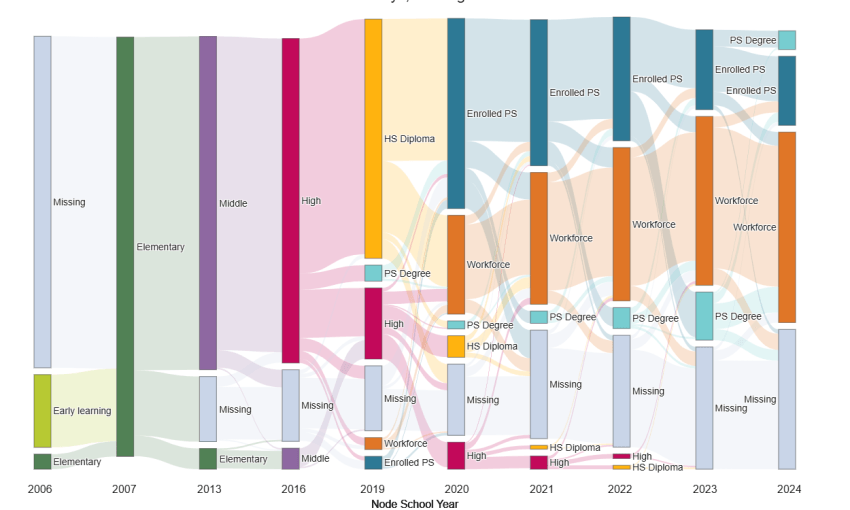
The Commission recommends the collection of labor data at the occupational level within industries and linking those data to education and training programs to provide greater transparency on industry-specific metrics of success and broader measures of well-being.
Policymakers, educators, employers, learners, and the public want to better understand the outcomes and returns on investment from different programs of study and training pathways. As learners discover their interests and strengths, they would benefit from more accessible and transparent information about occupations that align with their passions and can provide the financial security and life stability they desire. As unpredictable as the future can be, especially in the face of AI, information about emerging demand for particular skills and credentials should be provided to learners and considered in determinations of value when practicable.
The return on investment made in learners’ education and training should be defined by factors that contribute to their social and economic well-being, including, but not limited to, their wage and other job-related benefits. Recent changes to federal accountability for higher education require that institutions report their graduates’ employment and earnings outcomes. These data are important for institutions of higher education to better understand which of their graduates and programs are more primed for success. Ideally, these data should be linked to specific occupations to improve programs and better align with industry standards where necessary. These data can also provide learners with a better understanding of potential outcomes and empower them to make more informed choices about different career paths.
Related Promising Practices
The Texas Talent Accelerator
The Texas Talent Accelerator, a regional workforce hub, generates labor market insights to strengthen the North Texas talent pipeline.
- TX
- Break Down Silos
- Data Systems
- Employers
- Higher Education Leaders
- K-12 Educators & Leaders
- Policymakers
Some states are already shifting toward outcomes-based funding for higher education, with Texas leading the way in updates to their community college funding model in 2023.1 Texas’s community college funding model, established through House Bill 8, shifts state allocations from a primarily enrollment-driven formula to an outcomes-based system that rewards measurable learner success. Under this approach, colleges receive performance funding tied to key outcomes such as earning credentials of value, successful transfer to four-year institutions, and completion of workforce-aligned coursework, with additional weighting for high-demand fields and priority student populations. The model also incorporates a dual structure of performance-based funding and a funding floor to ensure institutional stability, while encouraging continuous improvement in student outcomes and economic mobility.2
Learner at a community college in Texas
“I want to give back to my community. I want to have an amazing legacy.”
High school student in District of Columbia
“My dream life [would be to] have a really nice brownstone, but in reality, I want to be able to afford groceries.”
Commissioners heard from learners about the importance of financial stability and sustainability, but they also expressed a desire to live a life of purpose in service to their families and communities. A narrow focus on earnings outcomes can obfuscate the importance of careers in the arts, education, public health, and social work (among others) that are critical to a healthy democracy and society. Industries should align on definitions of successful outcomes within their particular field that might be measured through quantitative or qualitative methods to expand the picture of success beyond future earning potential. In the performing and visual arts, success can be measured in financial sustainability, but artists also stress the importance of staying true to their vision, impacting their audience, and finding joy in the creative process.3
Related Promising Practices
Arkansas LAUNCH
Arkansas LAUNCH is a statewide workforce and career development platform designed to strengthen Arkansas’s talent pipeline.
- AR
- Data Systems
- Early Exploration
- Advising and Mentoring
- Employers
- Policymakers
The Kentucky Center for Statistics’ Longitudinal Data System
The Kentucky Center for Statistics collects and integrates education and workforce data for public access.
- KY
- Data Systems
- Policymakers
Endnotes
- 1
ExcelinEd, Higher Education Accountability (ExcelinEd, 2026), https://excelined.org/wp-content/uploads/2026/03/2026-Higher-Education-…
ability.pdf. - 2
Emily Schmidt, “Community College Finance Frequently Asked Questions,” Texas Higher Education Coordinating Board, https://www.highered.texas.gov/community-college-finance/community-coll….
- 3
Aronoff, “‘Ask the Artists’ Part 1: What Is Your Definition of Success?”