Expand Durable Skills Development Inside and Outside Classrooms
The Commission recommends that the development of learners’ durable skills be intentionally integrated into K-12 and college-level curricula to ensure that educators have the language, resources, and incentives to support this important aspect of individuals’ education.
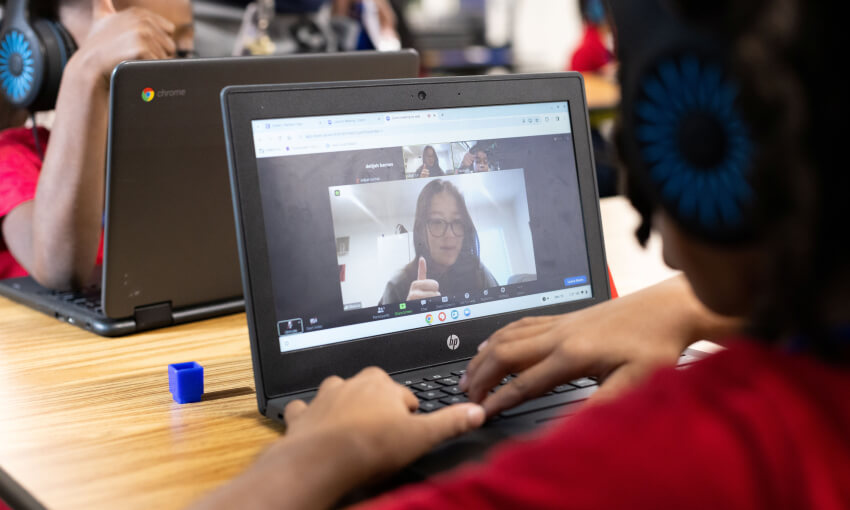
To prepare learners for a complex and evolving world, educators at all levels should incorporate into their curricula a range of skills, including core competencies, the ability to work in teams, and durable skills such as resilience, adaptability, and problem-solving. These skills can be fostered in the classroom and are also often learned through the liberal arts, creative pursuits and the arts, and extracurricular experiences such as community service, sports, and clubs. Classroom design, strong pedagogy, and role modeling by teachers and mentors also promote these vital skills and help learners to develop their sense of self, critical thinking, and collaboration skills.
Turnaround Arts is a national program of The Kennedy Center that provides arts education resources and a learning framework to Title I elementary and middle schools across seventeen states and Washington, D.C. In seven public schools in Milwaukee, Wisconsin, this programming provides learners with artistic and musical instruction and is also integrated into other classes in which learners develop critical thinking and presentation skills.1
Employer in California
“When it comes to youth development, getting ‘em ready for the workforce, we could hire for the technical skills that they may have, but what happens is that we end up firing for the lack of essential skills, durable skills, soft skills, like how to be a professional.”
Related recommendation:
Promote Durable Skills Across the P-20 ContinuumDurable skills may seem intangible or difficult to describe if they remain unnamed or undefined. Educators cannot be expected to support learners’ development of durable skills if they are unable to measure learners’ proficiency and track their progress against clearly defined benchmarks. Educators and service-year programs must have valid and reliable measurement tools that can validate durable skills and competencies. Additionally, such tools must be developed in partnership with employers or industry associations to be trusted and valued in the workplace.2
Related Promising Practices
Aurora University Skills Infusion Program
In Aurora University’s Skills Infusion Program, faculty align current coursework with transferrable skills for the workplace.
- IL
- Durable Skills
- Employers
- Higher Education Leaders
Academies of Shakopee High School in Minnesota
Academies of Shakopee High School in Minnesota is a program where students explore subjects they’re passionate about in small learning communities.
- MN
- Durable Skills
- Early Exploration
- K-12 Educators & Leaders
ElevateU at University of Montana
ElevateU of the University of Montana helps professors infuse durable skills and career competencies in their curriculum.
- MT
- Durable Skills
- Early Exploration
- Employers
- Higher Education Leaders
Endnotes
- 1
Milwaukee Public Schools, “Turnaround Arts,” https://www.milwaukeepublicschools.org/academics
/programs/turnaround-arts. - 2
Molly Kent and Catherine Van Ness, “Advancing Skill Development and Employment Outcomes for Postsecondary Students,” Bulletin of the American Academy of Arts & Sciences 79 (3) (Spring 2026): 4–6, https://www.amacad.org/bulletin/spring-2026
/advancing-skill-development-and-employment-out
comes-postsecondary-students.