Laurie L. Patton
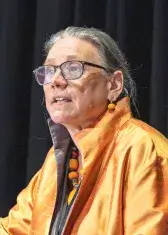
It is my pleasure to present this edition of the Annual Report of the American Academy of Arts and Sciences, the first since I officially began my term as president in January 2025. I would like to begin by expressing my sincere gratitude to the hundreds of members whom I have had the opportunity to meet and learn from this year.
Through these conversations, I have been deeply inspired by the goodwill, creativity, and sense of purpose that our members bring to the Academy. I have also been struck by how well the Academy “carries its history” on a daily basis. We remember our origins, both the successes and challenges, and that memory informs our work. That dimension is key to the intellectual leadership we can provide at this moment in our nation’s history.
Indeed, as I have met with members and delved into our history, it has become clear that by actively and visibly responding to the challenges of our time, the Academy can best fulfill its original mission, as envisioned by our founders in 1780, “to cultivate every art and science that may tend to advance the interest, honor, dignity, and happiness of a free, independent, and virtuous people.”
As I noted at the Academy’s recent Induction weekend, that original mission statement cannot be repeated enough; every word is precious. It tells us that, in the democracy our founders imagined, the free pursuit of knowledge nurtures the common good. It clarifies our interests. It deepens our honor and dignity. It builds the conditions for our pursuit of happiness.
It is with this understanding that I worked throughout the year with Academy governance and staff to develop a new strategic framework, which was shared by email with all members in September. As a reminder, the framework is guided by four animating principles:
Focus on Strengthening Democracy
Develop Relevant and Timely Products and Resources
Learn from the Local
Amplify Our Convening Power
These animating principles are reflected in, and will guide, seven strategies of implementation for conducting the Academy’s work in the years ahead:
Celebrate Excellence
Long-Term Programmatic Initiatives
Learning from Local Knowledge
Produce a Range of Resources
Convenings and Membership Engagement
Visibility and Outreach
Financial Sustainability
While these strategies are intended to set a course for the Academy during the next seven years, I am pleased to report that we have already made important progress in each area.
Celebrating Excellence
In April, the Academy announced the election of 248 extraordinary new members, and in October we welcomed more than eight hundred attendees–members and their guests–to an inspiring Induction weekend in Cambridge. We also announced the selection of forty-one new posthumous honorees as part of the Legacy Recognition Program, which highlights the contributions of scholars, researchers, writers, artists, business leaders, community leaders, and others whose accomplishments have been overlooked or undervalued due to their race, ethnicity, gender, or sexual orientation. In 2025, the Academy also presented three of its prizes, honoring Dr. Anthony Fauci with the Award for Excellence in Public Policy and Public Affairs, Professor Andrea M. Ghez with the Rumford Prize, and Dr. Victor Seow with the Sarton Prize for the History of Science.
Long-Term Programmatic Initiatives
We have been able to integrate our focus on preserving and renewing our constitutional democracy early on after the strategic framework was approved. The Academy advanced the work of the Our Common Purpose (OCP) initiative through a range of publications, convenings, and coalition-building activities. We hosted national and local meetings of democracy leaders and launched a Local Democracy Working Group to support civic practitioners. This year, the Academy issued three new OCP-related reports: Habits of Heart and Mind: How to Fortify Civic Culture; Expanding Representation: Reinventing Congress for the 21st Century; and Preparing Students for Civic Life: A Guide for Higher Education Leaders (forthcoming in December), each generating national discussion and partnerships across academia, policy, and civil society. We also released Community Partnership Visas: How Immigration Can Boost Local Economies, promoting place-based visa policies through cross-ideological outreach.
In the education program area, the 2025 Higher Education Forum, held in Aspen, CO, explored leadership challenges amid political, technological, and financial pressures, engaging more than one hundred higher education leaders around the question “Is Higher Education Leadership Possible?” Meanwhile, the Commission on Opportunities After High School advanced strategies to improve education-to-work pathways through stakeholder engagement, roundtables, and student listening sessions held across the country.
In the area of global security and international affairs, the Academy advanced its Promoting Dialogue on Arms Control and Disarmament project through meetings in Shanghai and Beijing, engaging more than fifty Chinese experts and U.S. officials. We also convened leading scholars for events on nuclear deterrence, the laws of armed conflict, and the future of security studies, shaping priorities for emerging work in global security.
In the humanities, arts, and culture program area, the Humanities Indicators project released the results from a major national survey of humanities departments1 and a study on student pathways in the humanities,2 generating extensive media and scholarly attention. The Academy also convened cultural leaders to address challenges facing museums, libraries, and arts institutions, both through an exploratory meeting held in Chicago and virtual roundtable discussions that explored potential future work to help cultural organizations be resilient, communicate their value, and better serve their communities in the years ahead. This important conversation has served as the basis for a longer-term project on the role of cultural institutions in a thriving democracy.
In the area of science, engineering, and technology, the project on AI and Mental Health Care engaged in a deliberative, nonpartisan, and cross-sectoral exploration of when and how AI should be used in mental health care. We also hosted roundtables on public trust in science and on sustaining science funding, bringing together experts to address misinformation, promote civic engagement, and develop strategies for a stronger, more resilient research ecosystem. These roundtables will help inform the Academy’s work to support leaders in the sector.
Learning from Local Knowledge
The Academy pursued a number of initiatives to better engage with and serve America’s communities. In January, the Academy held an exploratory meeting to discuss how local anchor institutions, such as colleges, universities, and faith-based organizations, can help address challenges in the housing market. In connection with the Commission on Opportunities After High School, the Academy is planning a convening on community colleges and their role in promoting durable skills in their communities. And we are developing an exciting new initiative to celebrate, convene, and connect with knowledge leaders in local communities across the country. Please stay tuned as this work develops.
Producing a Range of Resources
We are exploring a range of new products and resources, including two interactive maps for the Commission on Opportunities After High School and a new model for “blueprints for action,” which will be applied to our project on housing and our roundtable series on science funding. As new project work moves forward, we will explore additional innovative ways to produce engaging and updatable intellectual resources. We want our work to be useful to our members and partners on an ongoing basis.
Convenings and Member Engagement
In 2025, the Academy achieved a new record, with 1,122 members attending at least one event, the most ever in a single year. We held member events in sixteen cities across the country, nine of which were hosted by local committees, and 52 percent of members received an invitation to an event in their local area. In total, meetings and events included more than 5,700 attendees. I personally had the pleasure of visiting with members in New York, Washington, D.C., the Research Triangle, Atlanta, Southern California, Chicago, the San Francisco Bay Area, Ann Arbor, and New Haven.
Visibility and Outreach
In response to the rapid pace of current events, the Academy launched a series of “pop-up webinars” to address key issues as they developed, including cuts to science funding, tariffs, autocracy and democracy, the limits of executive power, and the question of whether we are in a constitutional crisis. In the spring, the Academy joined with the American Association of Colleges and Universities (AAC&U) to convene hundreds of higher education leaders and produce a historic joint statement that defended the values and freedoms of higher education and called for a future marked not by conflict but by constructive engagement. The Academy’s Board also released its own statement, committing “to urge public support for the arts and sciences and also work to safeguard the conditions of freedom necessary for novel discoveries, creative expression, and truth-seeking in all its forms.” The full text of both statements can be found in the pages that follow.
Dædalus, our quarterly journal, remains one of the most visible examples of the Academy’s work, and we have worked to reinvigorate it by organizing each issue around a central question and by adding a striking visual to each cover.
Financial Sustainability
With regard to financial sustainability, the Presidential Priorities Fund, initiated by my predecessor David Oxtoby, has exceeded its $2 million goal, and we have benefited from a number of additional major gifts and foundation grants that are allowing us to move quickly in launching new initiatives. I am grateful to all who have strengthened the Academy through their generosity, be it through the annual fund, major gifts, grants, or the Minerva Society, our planned giving program.
A Critical Moment
This Annual Report comes at a critical moment both for the Academy and the nation. We face serious challenges: an unstable political environment, unprecedented pressure on philanthropy and civil society, and the politicization of values previously considered to be nonpartisan. And yet I have been heartened by the response from our members and our partner institutions. It is clear that they are turning to the Academy to lead. Our independence matters. Our longevity gives them confidence. Our convening power gives them resilience. And our commitment to nonpartisanship gives them hope. I share this hope, and in the year ahead I look forward to working with you to fulfill it, both for our Academy and for the nation it serves.