
The Global Security and International Affairs program fosters knowledge and promotes innovative and evidence-based policies to address crucial issues affecting the international community. It draws on the expertise of a broad range of policymakers, practitioners, and scholars to design and lead projects engaging with the pressing strategic, development, and moral questions that underpin relations among people, communities, and states worldwide. Each initiative embraces a broad conception of security as the interaction among human, national, and global security imperatives. Project recommendations move beyond the idea of security as the absence of war toward higher aspirations of collective peace, development, and justice at all levels of society.
Committee on International Security Studies
CHAIRS
Scott D. Sagan
Stanford University
Jennifer M. Welsh
McGill University
MEMBERS
Tanja M. Börzel
Freie Universität Berlin
Neta C. Crawford
University of St. Andrews
Matthew Anthony Evangelista
Cornell University
Tanisha M. Fazal
University of Minnesota
Martha Finnemore
George Washington University
M. Taylor Fravel
Massachusetts Institute of Technology
Lawrence D. Freedman
King’s College London
Oona A. Hathaway
Yale University
Susan Landau
Tufts University
Rose M. McDermott
Brown University
Steven E. Miller
Harvard Kennedy School
Anne Woods Patterson
Georgetown University
Barry R. Posen
Massachusetts Institute
of Technology
Paul H. Wise
Stanford University
Project
Promoting Dialogue on Arms Control and Disarmament

The current nuclear age is characterized by a simultaneous collapse of arms control agreements and the absence of any strategic dialogue among the three main nuclear players. To address this gap, the Promoting Dialogue on Arms Control and Disarmament project convened Track II dialogues between experts and former policymakers from the United States, Russia, and China. These sessions are designed to identify critical short-term goals in arms control that would serve to minimize and reduce the potential risks of nuclear arms-racing and escalation. The meetings identify areas for cooperation and promote conceptual thinking about measures that might strengthen strategic stability and help to reduce the significant dangers of nuclear weapons being used in the future.
Additional work weaves the project’s expert discussions and policy recommendations together to produce publications on critical debates within nuclear arms control. Through targeted briefings and events with policymakers, the project also seeks to foster and strengthen knowledge on key issues and challenges facing the United States in arms control and international security, with particular attention to the careful management of the strategic competition posed by China and Russia.
PROJECT CHAIR
Steven E. Miller
Harvard University
PROJECT STAFF
Kaitlin Peach
Raymond Frankel Nuclear Security Policy Fellow (2025–present)
Mitch Poulin
Program Associate for Global Security and International Affairs
Peter Robinson
Chief Program Officer
Ottawa Sanders
Raymond Frankel Nuclear Security Policy Fellow (2023–2025)
Betsy Super
Program Director for American Institutions and Global Security
FUNDER
The Raymond Frankel Foundation
Project Publications
The Future of Nuclear Arms Control and the Impact of the Russia-Ukraine War, Nadezhda Arbatova, George Perkovich, and Paul van Hooft (2024)
The Altered Nuclear Order in the Wake of the Russia-Ukraine War, Rebecca Davis Gibbons, Stephen Herzog, Wilfred Wan, and Doreen Horschig (2023)
Missile Defense and the Strategic Relationship among the United States, Russia, and China, Tong Zhao and Dmitry Stefanovich (2023)
Minimizing the Negative Effects of Advances in Military-Relevant Space Capabilities on Strategic Stability, Nancy W. Gallagher and Jaganath Sankaran (2023)
Nuclear Perils in a New Era: Bringing Perspective to the Nuclear Choices Facing Russia and the United States, Steven E. Miller and Alexey Arbatov (2021)
Project Meetings
Forum on U.S.-China Relations and Strategic Stability; Strategic Security Meetings
July 7–11, 2025
Shanghai, China; Beijing, China
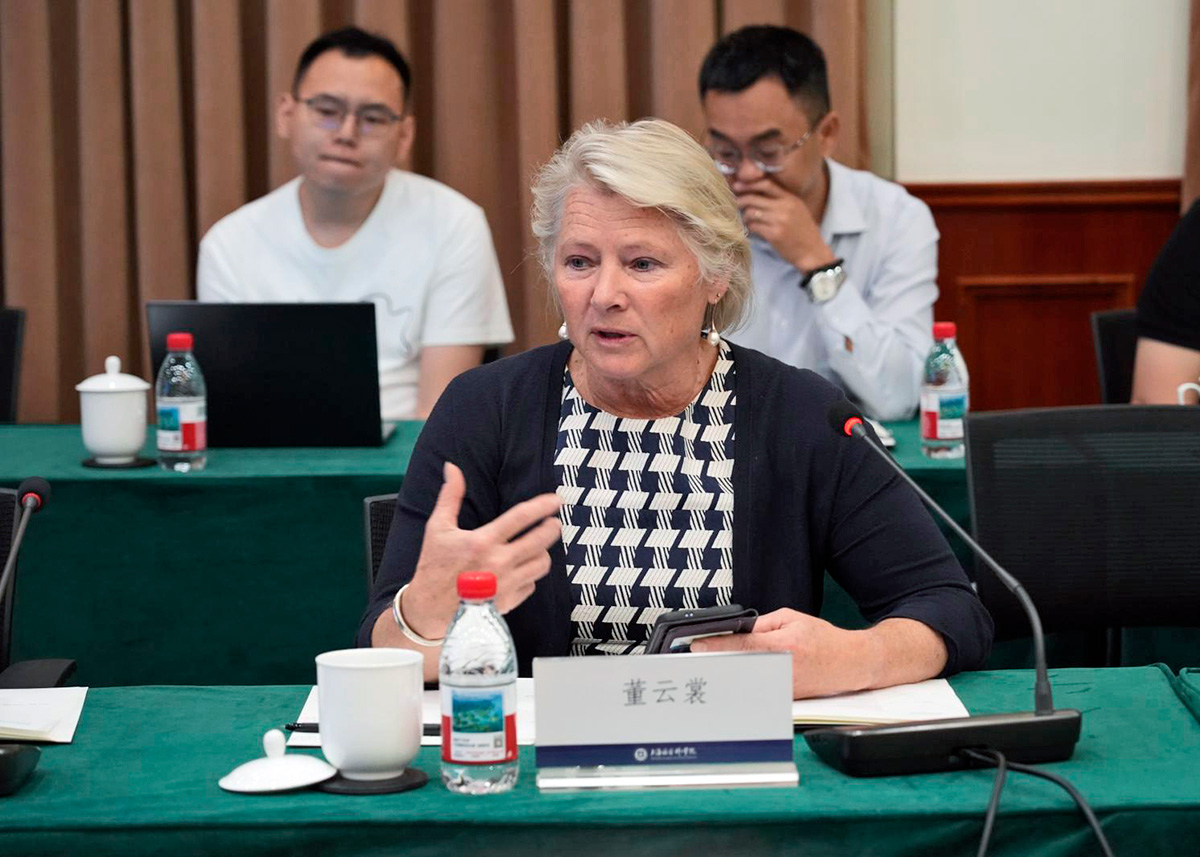
In partnership with Harvard University’s Managing the Atom project, the Academy and the Shanghai Academy of Social Sciences organized a Track II dialogue to explore U.S.-China Relations and Strategic Stability. Following the dialogue, the Academy delegation, led by Steven E. Miller (Harvard University), traveled to Beijing for meetings, including at the U.S. Embassy, the China Institutes of International Relations, China Ministry of Foreign Affairs, and two universities in Beijing. Discussions focused on the broader U.S.-China relationship and nuclear issues, including nonproliferation challenges, arms control, and the Golden Dome. Participants briefed State Department officials in Washington, D.C., upon return and highlighted areas of potential cooperation and the importance of governmental and nongovernmental dialogue to improve relations.
U.S. Participants
Matthew Bunn
Harvard University
Mark Fitzpatrick
International Institute for Strategic Studies
Francesca Giovannini
Harvard University
Edward Ifft
Stanford University
Laura Kennedy
formerly, Conference on Disarmament
Steven E. Miller
Harvard University
Susan Thornton
Yale University
Hui Zhang
Harvard University
Exploratory Meetings
The Future of the Laws of Armed Conflict
March 5–6, 2025
House of the Academy, Cambridge, MA
This exploratory meeting examined the extent to which international humanitarian law (IHL) has remained effective amid increasingly complex global conflicts. Speakers described IHL’s role in shaping behavior, the challenges of legal enforcement, and IHL’s limitations in addressing all forms of harm. The participants noted the growing threats to IHL, including frequent violations, emerging technologies like artificial intelligence, and widespread erosion of democratic norms. They stressed the urgent need to reform legal frameworks to better address modern conflicts, protect civilians, and uphold existing international norms.
MEETING CHAIRS
Scott D. Sagan
Stanford University
Jennifer M. Welsh
McGill University
Participants
Gabriella Blum
Harvard Law School
Tanja A. Börzel
Freie Universität Berlin
Ioana Cismas
Centre for Applied Human Rights, York Law School
Neta C. Crawford
University of Oxford
Tom Dannenbaum
Fletcher School of Law & Diplomacy
Janina Dill
University of Oxford
Matthew A. Evangelista
Cornell University
Tanisha Fazal
University of Minnesota
Oona A. Hathaway
Yale Law School
Elena Kempf
Massachusetts Institute of Technology
Susan Landau
Tufts University
Dustin A. Lewis
Harvard Law School
Frédéric Mégret
McGill University
Steven E. Miller
Harvard Kennedy School
Anne Woods Patterson
Georgetown University
Laurie L. Patton
American Academy of Arts and Sciences
Barry R. Posen
Massachusetts Institute of Technology
Annie Shiel
CIVIC
Matthew C. Waxman
Columbia Law School
Paul H. Wise
Stanford University
John Fabian Witt
Yale Law School
Project Staff
Mitch Poulin
Program Associate for Global Security and International Affairs
Peter Robinson
Chief Program Officer
Ottawa Sanders
Raymond Frankel Nuclear Security Policy Fellow
The Future of Nuclear Deterrence
September 18–19, 2025
Stanford University
How can states be dissuaded from using nuclear weapons? Although the central questions of deterrence are largely the same as they were twenty or even forty years ago, the strategic environment today is remarkedly different. This meeting, hosted by Stanford University’s Center for International Security and Cooperation in collaboration with the MIT Center for Nuclear Security Policy and the Academy, examined how deterrence requirements should be understood in a multi-threat environment, the future of arms control, the prospect of “friendly” nuclear proliferation, the role of missile defense, and lessons from the war in Ukraine, among other topics. The participants highlighted questions for future research and the importance of creating a network of scholars and practitioners to address the evolving challenges of nuclear deterrence.
MEETING CHAIRS
Vipin Narang
Massachusetts Institute of Technology
Scott D. Sagan
Stanford University
Participants
Andrew Coe
Vanderbilt University
Matthew Daniels
Stanford University
Tom Dannenbaum
Tufts University
Alexandre Debs
Yale University
James Fearon
Stanford University
Nicole Grajewski
Carnegie Endowment for International Peace
Rebeccah Heinrichs
The Hudson Institute
Jill Hruby
formerly, National Nuclear Security Administration
Colin Kahl
Stanford University
Rose M. McDermott
Brown University
Steven E. Miller
Harvard Kennedy School
George Perkovich
Carnegie Endowment for International Peace
Ori Rabinowitz
Stanford University
Deborah Rosenblum
formerly, U.S. Department of Defense
Mallory Stewart
Texas A&M University
Lauren Sukin
University of Oxford
Mohammed Tabaar
Texas A&M University
William H. Tobey
Harvard Kennedy School
Pranay Vaddi
Massachusetts Institute of Technology
John Warden
Lawrence Livermore National Laboratory
Andrew Webber
The Council on Strategic Risks
Tong Zhao
Carnegie Endowment for International Peace
Project Staff
Kaitlin Peach
Raymond Frankel Nuclear Security Policy Fellow
Mitch Poulin
Program Associate for Global Security and International Affairs
Betsy Super
Program Director for American Institutions and Global Security
Funders
Louise Henry Bryson and John E. Bryson †
Lester Crown
Alan M. Dachs
Bob and Kristine Higgins
Kenneth L. and Susan S. Wallach
† Deceased
The Future of Security Studies
December 4–5, 2025
House of the Academy, Cambridge, MA
At this exploratory meeting, international relations scholars, journalists, philanthropic leaders, and practitioners assessed how the field of security studies might respond to emerging and troubling global trends, including shifting power dynamics, new technologies, and nontraditional threats like climate change and disease. The participants considered how institutions can adapt to decreased domestic funding, explored new research questions, and identified new priorities.
MEETING CHAIRS
Rose M. McDermott
Brown University
Scott D. Sagan
Stanford University
Jennifer M. Welsh
McGill University
FUNDER
The Raymond Frankel Foundation
Roundtable Events
In 2024, the Global Security and International Affairs program convened climate scientists, scholars of international relations, and global security practitioners to examine how climate change and global security interact. Recognizing the urgency and complexity of these issues, the Academy committed to fostering cross-disciplinary dialogue to support collaborative research and informed policymaking about climate and security policy. Building on this commitment, the Academy held a series of roundtable events in 2025 to further explore these key themes.
Managing Solar Radiation Management
April 17, 2025
Virtual
This roundtable examined the governance challenges of Solar Radiation Management (SRM), a controversial set of proposed technologies designed to reflect sunlight back into space to temporarily cool the planet. During the meeting, environmental scientists, international relations scholars, and policy experts discussed the scientific, political, and ethical dimensions of SRM, including the role of private actors, the assumptions behind the public’s skepticism, and the lack of international coordination in governing the technologies. Speakers emphasized the need for regulation, warning that a lack of legal norms could exacerbate global inequities and geopolitical tensions if and when SRM were deployed. Participants also stressed the importance of basing governance decisions on scientific evidence while incorporating the perspectives of Indigenous communities and voices from the Global South.
MEETING CHAIR
Tanisha M. Fazal
University of Minnesota
FEATURED SPEAKERS
Chris Field
Stanford University
Peter C. Frumhoff
Harvard University
Sikina Jinnah
University of California, Santa Cruz
Frank Keutsch
Harvard University
The Carbon Footprint of Conflicts: The Hidden Impacts of Modern Wars
July 17, 2025
Virtual
This event explored the impact of military activities on the global climate crisis. The roundtable highlighted the often-overlooked and underreported carbon emissions produced by the militaries, including the additional emissions that occur during conflicts. Participants discussed the importance of reducing military emissions as part of global climate goals and examined the challenges and methods for tracking these emissions. Speakers called for greater transparency, stronger international emissions reporting standards, and new strategies to reduce military-related emissions.
MEETING CHAIRS
Neta C. Crawford
University of Oxford
Tanisha M. Fazal
University of Minnesota
FEATURED SPEAKERS
Stuart Parkinson
Scientists for Global Responsibility
Mykola Shlapak
Initiative on GHG Accounting of War
Climate(s) of Insecurity
January 2026
Virtual
This virtual roundtable will explore the complex and contested relationship between climate change and conflict. The participants will consider critiques of the securitization of climate, including the ways in which security frameworks may clarify or obscure conflict drivers.
MEETING CHAIR
Tanisha M. Fazal
University of Minnesota
FEATURED SPEAKERS
Marwa Daoudy
Georgetown University
Cullen Hendrix
Peterson Institute for International Economics