The humanities, arts, and culture are woven through virtually every Academy program, in which artists and humanists add interdisciplinary breadth to projects in science, democracy, and security. However, the Academy also undertakes projects that put humanities, arts, and culture at the forefront–tracking and reporting data on the health of the sector through the Humanities Indicators, and working with leaders in the field to articulate the needs of the sector and their importance to a vital and thriving nation through a new initiative on Democracy, Arts, and Cultural Spaces.
ADVISORS
Johanna Drucker, Chair
University of California, Los Angeles
Louise Henry Bryson
Public Media Group of Southern California
Joy Connolly
American Council of Learned Societies
Oskar Eustis
The Public Theater
Rubén Gallo
Princeton University
Sandra Jackson-Dumont
Getty Research Institute
Margaret Jacobs
University of Nebraska
Marie-Josée Kravis
Museum of Modern Art
Sara Lawrence-Lightfoot
Harvard University
Pedro Noguera
University of Southern California
Carl H. Pforzheimer III
Carl H. Pforzheimer and Co. LLC
Oscar Tang
New York, NY
Ayanna Thompson
Arizona State University
Sherry Turkle
Massachusetts Institute of Technology
Mark Volpe
Boston Symphony Orchestra
Daniel Weiss
Philadelphia Museum of Art
Jay Xu
Asian Art Museum of San Francisco
Project
Democracy, Arts, and Cultural Spaces

In November 2026, after almost two years in development, the Academy introduced a national, multiyear initiative designed to strengthen and promote the role of cultural institutions as essential components of a healthy and thriving democracy. Building on a series of meetings with leaders from across the sector in 2025 and early 2026, this initiative will convene experts, conduct research, host listening sessions, and produce practical resources and recommendations to help cultural organizations and their communities better understand and adapt to the current social and political challenges they face. The project will also develop two separate research projects looking at the local cultural ecosystems of three communities, as well as an inventory of the nonprofit cultural sector with an accompanying website. At the end, the project will build on that work with a final report and recommendations intended to lay the groundwork for a more secure future for the sector.
PROJECT CHAIRS
Leah Dickerman
Museum of Modern Art
Oskar Eustis
The Public Theater
Cynthia Chavez Lamar
Smithsonian’s National Museum of the American Indian
Funders
Amos B. Hostetter, Jr. and Barbara W. Hostetter
Henry R. Kravis
Marie-Josée Kravis
The Tang Fund
MEETINGS: Virtual Roundtables
Expanding the Definition of Cultural Institutions
Moderated by Johanna Drucker
August 17, 2026
Envisioning a New Cultural Landscape
Moderated by Oskar Eustis
August 31, 2026
Preparing More Resilient Cultural Organizations
Moderated by Cynthia Chavez Lamar
September 9, 2026
Cultural Spaces as Civic Spaces
Moderated by Leah Dickerman
September 16, 2026
Project
The Humanities Indicators

The Humanities Indicators provide nonpartisan statistical information about all aspects of the humanities: from early childhood reading, through undergraduate and graduate education in the humanities, to employment and humanities experiences in daily life, such as reading and visits to museums. Now marking its sixteenth year as a publicly available website, the project tracks the condition of the humanities enterprise via analyses of data gathered by the federal government and its own original research. The project is one of the most cited activities of the Academy, and journalists, advocates, government agencies, and academic leaders regularly call on the project staff for information and their expertise.
Recent work has focused on the health of the field in academia, with significant new reports based on focus groups with humanities department chairs, high school teachers and counselors, and high school students, as well as interviews with college students interested in the humanities. The focus groups and interviews with students assisted in the development of a survey of young people about their interests in and engagement with the humanities as an area of study, and spurred additional survey research about student reading habits. Alongside that work, the project is also developing updates to indicators and reports about career outcomes for humanities graduates. The Humanities Indicators are accessible at www.amacad.org/humanities-indicators.
PROJECT DIRECTORS
Norman M. Bradburn
NORC at the University of Chicago
Robert B. Townsend
American Academy of Arts and Sciences
ADVISORS
Edward Ayers
University of Richmond
Jonathan R. Cole
Columbia University
John Dichtl
American Association for State and Local History
Michael Hout
New York University
Felice J. Levine
American Educational Research Association
James Shulman
American Council of Learned Societies
Phoebe Stein
Federation of State Humanities Councils
Judith Tanur
Stony Brook University
PROJECT STAFF
Carolyn Fuqua
Program Officer for the Humanities Indicators
Sara Mohr
Pforzheimer Foundation Fellow and Program Officer for Humanities, Arts, and Culture
FUNDERS
Mellon Foundation
National Endowment for the Humanities
Carl H. Pforzheimer III
National Endowment for the Arts
The Humanities Indicators were developed with generous support from the National Endowment for the Humanities, Elihu Rose and the Madison Charitable Fund, John P. Birkelund, Peck Stackpoole Foundation, Rockefeller Foundation, Sara Lee Foundation, Teagle Foundation, Walter B. Hewlett and the William R. Hewlett Trust, and William and Flora Hewlett Foundation.
PROJECT PUBLICATIONS
The Academic Humanities Today: Opportunities and Challenges (American Academy of Arts and Sciences, 2026)
Research Brief: Pathways and Barriers to the Humanities: The Perspectives of High School and College Students (American Academy of Arts and Sciences, 2026)
Research Brief: An Estimate of Humanities Employment in the United States (American Academy of Arts and Sciences, 2026)
Research Brief: Understanding the Public Humanities Through the State and Jurisdictional Humanities Councils (American Academy of Arts and Sciences, 2026)
Academy Article: “How Often Does the Public Engage with AI?” (American Academy of Arts and Sciences, 2026)
Academy Article: “The Humanities in High School and Beyond: What Secondary Educators Can Tell Us” (American Academy of Arts and Sciences, 2026)
PROJECT MEETINGS
Humanities Indicators Advisory Committee Meeting
April 20, 2026
Virtual
Members of the Advisory Committee reviewed draft research from the project, discussed potential future work, and offered advice on new research topics.
What We Can Know and What We Should Know about the Humanities
October 29–31, 2026
House of the Academy, Cambridge, MA
The meeting brought together humanities leaders, advocates, and researchers to discuss the challenges facing the humanities, identify urgent gaps in existing data and research, and explore how to develop new resources to address those pressing needs.
STAFF PRESENTATIONS
Modern Language Association 2026 Convention
January 8, 2026
Toronto, Canada
Program Officer Carolyn Fuqua participated in a panel on “Navigating the Data Crisis: Finding Humanities Data to Advocate for Your Program or Institution,” and provided a review of data sources related to the career outcomes of humanities majors.
Mpact Conference
March 25, 2026
University of Maryland, College Park
Program Director Robert Townsend chaired a panel on “Developing Trustworthy, Human-Centered AI Technologies.”
125th Anniversary Graduate Education Symposium
April 28–29, 2026
Princeton University
Program Director Robert Townsend participated in a panel on “Preparing Graduate Students in Humanistic Fields for Dynamic Careers & Labor Market Changes” and in several other discussions at the 125th Anniversary Graduate Education Symposium.
AI & History Symposium
June 10, 2026
Lucy Family Institute for Data & Society,
Washington, D.C.
Program Director Robert Townsend participated in a panel titled “Old News or Generational Tool? Will AI Change History?”
Case Western Reserve University
September 7–8, 2026
Cleveland, OH
Program Director Robert Townsend spoke to a class on Public Humanities and to faculty, graduate students, and administrators at a meeting hosted by the Baker Nord Institute.
Coastal Carolina University
September 15–16, 2026
Conway, SC
Program Director Robert Townsend delivered a presentation on “Uncharted Waters: What’s Really Happening to the Humanities?” and participated in other discussions with students and faculty.
Northern Iowa University
September 21–22, 2026
Cedar Falls, IA
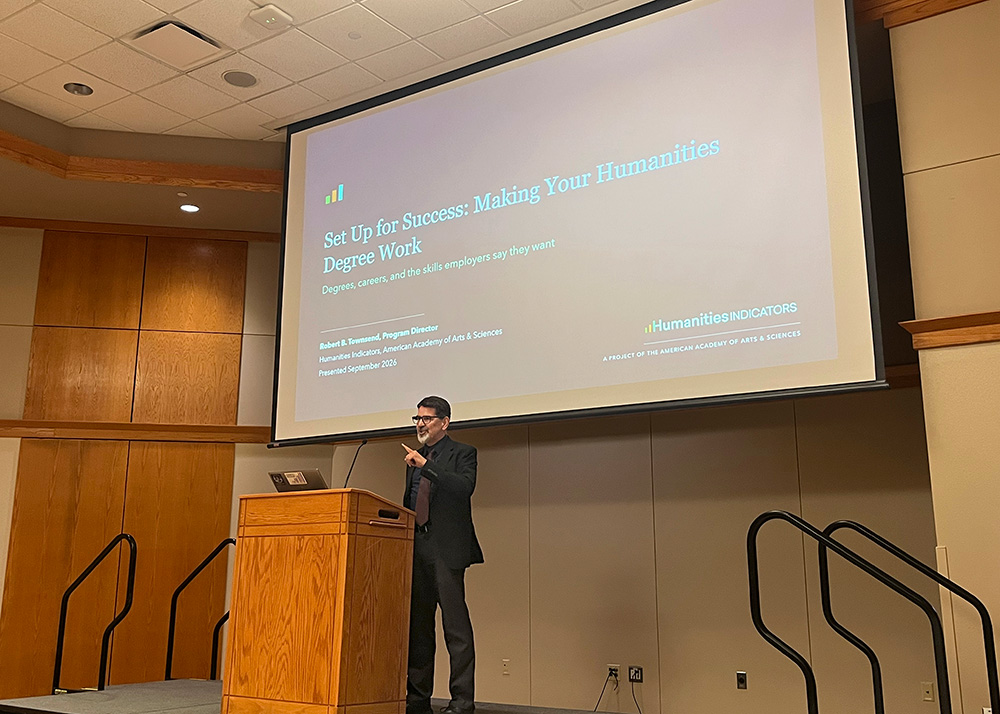
Program Director Robert Townsend delivered a presentation on “Set Up for Success: Making Your Humanities Degree Work,” and engaged with students and faculty in several classes and meetings.
Saint John’s University
September 28, 2026
Queens, NY
Program Director Robert Townsend delivered a New York–focused version of the presentation “Set Up for Success: Making Your Humanities Degree Work” and met with faculty.
The Resilient Humanities Ph.D.: Scholarly Formation for the 21st Century
November 3–5, 2026
University of Texas at Austin
Program Director Robert Townsend participated in a panel on doctoral training of humanities Ph.D.s and participated in workshops with faculty and graduate students.
Indiana University
December 3–4, 2026
Bloomington, IN
Program Director Robert Townsend delivered two talks: the first on “What’s Really Happening to the Humanities? (And What You Can Do About It)” and the second on “Incorporating AI into Research Workflows.”
Project
The History of the Academy Book Project

Looking ahead to its 250th anniversary in 2030, the Academy selected historian Jacqueline Jones (University of Texas at Austin) to write a one-volume account of the history of the institution. The book will offer a comprehensive and candid account of the Academy’s activities and membership since its founding in 1780, and place the Academy within the broader context of the nation it was created to serve.
Jacqueline (Jackie) Jones’s work has been recognized with the Pulitzer Prize, the Bancroft Prize, a MacArthur Fellowship, membership in the American Academy, and most recently the presidency of the American Historical Association. Her publications include Labor of Love, Labor of Sorrow: Black Women, Work, and the Family from Slavery to the Present; Saving Savannah: The City and the Civil War; A Dreadful Deceit: The Myth of Race from the Colonial Era to Obama’s America; and No Right to an Honest Living: The Struggles of Boston’s Black Workers in the Civil War Era.
ADVISORS
Catherine Allgor
Massachusetts Historical Society
Paula J. Giddings
Smith College
David A. Hollinger
University of California, Berkeley
Sally Gregory Kohlstedt
University of Minnesota
Earl Lewis
University of Michigan
John R. McNeill
Georgetown University
David W. Oxtoby
American Academy of Arts and Sciences
David M. Rubenstein
The Carlyle Group
Ben Vinson III
Harvard University
FUNDER
Jack, Joseph, and Morton Mandel Foundation