Benjamin Franklin’s Glass Armonica in Concert
By Michele Lavoie, Director of Archives
The year 2026 marks both the 250th anniversary of the founding of the United States and the 320th anniversary of the birth of Benjamin Franklin, founder of the American Philosophical Society in Philadelphia and a member of the Academy’s first elected class of members in 1781.
In January 1956, to commemorate the 250th anniversary of Franklin’s birth, the Academy organized a three-part lecture series exploring different aspects of his life and achievements, culminating in a birthday dinner. One of the after-dinner speeches focused on “Franklin and Music,” which led to another celebratory event a few months later.
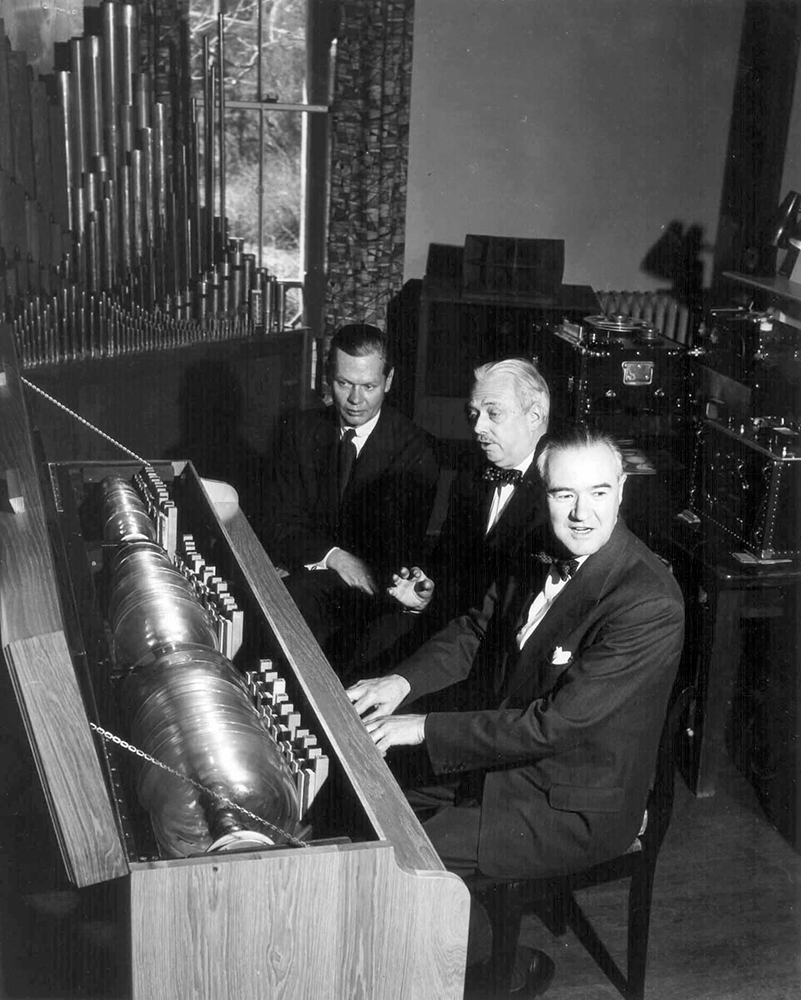
This fourth event, held in conjunction with the Academy’s Stated Meeting on April 11, 1956, was a concert honoring both the 250th anniversary of Franklin’s birth and the 200th anniversary of Mozart’s birth. Organist and Academy member E. Power Biggs (elected 1950) led the program. Several musicians affiliated with the Boston Symphony Orchestra joined him, including Academy members violinist Richard Burgin (elected 1947) and tenor Roland Hayes (elected 1953). Biggs’s remarks were later published in Dædalus.1 The concert was held in the Kresge Auditorium at MIT and featured a unique performance of Mozart’s adagio for the glass armonica, along with other musical works by Mozart and Franklin.
For the occasion, the Academy commissioned a recreation of Franklin’s own design for the glass armonica, as detailed in his Letter to Beccaria (Milan, 1776). Corning Glass Works constructed the instrument in collaboration with renowned organ builder Herman Schlicker. However, design flaws made the instrument unsuitable for performance—the glass bowls cracked from the hammer pressure specified in Biggs’s original design–so a much simplified version had to be constructed for the concert. The instrument still exists today and is part of the Academy’s archival collections.