By Kate Carter, John E. Bryson Director of Science, Engineering, and Technology
On a gray London morning in January, I walked past familiar markers of institutional gravity on my way to the Royal Society. Stone facades. Heavy doors. Plaques engraved with names that have outlived the controversies of their eras. It is easy, in places like this, to slip into a kind of historical reverence that feels comforting, even anesthetizing.
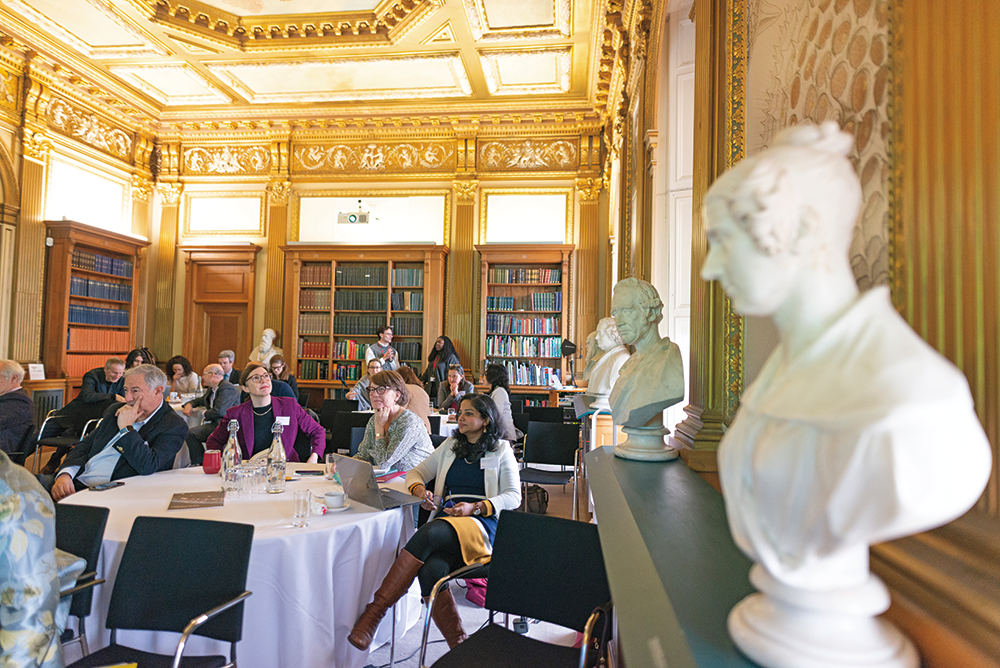
Inside, the atmosphere for the joint meeting on Knowledge Diplomacy hosted by the Royal Society and the American Academy felt weighted with a deep scientific history. The Royal Society’s meeting rooms are ornate, with cherubs dancing across ceilings trimmed with gold leaf and intricate designs carved into wooden doors. I learned rather quickly that leaning too far back in my chair meant concussing myself on the larger-than-life marble bust of Henry John Stephen Smith, one of dozens of scientific greats observing our proceedings. At one point, a participant gestured around the room and suggested that it in itself embodied a kind of knowledge: scientific truth fused with artistic and human truth. It was a useful provocation, an argument about what a civilization looks like when it takes knowledge seriously.
The meeting, cochaired by Mark Walport (Foreign Secretary and Vice President of the Royal Society) and France Córdova (President of the Science Philanthropy Alliance), convened senior scientists, funders, diplomats, and institutional leaders from both sides of the Atlantic to grapple with a deceptively simple set of questions: How do we accumulate knowledge and use it? How do we evaluate knowledge and trust it? And can “knowledge diplomacy” help our countries navigate through what nearly everyone in the room described as a tipping point?
This was not the Academy’s first collaboration with the Royal Society. The earliest recorded connection dates to 1785, when Benjamin Gale, a member of the Royal Society, contributed “Observations on the Culture of Smyrna Wheat” to the first volume of the Academy’s Memoirs. Since then, the two organizations have worked together on efforts ranging from advancing discovery and strengthening scientific exchange to supporting peace.
Royal Society and American Academy Collaborations
| 1785 | Benjamin Gale’s “Observations on the Culture of Smyrna Wheat” published in the Academy’s Memoirs |
| 1962 | International Pugwash Conference |
| 2012 | Program on the Evolution of the Internet: Emerging Challenges and Opportunities |
| 2014 | Program on the Universe Is Stranger Than We Thought |
| 2018 | Program on Technology and the Future of Work |
| 2026 | Convening on Knowledge Diplomacy |
Source: Data from the archives at the American Academy. Table created by Jen Gentili, Program Associate for Science, Engineering, and Technology at the Academy.
It would be easy for a meeting this steeped in history to wield that history as a salve. Instead, the opening keynote presentations set a tone that was bracingly direct. A former frontline politician traced the arc of their own political career as a parable, recalling how they entered office at the turn of the millennium determined to champion evidence-based policymaking, especially around climate. Despite early progress and a body of climate evidence, however, the “facts gave way to factions” and the political will to act collapsed. Their country lost a decade of progress on climate policy.
What Has Shifted
That story—specific, rueful, and told without self-exoneration—set the tone for much of what followed. This meeting didn’t treat the erosion of knowledge as an abstract structural problem. The room was full of people who had watched it happen, sometimes on their watch, and were trying to understand why.
The examples accumulated quickly. A senior diplomat described the Quebec Agreement, in which Churchill effectively used the knowledge generated by British universities as currency to support the Manhattan Project. This pooling of resources laid the foundation for a defense arrangement that still endures. The story was shared not as nostalgia, but as a reminder that knowledge has always been entangled with power, and that this entanglement has sometimes produced durable institutions.
Others offered less reassuring evidence. One participant described a national digital archive that seemed comprehensive and stable but was actually held together by licensing agreements that were impossible to trace and could change with little notice. Without any physical destruction, an entire collection could become inaccessible overnight.
The opposite scenario was equally alarming: retracted studies that continue to circulate through secondary databases, media coverage, and AI training data, so that corrections rarely eliminate the studies’ influence. Self-correction remained an aspiration rather than a reliable mechanism—an ideal that worked reasonably well within contained expert communities, but whose limits become painfully visible once claims circulate rapidly. For much of the twentieth century, major scientific institutions occupied an implicit custodial role over these problems, not owning or fully controlling their circulation, but anchoring their legitimacy. That arrangement was never neutral; it reflected geopolitical power, disciplinary hierarchies, and exclusionary histories that determined whose knowledge mattered. Entire traditions of inquiry—indigenous, vernacular, or rooted in communities that did not speak through journals or academies—were excluded from that custody. But for those inside the system, it created a legible center of gravity. That structural position has now eroded. No single actor today occupies the position or holds the authority that institutions once assumed was theirs.
What Knowledge Diplomacy Is—and Isn’t
Against this backdrop the discussion turned to “knowledge diplomacy.” For a meeting largely focused on leading under uncertainty, it was perhaps reassuring that little time was spent trying to lock down a precise definition of knowledge diplomacy. What emerged instead was a practical understanding: knowledge diplomacy refers to the work of sustaining the conditions that allow knowledge to cross borders and be contested, corrected, and preserved, even under political instability and increasing fragmentation.
Participants were clear about what the concept was not. This was not a meeting about international scientific collaboration; everyone took that as baseline practice. It was not about putting more scientists into political office. And it was not about the growing political instability in the United States, though that reality was ever-present in the room.
During one break, several participants gathered around a laptop to read a transcript of President Trump’s Davos remarks about Greenland. It was also hard to ignore that the only all-American panel on the program was titled “Knowledge Under Threat.” Earlier, a speaker had recounted the fatal midair collision over the Potomac in January 2025 and President Trump’s immediate suggestion that it was caused by diversity initiatives at the FAA. When reporters pressed him on the source of that claim, he replied, “Because I have common sense,” which subsequent investigation did not support. Yet that very idea that common sense has authority over evidence represented in miniature the epistemological challenge the meeting had been convened to address.
The Mismatch
Despite the external tensions within this cathedral of science, the most urgent scrutiny turned inward.
During the COVID-19 pandemic and ongoing debates about climate change, scientific institutions were positioned not only as arbiters of evidence but as authorities of acceptable courses of action. Yet, as participants acknowledged, the questions being asked were never purely epistemic. They involved tradeoffs among competing goods, distributional consequences, and time horizons stretching well beyond the evidentiary record. Science can generate probabilistic claims about likely outcomes. But it cannot, on its own, determine which risks are tolerable, which harms are acceptable, or whose losses should be prioritized. When institutions are expected to supply these answers, disagreement begins to look like failure, revision as incompetence, and uncertainty as weakness.
Participants went a step further, asking how much institutions themselves had contributed to this mismatch. The expectation that science could deliver certainty on contested public questions was not imposed entirely from the outside; it was also cultivated, sometimes eagerly, by institutions that benefited from the authority such certainty seemed to confer.
This tension surfaced most clearly in a sustained argument about COVID-era decision-making. One participant pointed to school closures as a case in point, in which aggressive public health positions in parts of the United States demonized countries like Sweden without honestly examining the tradeoffs between two deeply imperfect options. The phrase “following the science” was invoked repeatedly in contexts in which the science was genuinely ambiguous and what was really at stake was a political judgment about whose suffering should be prioritized.
Another participant pushed back. In a crisis, leaders cannot say, “We’re not quite sure, but maybe stay home.” They have to act. The fault comes afterward, when inquiry commissions spend years assigning blame for decisions that had to be made in real time with incomplete information. A third voice cut through the exchange. They argued that the real issue was the failure to distinguish facts from values, and the tendency of scientists to present a mix of both as though they were entirely factual. Openness in research is both an evidence-supported practice and a value commitment. Diversity in science is both methodologically sound and a moral position. When scientists convey something to policymakers that reflects their own beliefs, the resulting confusion can cause real damage. The community senses the mixture, even if the messenger does not acknowledge it.
A former frontline politician responded with unusual candor. There was a risk, they said, that science would end up bundled with a set of progressive cultural positions that large segments of the public had come to distrust. Not because the positions were wrong, but because they were associated (whether fairly or not) with societal elites whose values had been pushed too far and were not shared by ordinary people. If science became associated with that bundle, it would inherit the resulting backlash. Several participants noted, with evident discomfort, that the war on science might be coming not only from outside. It could also come from within: from academic cultures that had not reckoned honestly with how they were perceived.
Who Bears the Cost
A system built for internal self-correction is now being asked to perform legitimacy in real time, at a planetary scale. And the burden is not shared equally. Early-career scholars often experience international collaboration, data sharing, and public-facing work as a personal exposure rather than as an institutional opportunity. Their professional standing, visa status, and future employment opportunities can hinge on decisions over which they have little control. Scholars working in politically sensitive contexts routinely face reputational and political risk, often without reciprocal protection from the institutions that benefit from their work. When these institutional safeguards weaken, individuals end up absorbing the shocks.
A participant working in global health made the point more concrete. About 1 percent of the world’s population has epilepsy. Seventy-five percent of these cases can be treated with a drug that costs twenty-five cents a day. Yet 80 percent of those affected are undiagnosed. Here is a case in which the scientific knowledge already exists and the treatment is inexpensive, but what is missing is the institutional scaffolding to move it from the laboratory to the people’s lives it could change. If knowledge diplomacy cannot address that kind of gap, one participant asked, then what exactly is it for?
Stewardship, Not Ownership
If institutions can no longer plausibly claim comprehensive guardianship over knowledge, what role remains? The discussion kept returning to the stewardship of conditions that is shaping the environments in which knowledge can be produced, challenged, preserved, and corrected without placing disproportionate risk on the most vulnerable participants.
In practice, this means confronting infrastructure that was never designed to serve as a long-term public good. Data repositories, publishing platforms, and digital archives increasingly operate within commercial arrangements that are accountable primarily to shareholders, not to the epistemic durability of knowledge. It means grappling with incentive systems that reward speed and novelty over maintenance. Careers advance by producing new findings, not by curating datasets or sustaining repositories. Funders support innovation over upkeep. As a result, the work of sustaining knowledge infrastructure becomes professionally peripheral even as our dependence on that infrastructure grows.
And it means making risk visible and collective rather than implicit and individual, asking not only whether a collaboration is scientifically valuable, but who bears the downside when conditions change. None of these challenges fall neatly under the authority of any single institution. Knowledge diplomacy, in this sense, is less about representing national interests abroad and more about building durable channels through which institutions can share responsibility and act collectively when unilateral action is insufficient.
What Resists Resolution
During the meeting, the problem of speed came up repeatedly. Many of the infrastructures on which knowledge now depends operate at tempos far faster than scientific institutions can move. Software updates, platform policies, export controls, and political alignments can shift in weeks, a pace very different from that of academic governance. A senior diplomat who had worked in both the private sector and government observed that in consulting, you might have three months to study a problem; in government, you are lucky to get three days, and often you only have three hours. Governments do their best with the knowledge available, but that knowledge is almost always incomplete. The takeaway was not that speed is impossible, but that institutions designed for deliberation will need to learn which decisions can wait and which cannot.
Concerns over authority were equally pressing. If no single institution occupies a central custodial position, who has standing to convene, set norms, or call out failures? National academies retain symbolic influence, but they have limited formal authority over publishers, funders, and private platforms. One participant compared major technology companies to the Roman Catholic Church in the Middle Ages: immensely wealthy, operating across borders, and capable of looking into your soul. Whether that metaphor felt hopeful or alarming depended on your perspective. But the underlying point was serious: the actors shaping how knowledge circulates are increasingly private, transnational, and largely unaccountable to the public.
The tension was palpable between openness and protection. Scientific exchange has traditionally relied on norms of openness and replication. But geopolitical volatility and national security concerns increasingly shape how knowledge moves. A participant involved in the AUKUS submarine collaboration explained that unlocking the scientific potential of the agreement required first convincing the administration to loosen security restrictions on American research. Even within an alliance, and on an issue of shared strategic interest, openness had to be fought for. If that is what it takes among allies, the prospects for broader scientific exchange deserve sober assessment.
Underlying all of it is a more subtle discomfort: knowledge diplomacy requires institutions to operate in explicitly political environments while maintaining commitments to epistemic rigor. Though that balancing act is not new, institutions are no longer operating against a background of assumed stability. Their choices are interpreted, contested, and amplified in real time.
The Translator Problem
A recurring frustration concerned the distance between what scientists know and how that knowledge reaches the public. One participant noted that they had grown up in an industrial town with a healthy skepticism about what politicians and newspapers were saying, a skepticism rooted in lived experience. That kind of critical discernment is harder to cultivate in an information environment in which people select from billions of sources shaped by algorithmic bias. Teaching children to be healthily skeptical without becoming cynical, they suggested, was one of the most important and least discussed challenges facing democratic societies.
Others pushed the criticism inward. One participant argued that scientific publishing is frustratingly wary of drawing out policy implications. Papers proudly claim innovations in methodology that no lay reader can assess, then offer cavalier observations about implications in a final paragraph. The entire system of rewarding research excellence (e.g., incentives, prestige structures, and career logic) seems designed to produce knowledge that stops one step short of being useful to the people who need it. If knowledge diplomacy means anything, it must include reforming how knowledge is packaged for the world it is supposed to serve.
Leaving the Room
The Royal Society, much like the American Academy, offers a reassuring sense of continuity. These institutions have endured wars, political upheaval, and technological revolutions—countless moments when knowledge was threatened.
What feels different now is not the presence of conflict itself, but the architecture within which it unfolds. Custody of knowledge is fragmented, circulation is accelerated, correction is uneven, and authority is diffuse. The threats to science in 2026 are real and existential.
But the meeting also surfaced a harder question, one that the institutional register of “knowledge diplomacy” can make easy to avoid: whether the best response to these threats is to become more diplomatic, or to become more scientific. Diplomacy is about managing relationships between powers. Science is about producing truths that do not answer to power at all. Over the past several decades, the gravitational pull of institutional life has tugged science steadily toward the first posture, toward consensus-building, stakeholder management, strategic communication, the careful navigation of funding landscapes and political sensitivities. Participants acknowledged the necessity of that posture, but more than one mourned something lost in the process. There is a part of science that is rebellious, a part that takes comfort in being disruptive, unpopular, and ungovernable in the service of what the evidence actually shows.
Some of what has fragmented, such as the concentration of epistemic authority in a narrow set of institutions, languages, and geographies, was itself a form of fragility masked as order. Science that is genuinely revolutionary, that challenges its own biases as ruthlessly as it challenges external dogma, that serves people rather than prestige, is harder to attack than science that looks like one more arm of the establishment. The vulnerability the meeting diagnosed is real, but the remedy may not be better institutional architecture. It may be recovering the intellectual fearlessness that made these institutions worth building in the first place.
Carved above the entrance to the Royal Society are the revolutionary words Nullius in verba—take nobody’s word for it. Not the king’s. Not the church’s. Not your own institution’s, if the evidence says otherwise. If knowledge diplomacy is to mean anything durable, it will need to honor that spirit: not the careful management of what science communicates to the world, but the fierce, ungovernable commitment to discovering the truth. Even when it is unwelcome. Even when it is costly. Even when everyone in the room would prefer something more diplomatic.