Life and Death in the Republic
By Maggie Boyd, Archivist
In 1785, the Academy undertook one of the earliest large-scale, systematic public health surveys in the United States. At its 22nd meeting, held on August 24, 1785, members voted “that a Committee be appointed to devise a plan for a Bill of mortality, to be dispersed through the several towns in this Commonwealth, to be reported at the next Meeting.” With origins in sixteenth-century plague tallies and demographer John Graunt’s seventeenth-century system for tracking demographic statistics, Bills of Mortality recorded basic vital statistics, but sometimes also unusual phenomena, such as cosmological and meteorological events. The committee drafted a “Formula,” or form approved by the Academy, to be printed and distributed to ministers, doctors, and town clerks throughout New England.
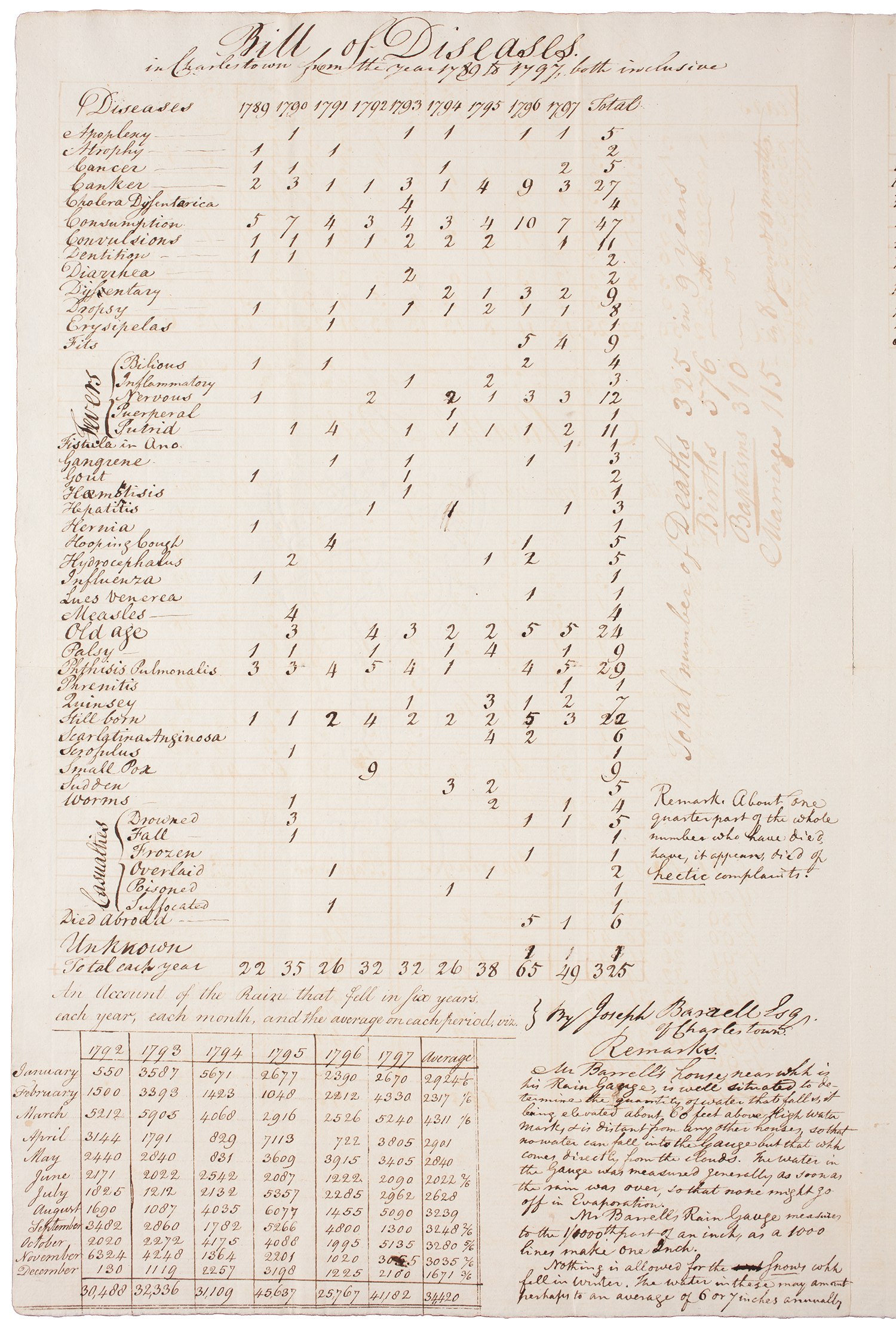
The Bills of Mortality received by the Academy document patterns of life, death, and population growth in the early American Republic. One Bill, submitted by geographer Jedediah Morse in 1798, includes a table of causes of death in Charlestown between 1789 and 1797. Among the recorded causes were “Worms” (4 deaths), “Dentition” (2 deaths), and “Overlaid” (1 death), referring to a fatal accident. Another table shows a growing community in Charlestown, with nearly twice as many births in 1797 as in 1789.
To learn more, visit our the Academy’s website.