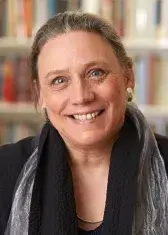
As I reflect on my first year as president of the Academy, I am struck by how our members came together in so many different ways to address such a broad range of challenges, including unprecedented threats to academic freedom, the research enterprise, and the rule of law. And while it was a year of great challenges, there were also moments of great hope. For me, top among those moments was the Induction of our 2025 class of new members here in Cambridge in October.
This issue of the Bulletin details a number of the events of Induction weekend, and I hope you will get a sense of the spirit of inspiration, celebration, and service that animated the proceedings. In addition to these events, on the Saturday morning of Induction weekend we invited our new members to come to the House of the Academy for a series of conversations with Academy leaders. This provided an opportunity to share some thoughts about a critical question: How can we best fulfill the vision of our founders “to cultivate every art and science which may tend to advance the interest, honor, dignity, and happiness of a free, independent, and virtuous people”?
For me, there are two imperfect, partial, but critical answers to this question.
The first is to reconnect the disciplines, so that the insights of human creativity can be better and more deeply shared. As Academy members, each of you has had moments in your creative lives when you see patterns that connect one sphere of knowledge to another. Academy member and art historian Martin Kemp calls this “structural intuition,” and he spent his life writing about the connections between the arts and the sciences—from Platonic solids, to Leonardo’s drawings, to D’Arcy Thompson’s models for growth in biology. He argues that structural intuitions are forms of curiosity that awaken when we recognize patterns of order and long to describe them and give them shape in the world. As Academy members, each of you understands the link between art and science because you have pursued that deep curiosity and taken knowledge to another level because of it. Your own “structural intuitions” have reconnected the disciplines already. You have taken your perceptions to other spheres so you can ask new questions.
The second way we can fulfill our founders’ vision is to continue to choose the pursuit of knowledge. That pursuit, in itself, is a way to practice democracy. Just as our founders were asked to build, fund, and defend the pursuit of knowledge in a new nation, I believe today we are tasked to build, fund, and defend knowledge in a divided nation. Our times demand that we stand for the ideals of academic freedom and human creativity. They also demand that we remind others that such freedom to pursue knowledge is the foundation of citizenship and fundamental to our democratic ideals.
As we approach and prepare for the 250th anniversary of the Academy in 2030, I hope we will continue to embody those ideals together and sow new seeds of a common life. And I hope that you will join us in creating and participating in meetings that nourish the life of the mind, developing and using intellectual resources that will stimulate curiosity as well as propose solutions, and gather productively and energetically, as we have for almost 250 years, around the key questions of our time. To gather at all in the free pursuit of knowledge is the beginning of democracy, and to persevere in doing so is democracy’s perseverance.
Yours cordially,
Laurie L. Patton