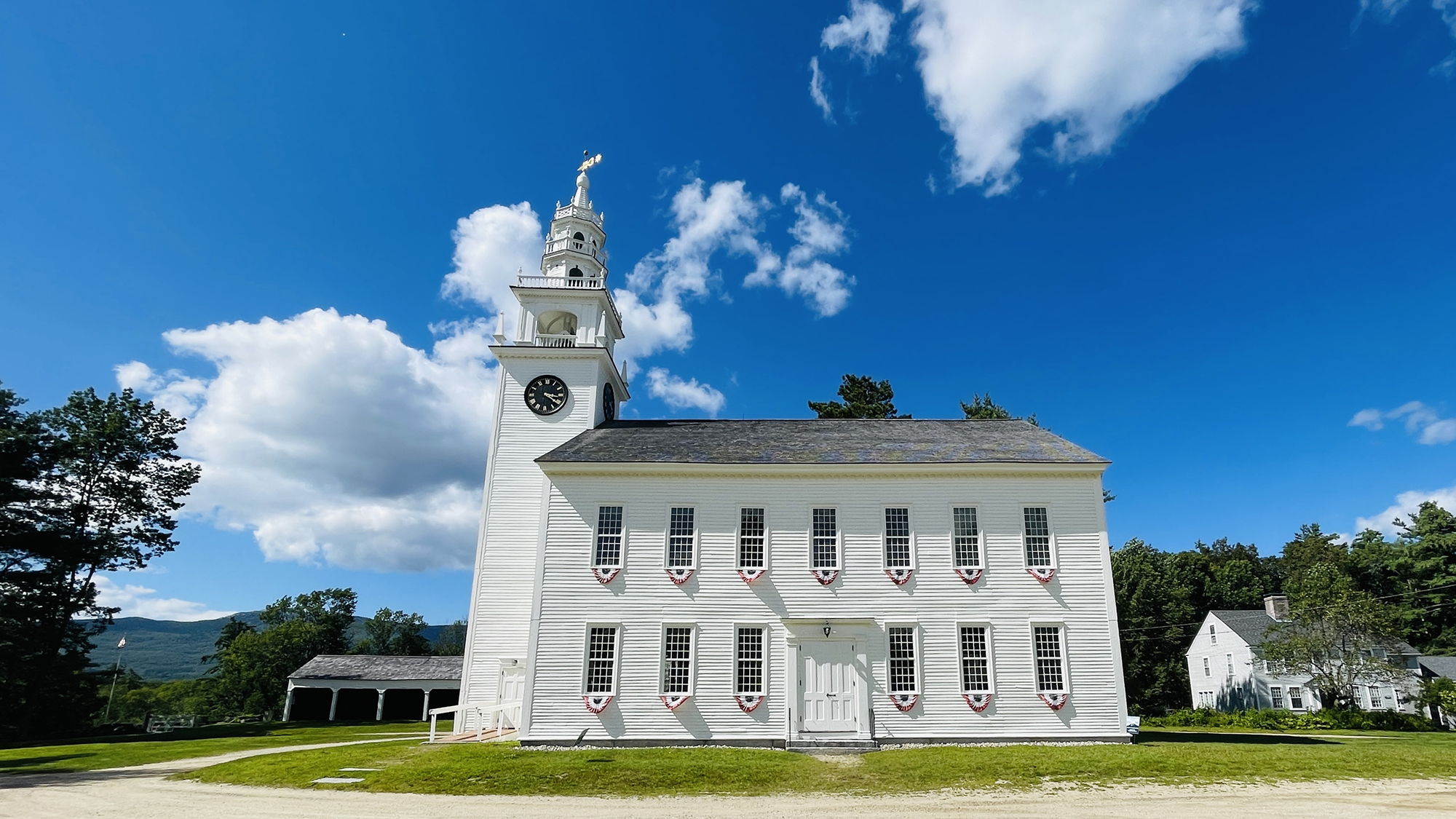
Constructed in June 1775, while the cannonade boomed from Bunker Hill, the Jaffrey Meetinghouse is the New Hampshire town’s earliest public building. Image: Catherine Seiberling Pond.
On July 4, 1976, on the large and grassy common by the white clapboarded Jaffrey Meetinghouse, townsfolk and summerfolk mustered for the Bicentennial town parade. The meetinghouse itself had been the town’s public gathering place for over two centuries. At ages 10 and 13, dressed in colonial period costumes assembled by my mother, my twin brothers and I knew we were part of something greater than this pastoral setting—our home—in southwestern New Hampshire.
Each July 4 at noon, Jaffrey gathers in this special structure to read aloud the Declaration of Independence—a tradition launched in 2001 by Rob Stephenson, on the 225th anniversary of the document’s signing. A longtime galvanizing force in Jaffrey around historic preservation initiatives and community pursuits, Stephenson has led different phases of the meetinghouse’s restoration. He also created a website repository for aspects of the town’s history.
The Jaffrey Center Village Improvement Society, the Jaffrey Historical Society, the Jaffrey Historic District Commission and the Selectmen’s Meetinghouse Committee in the Town of Jaffrey cosponsor the event. Enveloped in the warm scent of wood hewn from ancient New Hampshire forests, local officials, community leaders, and older children take turns reading in this building that has sheltered community gatherings for centuries.
After the reading, those gathered sing “Yankee Doodle,” this year led by Bill Raymond, followed by three cheers for the United States. Scouts Troop 33 climbed the stairs to ring the booming steeple bell, cast by the Paul Revere Foundry in 1822. Its ringing resounds across the common and most of Jaffrey. After the annual readings, there is an ice cream social and tours of adjacent historic buildings.
The town voted to build the meetinghouse in 1774 upon a hill beneath Mount Monadnock; it was constructed in the spare and simple construction of the period. Well-preserved historic homes and civic buildings cluster around, as if in homage.
The adjacent Old Burying Ground, Jaffrey’s first cemetery, shelters the town’s earliest citizens. Others lie there as well, including Pulitzer Prize-winning American novelist Willa Cather, who spent many autumns writing at a nearby inn. So does local African American tanner Amos Fortune and his wife Violate. Around the age of 60, he had purchased his own and, later, his wife’s freedom in Boston before moving here. Upon his death in 1801, Fortune left an endowment to Jaffrey and the meetinghouse—even though the town required that its Black citizenry must stand in the upper balcony. With his gift, the Town of Jaffrey later created a summer lecture forum in Fortune’s name, which has been held at the meetinghouse since 1946.
The classic New England meetinghouse served as an early Congregational church and was often the location of annual town meetings—an enduring stronghold of citizen input. These cathedrals of democracy are found in many New England towns, examples of America’s earliest official public architecture.
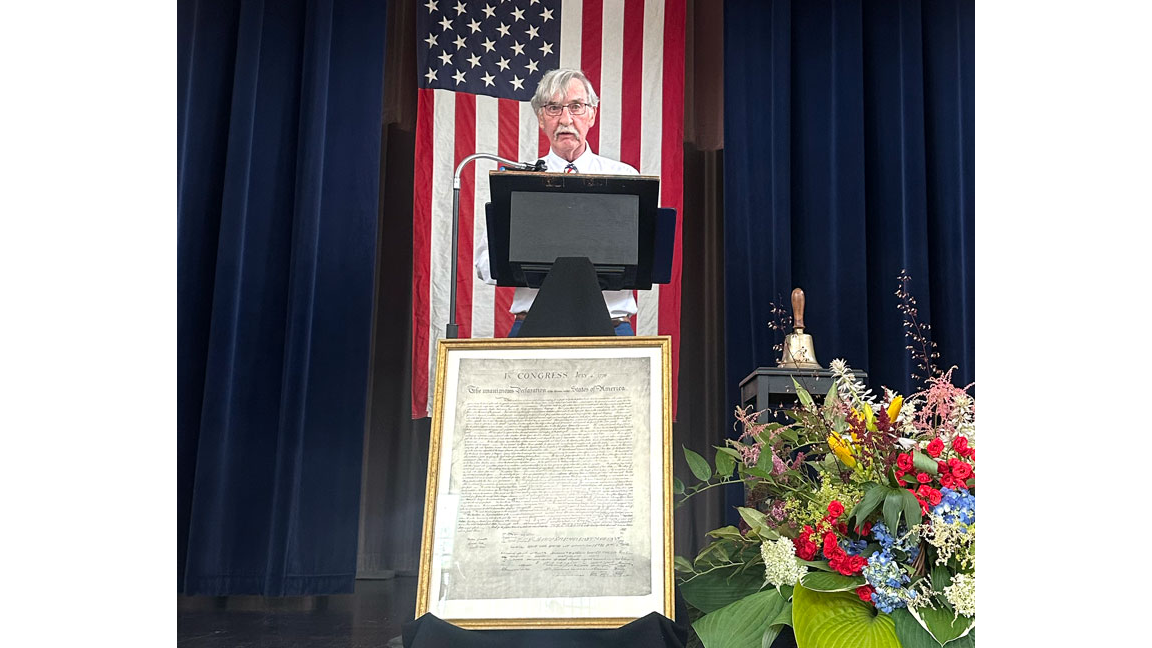
Frank Sterling has been a reader of the Declaration of Independence since the tradition began in 2001. He was born and raised in Jaffrey and is one of its longtime selectmen. He says of the experience, “The Declaration of Independence is one of the most important documents in history. Being part of the reading each year is a reminder of just how history-changing it was.” Image: Catherine Seiberling Pond.
Last year, many gathered to honor the 250th anniversary of the meetinghouse’s construction—just two years after the 250th celebration of the town’s incorporation in 1773. Tradition says the meetinghouse was raised on the day of the Battle of Bunker Hill on June 17, 1775. The first volume of The History of Jaffrey, written for the town in 1937, records workmen reportedly hearing the cannon booms from Charlestown, Massachusetts, over 70 miles to the southeast. Imagine those men constructing one of the town’s earliest buildings amidst the nascent clamor of the American Revolution—and then refreshing themselves with the barrels of rum and spirits offered in partial payment.
Three of the original 56 Declaration signers were from New Hampshire. The state is proud to have been the first colony to declare independence by adopting its own state constitution in January 1776, the ninth colony to ratify the U.S. Constitution, and to have become a state on June 21, 1788.
“It’s great to see how the whole town gets involved,” said Ethan Hutchinson, 15, who has been one of the Declaration readers for the last several years and is a senior patrol leader for Scout Troop 33. “I’ve been able to be a volunteer since I was little and it is cool to see how excited every single person gets about it every year.”
His father Paul, assistant Scoutmaster for Troop 33 and town moderator for the Town of Jaffrey, added: “Most people don’t sit and reflect on the words in the Declaration. But reading it slowly, or more importantly, listening to it, with a pause between lines as speakers change, gives us the chance to really reflect upon it.
“Usually what I hear from folks afterwards is that they are amazed how relevant it is today, even 250 years after it was written. It is a reminder that America is, and has always been, a work in progress. And every person, in every generation, has to step into their roles as citizens if the American experiment is going to continue. That has always been the case, and it always will be.”
© 2026 Catherine Seiberling Pond
Catherine Seiberling Pond is a freelance writer and architectural historian who lives on her family farm in Kentucky.