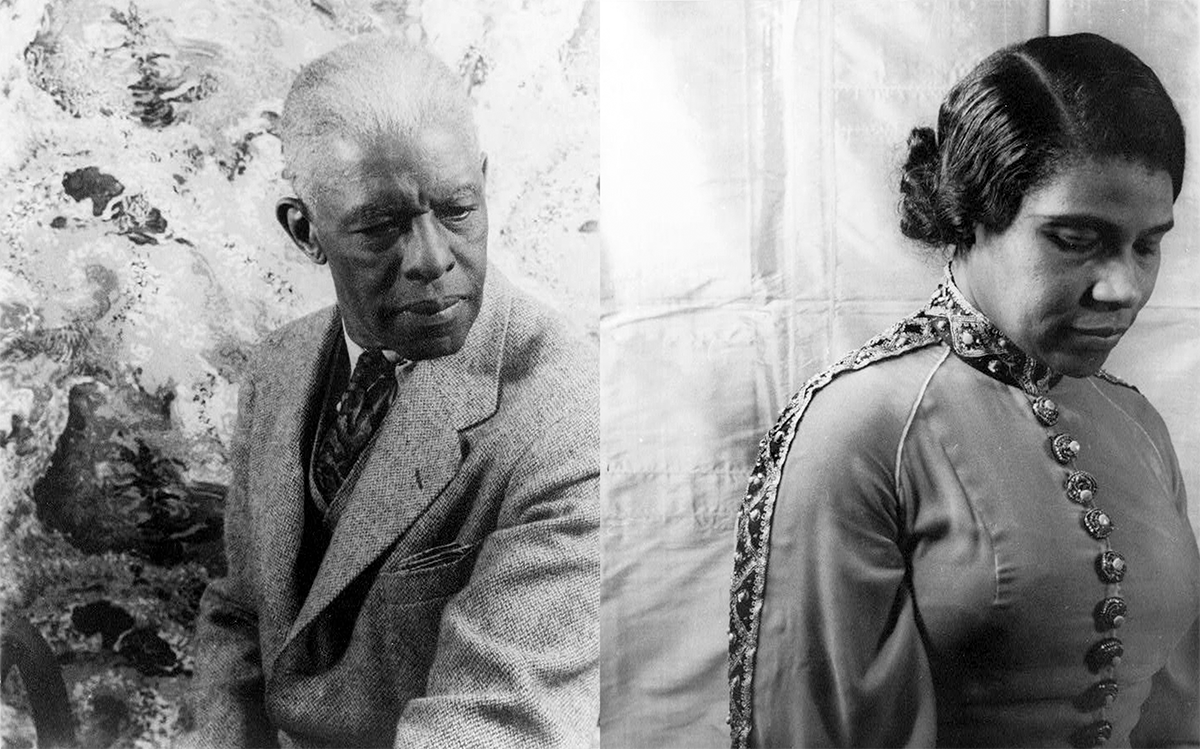
Images: Carl Van Vechten, 1962 and 1940.
Singers Roland Hayes (1887–1977) and Marian Anderson (1897–1993), elected to the American Academy of Arts and Sciences in 1953 and 1957, respectively, were among its first Black members and were the first professional singers so recognized by the Academy. They joined what was then a small group of members considered not only professional, but also popular musicians. Hayes sent the Academy a typed, formal, traditional letter accepting his election. Anderson’s letter a few years later had a more artistic flare: short, handwritten, and referring to herself in the third person. But both Hayes and Anderson were quite used to cutting new paths by the time they sent their acceptance letters.
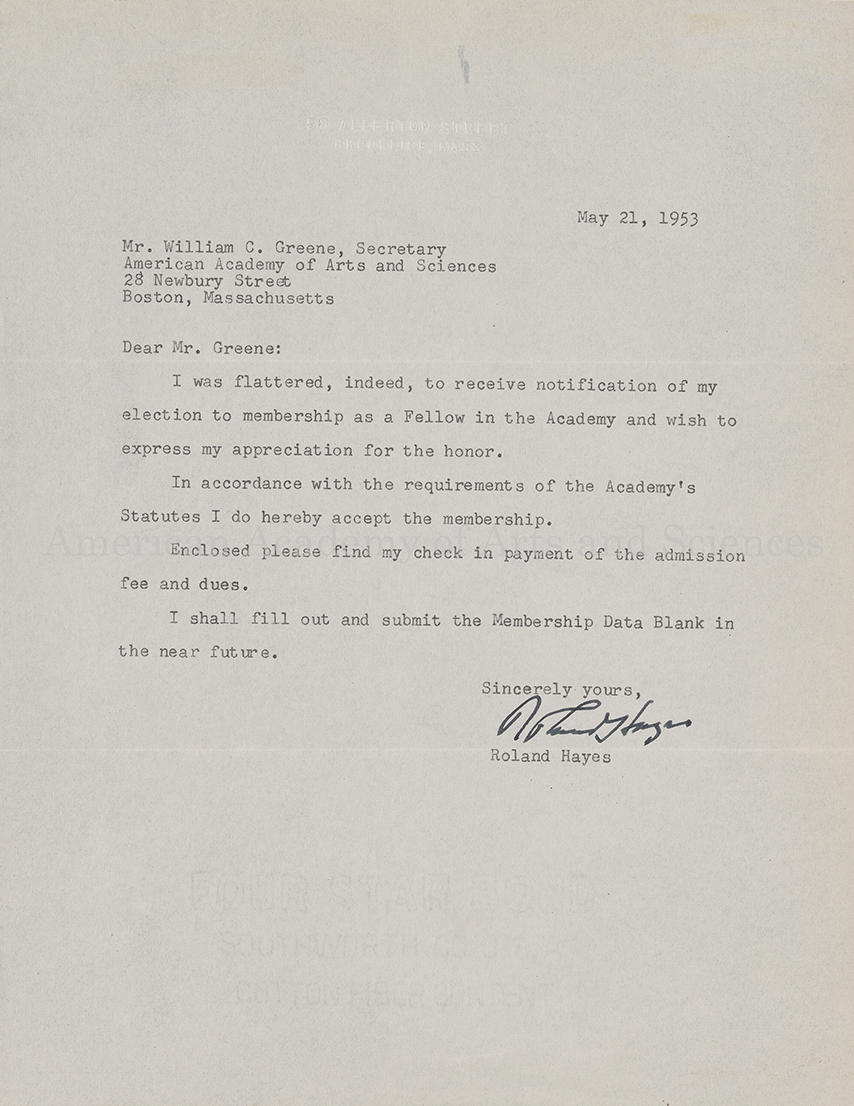
Image: Acceptance Letter from Roland Hayes, 1953. RG I-B-3: General records. Letterbooks—Bound. Volume 26, 1952-1955. Archives, American Academy of Arts and Sciences, Cambridge, Massachusetts.
Hayes, born and raised in rural Georgia by a former slave, discovered the music of Italian opera icon Enrico Caruso as a teenager and set off on a singing career that first took him to Africa and then Europe where he earned great acclaim and enough operatic bona fides to break into the American opera scene.1
The breaking was necessary due to the color line that prevented Black artists from engaging with opera's largely white audience. On Nov. 15, 1923, Hayes overcame this barrier when he became the first Black soloist to perform with the Boston Symphony Orchestra, whose manager had rejected him years earlier.2, 3
"Oh, the people went wild," Hayes said in an oral history interview with the City of Boston. "Oh, they were wonderful. They loved me."4
This performance transformed Hayes' career—he would go on to perform with renowned orchestras across the U.S. and the world—and laid a foundation for Black opera singers of the future, including Anderson.
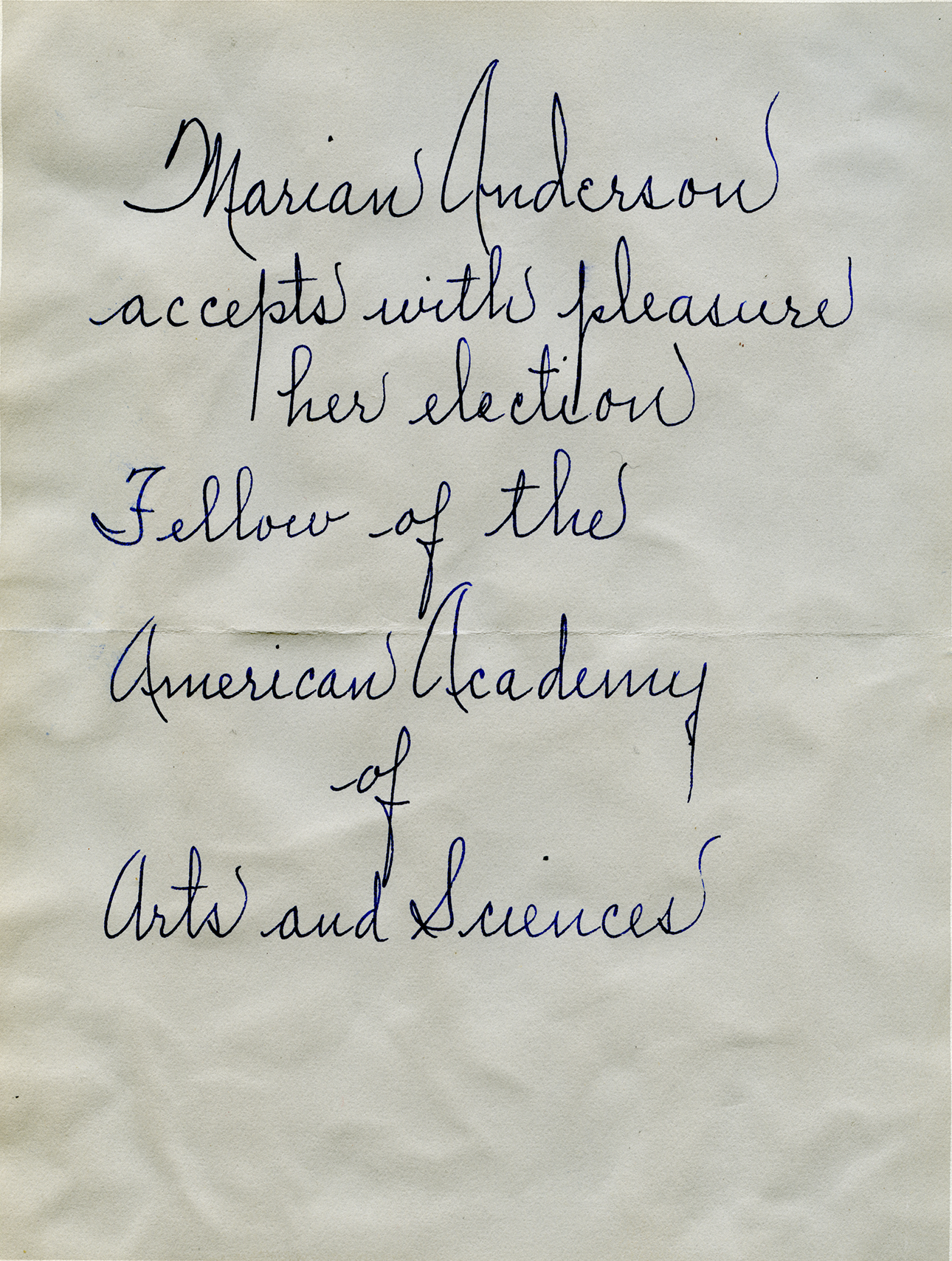
Image: Acceptance Letter from Marian Anderson, 1957. RG I-B-3: General records. Letterbooks—Bound. Volume 27, 1955-1957. Archives, American Academy of Arts and Sciences, Cambridge, Massachusetts.
Born in Philadelphia, Anderson sang in church choirs and took voice lessons from Black soprano Mary Saunders Patterson and then Agnes Reifsnyder and Guiseppe Boghetti.5, 6 A 1925 singing contest win and resulting debut at Lewisohn Stadium in New York with the New York Philharmonic Symphony Orchestra brought Anderson wider attention, but, like Hayes, her career did not launch in earnest until she toured Europe in the early 1930s.7 Anderson later returned to the U.S. and performed widely, albeit while experiencing extreme racial animus.
A dispute with the Daughters of the American Revolution, which would not allow Anderson to play Constitutional Hall in Washington, D.C. because of her race, vaulted the singer into the public consciousness, leading to her legendary performance on Easter Sunday 1939 at the Lincoln Memorial—75,000 people attended.8
"It was a tremendous thing and my heart beat like mad—it’s never beat like that before—loud and strong and as though it wanted to say something," Anderson told American Heritage Magazine.
Years later the DAR apologized to Anderson and she held several performances at their hall in the 1950s and 1960s. She continued to break through other racial barriers, becoming the first Black singer to perform with the Metropolitan Opera of New York in 1955.