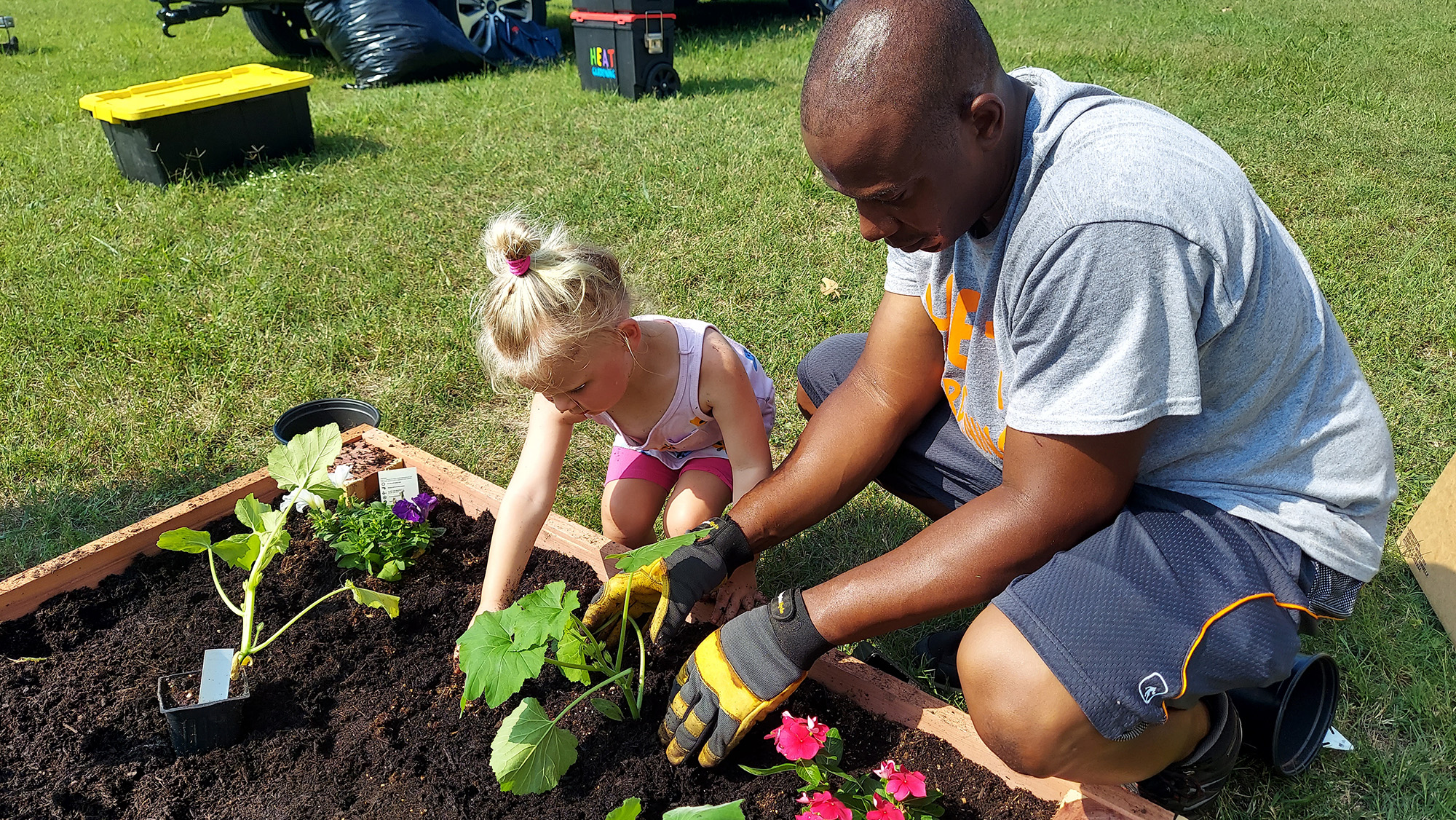
Alex Scott helps a schoolchild in a Vine Branch Fellowship school garden. Photo: Vine Branch Fellowship.
You could draw a line from the Declaration of Independence, sitting under glass in the National Archives, to a bed of okra growing just across the parking lot from a senior center in Wilson County, Tennessee. Those plants—along with a flock of chickens in a nearby elementary school and a pot of herbs growing on an apartment windowsill—embody how an increasing number of people in this Southern community are making good on the Declaration’s promise that they can pursue their own happiness, however they see fit. Every time they farm, these Tennesseans demonstrate that the American pursuit of happiness often blooms when neighbors pursue a shared vision.
But while it now includes dozens of people, this story begins with just four. Back in 2014, Alex and Shené Scott were living quiet lives in Wilson County, which sits 30 miles east of Nashville. He was a firefighter; she was a teacher; they had two children, then ages 10 and five. Then everyone in the family began facing serious health problems. Shené developed severe food allergies. Alex struggled with hypoglycemia. Their daughter was diagnosed with gluten sensitivity, and their son developed Type 1 diabetes.
To manage the increasingly strict demands of their family diet, the Scotts began growing their own food. They’d never done anything like that before, but soon enough, they had a small garden. And the more they ate from their own harvest, the more they learned about their health.
They joked that their son was their test subject. “We weren’t getting our vitals checked, and we weren’t getting our blood work done, but he was,” Alex says, with a butter-soft Nashville accent that charmingly contrasts with his imposing firefighter’s frame. “We would notice an organic apple wouldn’t shoot his number up. Or vegetables that we grew wouldn’t do this, but the ones we bought did. We would notice that with [Shené], she wouldn’t get sick off this, would get sick off that. At that time I had weight on me. I lost 60-70 pounds.”
What began with a few pots and pallets became a backyard full of gardening beds. Eventually, the Scotts moved to a new home with more land, to accommodate everything they grew. Now in their late 40s, Alex and Shené have their own farm in Lebanon, a small city of just over 53,000 people in Wilson County. They sell eggs, offer gardening consultations, and teach the basics of canning. They’ve also got a deeper sense of contentment. “When you're putting your hands in the soil, and you're doing the hard work, and you're literally seeing the fruits of your labor—it's just such a rewarding experience,” says Shené, whose bright energy and knack for clear explanations mark her as an experienced elementary school teacher.
Beyond The Garden Plot
This is already an American story: In the name of their family’s health, the Scotts used their sweat and sense to build a new life. But that’s just chapter one. By 2019, they wanted to share what they had learned, so they founded Vine Branch Fellowship, a nonprofit whose mission states it will “equip individuals, families, seniors, and low-income groups with the tools to create healthier food options.” Now they work with their fellow citizens to foster the same agricultural expertise that has impacted them at home. Their programming includes community gardens, classroom education, and summer camps, and it’s all provided free of charge. This underscores that the pursuit of happiness has a civic dimension—that the quest for a meaningful life includes the well-being of the entire populace. As Alex says, “We figure out how to do this in a way where it’s free to the people we talk to, give them access to stuff that we’ve gained access to. They have the opportunity to see what we see, experience what we experience, and maybe change their lives as well.”
To an outsider, it might seem like folks in Wilson County don’t need anybody’s help to grow a tomato. The county takes up almost 600 square miles; huge swaths of it are farmland. You might assume everyone’s got a little soil under their fingernails.
To some extent, that’s true. A 2022 agricultural census found almost 1,500 farms in the county. Even anecdotally, it’s easy to find residents with small family plots. Plenty of people in this region grow things every season.
But Wilson County is one of the fastest growing regions in Tennessee, up from 148,000 people in 2020 to 175,000 in 2025. This growth has a decidedly urban slant. A quarter of the county’s residents live in rental units, removed from farm life. Lebanon—which anchors the county—has had a facelift during that time. Fifteen years ago, its town square offered little more than antique stores and empty buildings, and now it boasts elegant shops, nice restaurants, and soon enough, a boutique hotel. As though to underline this shift, this February the Lebanon government removed a historic cabin that had been in the town square for decades. It’s another reminder that city ways are becoming the norm. Dalton Teel, a third grade teacher at a local elementary school, says, “The city school system in Lebanon: We are serving an urban population.”
According to local historian Scott Selliers, even all that farmland tells an urban story. He explains that much of the food grown in the area is earmarked for the global agricultural trade. A locally harvested pepper is often more likely to land in a Texas grocery store than on a Wilson County plate. “There’s the expectation that our kids must live in this food awareness, because they're in the agricultural belt,” Selliers says. “But in all practical reality, and I mean this, there's no difference between a kid in New York driving past a series of warehouses and a kid in Wilson County driving past a series of cattle fields. Neither one of those places is creating something that those kids are going to recognize or understand. We’re not producing enough calories and enough variety in our county to feed ourselves. We’re just as dependent on Wal-Mart and Kroger as the folks in Nashville.”
Eating Education
This explains why Shené Scott has met so many youngsters without basic agricultural knowledge. When she was a full-time teacher, she says, “I had a first grader who did not recognize corn. I’ve experienced that again since we’ve done this [with Vine Branch], when a kid was questioning, ‘Is that a tomato?’ And it was at their school garden.”
That’s not just a knowledge gap: It’s an existential disaster. Alienation from the natural world spurs such severe behavioral and emotional problems that social scientists have dubbed them “nature-deficit disorder.” That makes instinctive sense, even without the label. Most of us feel that life without nature—birdsong, crashing waves, crumbling soil—is no life at all.
Many in Wilson County are working together to build that tie to the earth. The public school system funds projects to help middle and high school students expand their agricultural literacy, and hosts a phalanx of greenhouses where kids grow and even sell their own produce. Fiddler’s Grove, a historic village, offers farming and cooking demonstrations to remind residents what the local soil can provide. The Scotts are part of this civic network, working together to reconnect their neighbors to the land. Vine Branch’s summer camp is held at Fiddler’s Grove. The Scotts’ daughter took an agricultural science class in a public high school. Collectively, they carry out the Declaration’s vision of a community that works together to govern itself in matters large and small. Their mutual effort recalls the Declaration’s final line, where the signers commit their lives, fortunes, and honor to realizing their ideals.
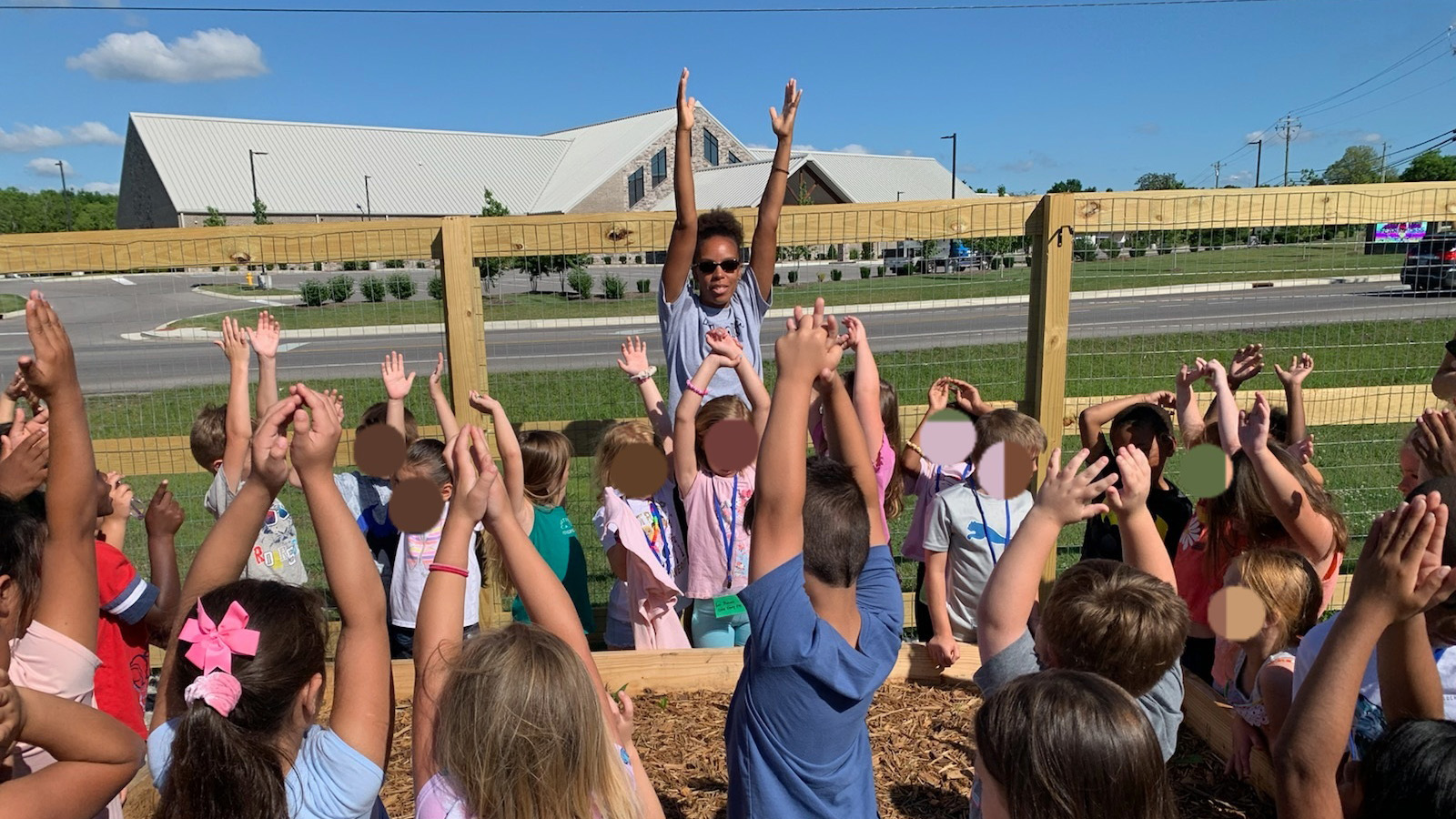
Vine Branch began offering gardening education to elementary schools in 2021. Photo: Vine Branch Fellowship.
“We’re trying to close that gap,” says Shené. “[The students] should be able to go outside and recognize all of their fruits and vegetables in a garden. They should be able to recognize fruits and vegetables when they go to the grocery store.”
Vine Branch began offering gardening education to elementary schools in 2021. Thanks to a connection inside the school system, they started by creating outdoor community gardens on school property. Schools soon asked Shené, with her educational background, to teach their students more about gardening and food. She now visits 30 classrooms at least once a year, often setting up indoor, aeroponic tower gardens that grow things like lettuce and herbs without soil. There’s one class she visits every month, covering everything from seed dissection to photosynthesis. (Shené is currently Vine Branch’s only employee, though they have up to 40 volunteers helping them on various projects.)
Sustainable Futures
Crucially, Vine Branch doesn’t want to manage projects forever. They hope that teachers and students will eventually take over their gardens, and that summer camp students will be inspired to grow plants on their own. They want to instill lifelong behavior, which is much more impactful than a few fun days in the dirt.
Dalton Teel, the third grade teacher, relishes this approach. In 2021 he collaborated with Vine Branch to install 10 outdoor gardening beds at his school. The program has since expanded to over 25 beds and a berry patch. There’s even a chicken coop, which students visit to collect eggs for their families. The first time the school principal’s son ate what Teel calls “grown-up people food,” it was a sweet potato from the garden. His class annually hosts a Thanksgiving meal for the students’ families, using vegetables they’ve helped grow.
“My students have a deep understanding of the process that it takes to produce food, and I don't know if most eight- and nine-year-olds in our country understand it like they do,” Teel says, adding that he’s seen this project deepen their enthusiasm for learning. “There have been a number of families in our school zone that have put a little garden bed in their backyard, or they've started raising chickens themselves, because they've seen how it can happen. They feel the confidence after working with it to do it for themselves. So over the past five years, it's been neat to hear the stories of how students encourage their parents to get something started for themselves.”
And they can spread this knowledge no matter where they live. “When we think of farming, when we think of gardening, we usually think of this big, huge space. ‘I got to have all of this space to grow a garden,’” Shené says, paraphrasing what others tell her. “A lot of kids nowadays, they live in apartments, but they still have a patio. They still have a back porch. We’re letting them know, ‘I can grow in my grow bag.’ You can grow in a bucket. No matter where you live, you can still grow.”
Vine Branch also works with adults, including at the aforementioned community garden that they launched near a senior center. It’s a large, fenced-in space with over a dozen beds growing peppers, okra, and other vegetables. Placards offer information about how things grow, and benches invite people to sit and enjoy the weather. Volunteers frequently come by to maintain the plants, and anyone who wants is welcome to harvest the vegetables once they’re ready to be picked. According to the Scotts, the garden’s “customers” are mostly senior citizens walking over from the center, and in a sign that humanity may still have hope, there haven’t been any conflicts over who gets to pick what. (There was, however, a request to double the amount of okra being grown.)
Sowing Common Ground
The community garden is something of a public commons. Similarly, Teel’s students have used their school garden as a springboard into civic life. Last year, several of his third graders spoke to the Wilson County Chamber of Commerce about their in-school farming. “I never thought that I would have six eight-year-olds holding a chicken and presenting in a boardroom,” he says. “They were speaking to a room full of adults about how to care for these chickens.” They also discussed how students get to take home eggs for free, and how Teel incorporates chickens into his teaching, like when he fries an egg to demonstrate chemical changes.
Teel watched his students rise to this occasion. “They didn’t miss a beat,” he says. “They had never even been in a room like that, and teaching them to advocate for what we were doing at school, that mattered. It was teaching them how to share the story of what we're doing, and the importance of setting a positive image in the community.”
Parents notice the impact, too. Sara and Justin Boswell arrange their schedules around Vine Branch’s summer program. They already live on a family farm with their nine-year-old daughter Paisley, so she knows plenty about where food comes from, but they don’t want her to miss the other lessons she gets at camp. “A lot of the activities that they do at the camp are group oriented,” Justin says. “It’s kids of all different ages and demographics and raisings, and it gives her a chance to express her opinion on how maybe she's seen us do things on our farm, versus how they might do things. It gives her the opportunity to see different ways of agriculture, or just being healthy.”
Teel is likewise drawn to growing as a form of communion. That’s why he volunteers with Vine Branch programs outside his classroom. “The more that we're able to engage with each other, to understand each other, to work together toward a common goal, even if it's something as simple as growing food, it strengthens the overall fabric of our community,” he says. “And I know that that matters. I've seen the impact of it. I've seen the joy and happiness that it brings. And that's why I keep doing it, because I want Lebanon to be a strong community. I believe that strong schools and community gardens contribute to that.”
This is how the ideals in the Declaration of Independence emerge in American life. A couple exercises their freedom to change their lives. They join a network of their neighbors to build something lasting from those changes. That network gets bigger and bigger, addressing shared problems and striving toward mutual goals. The common work becomes a common happiness, serving the common good.
© 2026 Mark Blankenship
Mark Blankenship is an award-winning arts and culture journalist who has contributed to The New York Times, Variety, New York/Vulture, NPR, and many other outlets.
Honoring excellence and leadership. Working across disciplines and divides. Advancing the common good. From 1780 to today.
Our Common Purpose, the Academy's ongoing and bipartisan work to strengthen democracy in 21st century America, produced recommendations, reflections, and reasons to pursue a more perfect reunion.
These initiatives, seeking structural and societal advances, were developed in recognition that a healthy democracy requires both responsive political institutions and a robust civic culture.