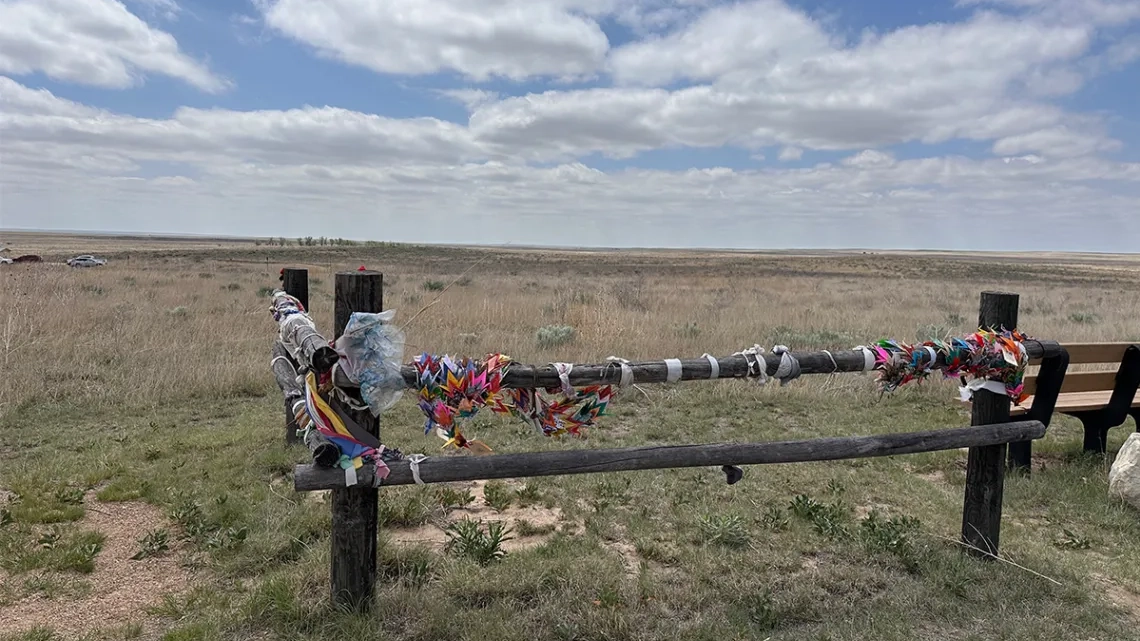
A fence that marks where remains from Sand Creek Massacre victims have been reinterred is decorated with origami cranes fashioned by descendants of internees at the Amache concentration camp. Photo: Jennifer Oldham.
Cottonwood trees rustled in the May wind on Colorado’s High Plains. Cheyenne and Arapaho elder Dale Hamilton coaxed a small flame from cedar chips nestled in an abalone shell. This was hallowed ground, with a dark and little-known history. One hundred sixty-two years ago, in a gully just yards away, the U.S. Army had massacred his ancestors on the deadliest day in state history.
Hamilton’s wife Bobbie removed her beaded moccasins and bent to face the iridescent mollusk. Four times, she guided tendrils of sharp-smelling smoke up and over her colorful skirt, her arms, and her black braids. After she stepped over the ceremonial offering from the west to the east, Bobbie turned and issued an invitation to about three dozen onlookers. These were people who, for their own reasons, understood what it meant to be betrayed by a government whose purpose, according to the Declaration of Independence—written long before this land was part of the United States—was to secure their safety and happiness.
“We invite each and every one of you to come up and cedar yourself off,” she said. “Cedar is sacred to us—it’s one of the ways we recognize and honor our ancestors.”
So began the third convening of two groups that had been mistreated by the U.S. government: descendants of Cheyenne and Arapaho tribes ambushed in the Sand Creek Massacre in 1864, and Japanese Americans forcibly relocated during World War II to the Amache internment camp 50 miles to the south. The gathering’s attendees had not been accorded the equality and unalienable rights promised in the nation’s founding document. At its writing 250 years ago, neither group had been conceived of as belonging to the declaration’s claims; Native peoples were called “savages” in the document and Japanese and Asian immigration had not yet been imagined.
While standing in line to receive the cedar blessing, participants commiserated about generational impacts of the federal government’s persecution of their ancestors. As they spoke, they found that they shared a reverence for spiritual ceremonies, grief that their relatives’ experiences aren’t taught in schools, and a need to acknowledge a historical trauma that still shapes their lives today.
Their efforts to learn from one another and to remember events that had shaped their families’ lives was a living example of, to paraphrase the Declaration, acknowledging grievances and dealing honorably with one another. On the eve of the nation’s 250th anniversary, their gathering embodies that document’s principles about working together across differences to find common ground—in this case, quite literally.
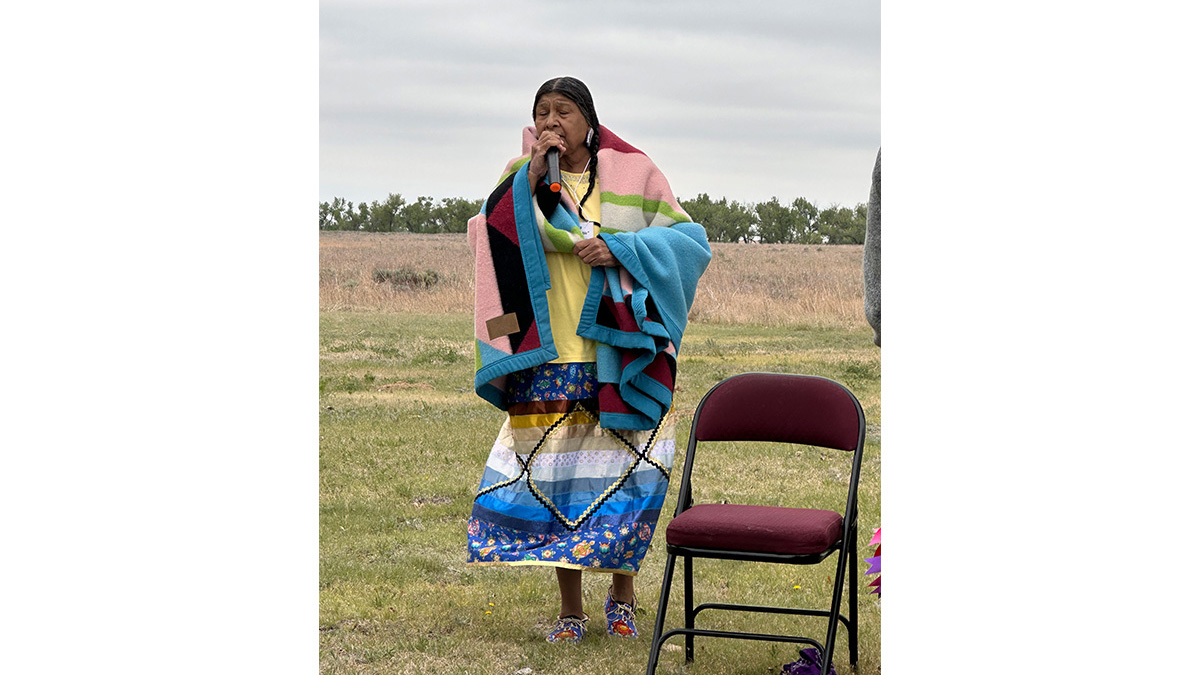
Cheyenne and Arapaho elder Bobbie Hamilton speaks to participants of the third annual convening between Japanese American descendants of the Amache internment camp and the Sand Creek Massacre. Photo: Jennifer Oldham.
For several years, National Park Service officials had spoken with descendants from both groups about organizing a gathering between them. The parties agreed that this gathering be combined with the Japanese internment camp descendants' annual May pilgrimage to the Amache relocation camp on the arid shortgrass prairie, 225 miles southeast of Denver. In 2023, the Hamiltons joined the commemoration ceremonies at the Amache site—and then invited those pilgrims to meet them at Sand Creek the next day.
As a way to further this partnership, the nonprofit Amache Alliance and the Sand Creek Massacre Foundation brought together young people as part of a 2024-2025 ambassador cohort, tasked with working together to share their legacies.
Attendees say the partnership, forged both at the in-person gathering and among the youth ambassadors, has helped liberate them from the weight of the U.S. federal government’s denial of their ancestors’ fundamental rights to life, liberty, and the pursuit of happiness. “Finding more cultural connections between our groups and our heritage has been really healing,” said Aya Sugiura, during the blustery May cedaring ceremony at the Sand Creek Massacre National Historic Monument. Her grandmother, she said, had been among 10,000 Japanese Americans imprisoned at Amache between 1942 and 1945. Sugiura had been a part of the original ambassador group, who are working together to choose the way their ancestors will be remembered. “The connection between the Amache site and the Sand Creek site is just one of many connections we were able to draw,” added Sugiura, in that effort to grapple with Colorado’s history.
The gathering is part of Colorado’s multiyear effort to sponsor a more honest and inclusive recounting of its history. This movement toward a clear-eyed narrative can be found in a guide of state landmarks compiled for this year’s celebration of the state’s 150 anniversary. The state earned its nickname, the Centennial State, when it joined the union 100 years after the signing of the Declaration of Independence. The guide suggests celebrants visit both Sand Creek and Amache to understand Colorado’s history.
The anniversary event is one of the many steps institutions statewide have taken to reconcile with tribal descendants by taking a harder look at atrocities against Native American peoples.
Among other efforts in this reckoning, in October 2025 the Denver City Council voted unanimously to name a 10-acre park “Amache Prowers Memorial Park” in recognition of the state’s Indigenous history. That makes this park the first in the city to be named for a Native woman: Amache Prowers, or Walking Woman, who had survived after her father was murdered at Sand Creek. Mauricio Asino, a direct descendant of Amache Prowers and a member of the Amache-Sand Creek youth ambassador cohort, had testified in front of the council in favor of the park. “It’s very very painful this history we live with,” said Asino’s grandmother, Rosalie Tallbull, on Nov. 9 during an online presentation featuring youth ambassadors.
Other efforts include a traveling museum exhibition at History Colorado and a bronze memorial statue titled Peace Keepers, featuring Cheyenne and Arapaho chiefs and a woman holding a baby in front of a tipi frame. It is scheduled to be unveiled in November at the state capitol.
In fact, in 2018, Prowers was inducted into the Colorado Women’s Hall of Fame as an “innovative mediator between cultures.” The name “Amache” had been suggested for the Japanese American internment camp near Granada in the early 1940s by Mayor R.L. Christy of Lamar, Colorado, in honor of Prowers.
The Sand Creek Massacre National Historic Site, added to the NPS system in 2007, includes Big Sandy Creek, an intermittent stream bed where soldiers attacked a peaceful encampment of roughly 750 Cheyenne and Arapaho on November 29, 1864. More than half of the 230 murdered tribal members were women and children.
As Amache descendants stepped in front of Bobbie Hamilton during the cedaring ceremony, she recounted the terror her ancestors experienced during the surprise attack.
“Our ancestor had a child, a little girl, and her name was Red Dress Woman,” she said through tears. “My ancestor took the little girl, her child, along the river. She put Red Dress Woman into the embankment and covered it up with foliage. She hid her and told her ‘no matter what, you don’t come out,’ so Red Dress Woman stayed in the embankment and she fell asleep there until the next day when she heard a man’s voice calling to come out—these were the survivors.”
The soldiers had butchered tribal members and marched with their body parts to Denver, where they displayed them as trophies, Hamilton said. Today, some of these remains have been repatriated and are laid to rest up the hill from where she stood.
Following the ceremony, participants walked to that memorial, with an expansive view of miles of untrammeled prairie. Strings of multi-colored origami cranes created by Japanese American Amache descendants decorated a split-level fence that marked the site. A tan tag attached to one read, “in solidarity with the people of Sand Creek.”
Nearby stood Laurie Akiyama, who had traveled with her daughters from Sacramento to participate in the Amache pilgrimage in honor of her father, George Akiyama, who passed away in 2005 and had been incarcerated with his siblings and his parents at the relocation camp. A day before the Sand Creek ceremony, she had walked in her father’s footsteps through the barracks where he stayed and the dining hall in which he ate. “We were crying,” Akiyama recounted. “My dad was drafted at Amache and he answered the call with the 442-regimental combat team—he fought while his parents were behind concertina wire.”
Her daughter, Michelle Huey, said her mother decided in part to come this year because “the current administration’s policies are attempting to scrub negative history.” Akiyama pulled aside her jacket to reveal a yellow T-shirt from the Japanese American National Museum that read “Scrub Nothing.” She said she wore it in part to protest a laminated sign posted at the entrance to the Sand Creek site that exhorted visitors to provide feedback about “any signs or other information that are negative about either past or living Americans.”
Huey’s sister Megan said that the stories of the massacre portrayed on large boards at the site had startled her, awakening her to the fact that her grandfather’s internment at Amache had taken place in the same geographical area as a Civil War-era atrocity against Native Americans.
“There are beautiful commonalities this weekend between people at Amache and Sand Creek,” Megan Huey said. “To hear actual personal stories at Sand Creek—as much as people don’t know about Japanese incarceration, I don’t know about this.”
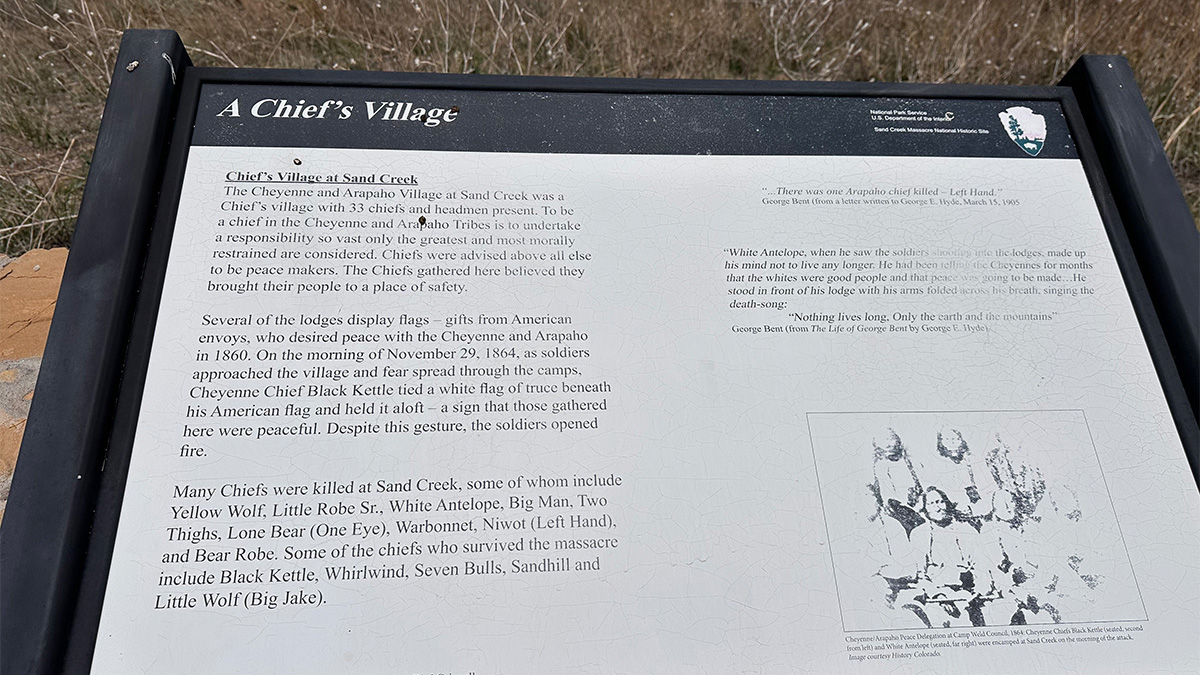
A U.S. National Park sign relays to visitors how Cheyenne and Arapaho chiefs were killed during the Nov. 29,1864, massacre. Photo: Jennifer Oldham.
Eric Leonard, superintendent for the National Park Service’s High Plains group of parks in Colorado and New Mexico, joined the group to say that the comments left by visitors to the Sand Creek Massacre National Historic Site are overwhelmingly positive. “All but one were deeply appreciative of the cooperation between the Arapaho and the Cheyenne” in working together to memorialize atrocities that took place at the site, he told the mother and her daughters.
The tribes and the park service are working to let more Americans know about the history at Sand Creek. Here on the sagebrush-covered plains less than an hour west of the Kansas border, descendants from both sites are partnering to close the gap between the grand principles announced in the Declaration of Independence and the reality that unfolded in the 250 years that followed.
In May, at the convening at the Sand Creek, Dale and Bobbie Hamilton said that correcting the long-standing erasure or mischaracterization of their histories in public places is among the goals they share with descendants of the Amache internment camp.
The ceremony’s participants vowed to stay in touch and to encourage others to educate themselves about where they came from and who their ancestors are. Their partnership may offer a model for Americans looking to acknowledge the country’s dark history. The commitment between Japanese American descendants of the Amache internment camp and Cheyenne and Arapaho whose ancestors were murdered at Sand Creek to preserve their past so that it will not be repeated may inspire others working to bring the nation closer to the Declaration’s principle that all are created equal.
© 2026 Jennifer Oldham
A different version of this article was co-published in Sierra Magazine.
Jennifer Oldham is an award-winning journalist whose work has been published with National Geographic, The Center for Investigative Reporting, The Washington Post, The Los Angeles Times, National Public Radio, and ProPublica, among others.
Honoring excellence and leadership. Working across disciplines and divides. Advancing the common good. From 1780 to today.
Our Common Purpose, the Academy's ongoing and bipartisan work to strengthen democracy in 21st century America, produced recommendations, reflections, and reasons to pursue a more perfect reunion.
These initiatives, seeking structural and societal advances, were developed in recognition that a healthy democracy requires both responsive political institutions and a robust civic culture.