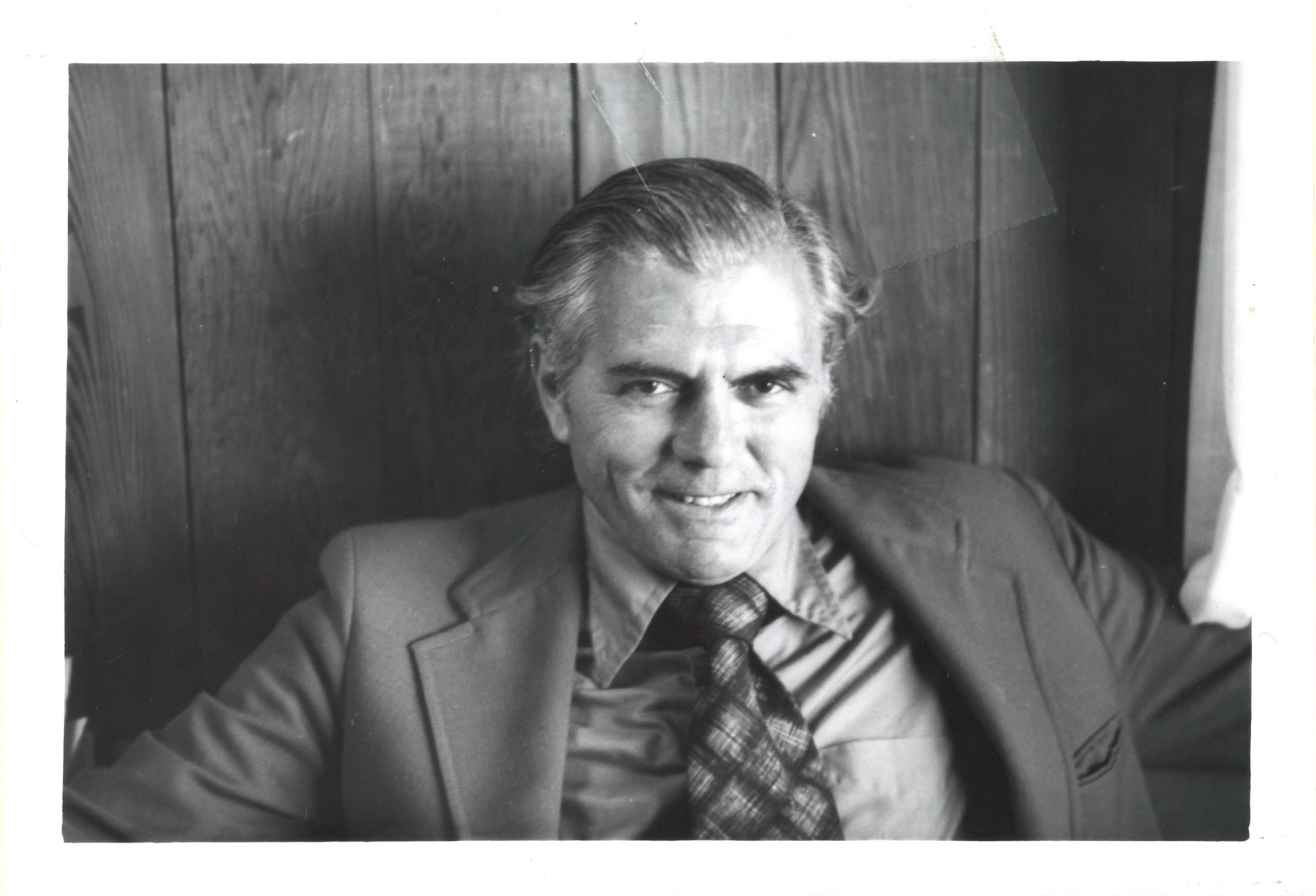
Image: Photograph of Irving Janis submitted with his Academy member form, ca. 1974, Irving Janis, ca. 1974. Photographer now unknown. Series VIII. Membership Files. Archives, American Academy of Arts and Sciences, Cambridge, Massachusetts.
When psychologist Irving Janis was elected to the American Academy of Arts and Sciences, much like members today, his membership did not begin with the public announcement alone. It entered into the Academy’s archive through his formal letter of accepted, and his completed Member Data Blank, of which the above photo comes from. This documentation reflects the increasingly administrative membership process of the mid-20th century. Just as new fields were emerging, the Academy continued to collect professional biographical information and create classification of membership.
The connection between public achievement to institutional record was made possible by the functional Data Blank. The nomination and election process identified Janis for the members’ consideration. The post-election documentation translated his recognition into Academy Records.
Pearl Harbor, the Korean War, the Bay of Pigs, the Vietnam War—these infamous quagmires opened psychologist Janis' landmark 1971 Psychology Today article credited with formally introducing the concept of the groupthink.
Amid intense international strife, Janis sought to understand how multiple contingents of brilliant political operators had so confidently thrust the country into such catastrophes. His theorized cause: “the development of group norms that bolster morale at the expense of critical thinking.”1
“The central theme of my analysis can be summarized in this generalization, which I offer in the spirit of Parkinson's laws: The more amiability and esprit de corps among the members of a policy‐making in‐group, the greater is the danger that independent critical thinking will be replaced by groupthink, which is likely to result in irrational and dehumanizing actions directed against out‐groups,” Janis explained in The New York Times.2
Groupthink ultimately evolved into a pop psychology phenomenon, an ironically monocultural idea applied to human-caused disasters of all kinds as a way to make sense of the seemingly nonsensical.3 Janis’ theory escaped the halls of power too, as new technologies, particularly the internet and social media,4 more easily enabled everyday people to form and act on mass misapprehensions of their own.
For his achievements, Janis was elected to the Academy in 1974.
He died November 15, 1990.5 Scholars in 2002 ranked Janis among the most distinguished psychologists of the 20th century for his work on groupthink.6