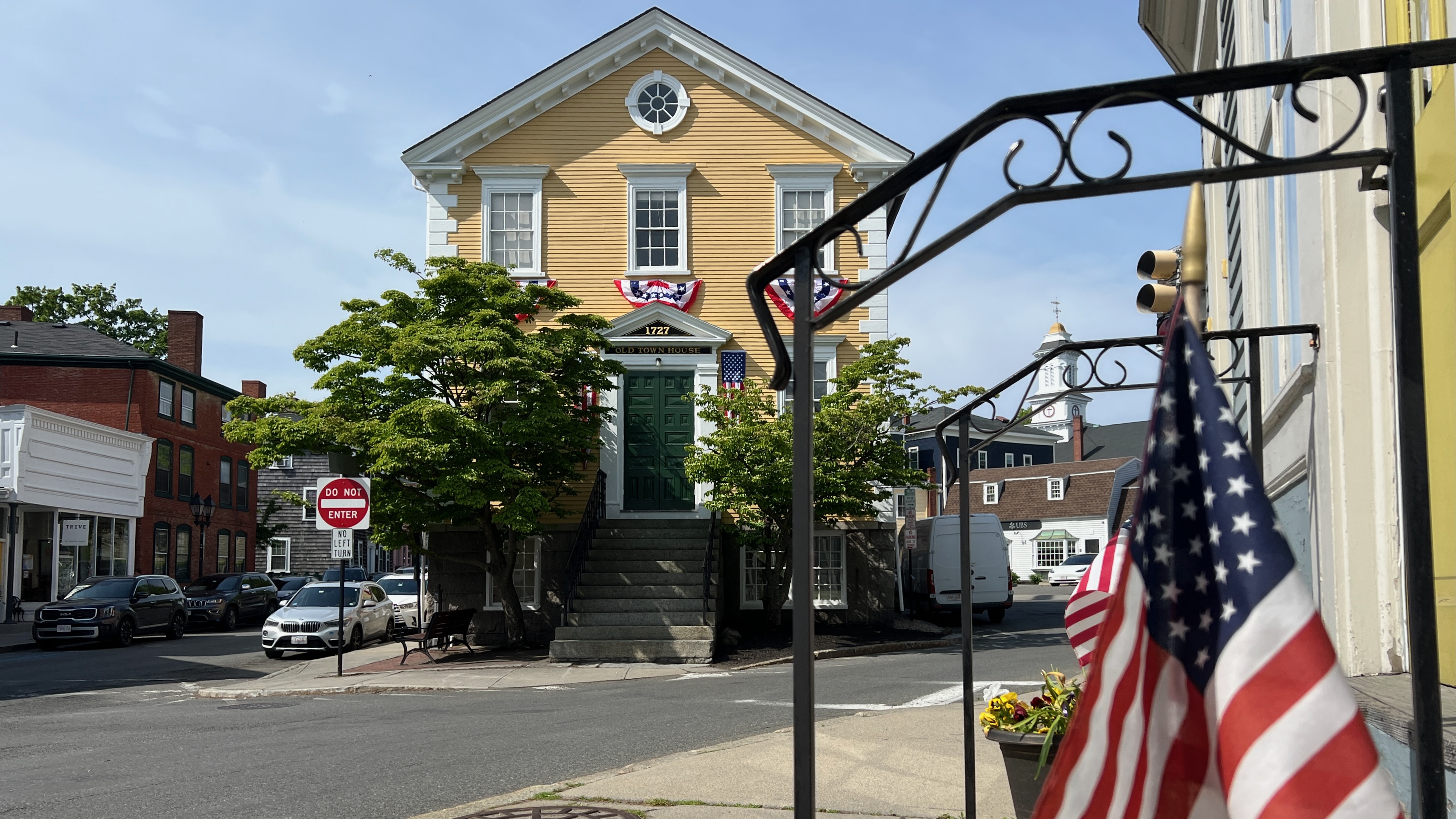
For nearly 400 years, the quaint town of Marblehead had been governed by town meeting, in which every resident who shows up gets a vote. Photo: Garrett Callahan.
It had been 42 years since this many people had jammed into a Marblehead, Massachusetts, town meeting. In May 2025, residents were crammed shoulder to shoulder with hundreds still trickling in from outside, when the fire chief declared it unsafe in the usual venue, the refined performing arts center displaying ornate floor-to-ceiling paintings and wall lighting. So town officials postponed till the next day to outfit the larger high school gym with plastic folding chairs, a bare stage, and a bright blue tarp over the hardwood floor.
More than 2,000 people (out of a population of more than 17,000 voters) squeezed themselves into the gym, which smelled of rubber and recent sweat. People in this coastal town had very strong opinions about whether, and if so, how, to comply with a new Massachusetts multifamily zoning mandate. Town officials had proposed a bylaw that would allow new zoning districts for multifamily housing. After four hours with roughly two dozen people taking turns at the microphone, a town leader was pleading with neighbors to stop attacking one another. The bylaw narrowly passed. But even as the votes were tallied, opponents were collecting signatures to unravel the measure and put the town’s democratic will to the test.
“This was the perfect storm of governance,” said Dan Fox, the chair of Marblehead’s Select Board, the town’s decision-making body. “Every different conflict came into play.”
The showdown was at once contemporary and consistent with the ideas in the Declaration of Independence, in which Thomas Jefferson wrote that governments derive “their just powers from the consent of the governed.” For nearly 400 years, the quaint town of Marblehead had been governed by town meeting, in which every resident who shows up gets a vote. But this time some citizens wondered if this heated debate across profound demographic divides would break this centuries-old system—or if Marblehead would show that, even in the 21st century, the American experiment with democracy can still work.
. . .
Marblehead, situated on a small, rocky peninsula into the Atlantic roughly 16 miles north of Boston, was founded in 1629 as part of neighboring Salem (of witch trial fame), before incorporating separately in 1649. Today, its 20,000-some residents include fishermen, artists, wealthy transplants, semi-remote white-collar employees from Boston, and longtime residents who can trace their lineage to the town’s founding. In this roughly four-square-mile town, you’ll find executives who have led Fortune 250 companies, lobstermen loading their boats before dawn during fishing season, working parents hurrying their kids to school, and retirees swapping stories at the local sail loft steps from the harbor.
The Marblehead median household income in 2024 was $182,132—75% higher than the state median. But the average income hovers around $256,000. Oceanfront properties with sprawling views and private docks can sell for more than $8 million. Meanwhile, the 4.4% of residents living below the poverty line—and renters, whose median income is around $72,000—endure a less opulent Marblehead.
Marblehead’s forebears played an outsized part in America’s fight for independence. The 14th Continental Regiment, led by Marblehead’s Gen. John Glover, formed from the town's fishermen and laborers. The militia rowed George Washington across the Delaware River during 1776’s pivotal Christmas attack on Trenton, New Jersey; you can see them alongside the general in Emanuel Leutze’s painting of “Washington Crossing the Delaware.” After becoming president, Washington stopped in Marblehead to thank the townspeople personally for all they did during the Revolution. Elbridge Gerry, a Declaration of Independence signer, was born in Marblehead and began his revolutionary responsibilities here.
This proud history has imbued the town with a fierce independence streak. Marbleheaders “have wanted to do things their own way,” said Deacon John Whipple of the town’s Our Lady Star of the Sea Church. Whipple, who served for 16 years on the Select Board, recounted a piece of town lore: During a 1940s or ’50s town meeting debate on a state mandate, one resident asked, “What do the laws of the Commonwealth of Massachusetts have to do with the town of Marblehead?”
Today, despite (or because of) Marblehead’s tucked-away location, heritage, and charming narrow streets, Marblehead faces a housing shortage. Home prices are climbing: the median sale price in April 2026 was $1.07 million. Seniors on a fixed income struggle to afford property taxes as home values rise, but often can’t find other options in town. Young families, along with blue-collar workers who serve the town’s restaurants and yacht clubs, feel priced out and move elsewhere.
. . .
Since its incorporation, Marblehead has operated under an open town meeting government. The town meeting body, comprising all town voters, acts as the legislative branch, while the Select Board is the town’s equivalent to an executive branch. The board consists of five elected volunteers who coordinate the town’s governance across boards and administrators.
Every year since 1649, the Select Board has called Marblehead for an annual town meeting gathering. Citizens openly debate and vote on the warrant—an agenda created by the Select Board and citizens—filled with items like budgets and salaries and potential new bylaws. The system grants Marbleheaders a large voice in their government. It’s one of the last remaining forms of direct democracy in the country.
“Marblehead is practicing its unalienable rights of self-governance through town meeting,” said town moderator Jack Attridge (the moderator's role is to govern town meetings). “Everybody has a chance to participate.”
Fox, the Select Board chair (and a Marblehead native), and Attridge, whose family goes back 13 generations in town, admit that the town meeting system can be “imperfect” and “inefficient.” But in the phrase that Winston Churchill popularized, “democracy is the worst form of government, except all those other forms that have been tried from time to time.” Conflict is inherent to the democratic process. Even so, the zoning bylaw prompted one of the most emotional Marblehead disputes in recent memory—and has dominated the warrant for three years.
The article was the planning board’s solution to comply with Massachusetts’ MBTA (Massachusetts Bay Transportation Authority) Communities Act, passed in 2021, more commonly known as Section 3A of the Zoning Act. The state law requires municipalities near transit lines to zone for multifamily housing. In a prosperous state with a housing crisis, the goal was to increase housing stock. The belief was that developers would quickly take advantage of any such zoning option. According to the state attorney general’s office, some 9,000 housing units across the state are currently in some level of development because of the law.
Marblehead’s proposal focused on three overlay districts that were zoned for a combined 897 additional housing units, the town’s minimum requirement under the law. Two districts would be in areas where there was already multifamily housing or commercial developments. Ironically, it was the proposal for Pleasant Street—lined with restaurants, a small cinema, and a community theater—that created the most backlash.
Marblehead failed to pass the article the first time it showed up, at the 2024 town meeting. At that meeting, a supporter asked for a re-vote, sparking accusations of fraud as many residents had left and prompting someone to throw a microphone onstage, near the town moderator. And yet the measure failed again.
Proponents argued Marblehead needed solutions to its housing crisis. Opponents argued that in such a densely built town—where centuries-old houses sometimes overlap so tightly that one house’s gutters drip into another’s eaves—construction would overwhelm town infrastructure, destroy its character, and displace local businesses.
At a later town meeting, some opponents, invoking the town’s revolutionary history, believed Marblehead didn’t need to obey the state. “Two hundred and fifty years ago, we didn’t take kindly to being mandated by the British government, and we kicked them out,” one resident said. Another added, “Elbridge Gerry is spinning in his grave that we’re sitting here tonight cowering about the fact that the government is going to be mad at us.”

Select Board Chair Dan Fox admits that the town meeting system can be “imperfect” and “inefficient.” But in the phrase that Winston Churchill popularized, “democracy is the worst form of government, except all those other forms that have been tried from time to time.” Photo: Garrett Callahan.
Tensions remained high during Select Board meetings inside Abbot Hall, Marblehead’s 150-year-old red brick town hall. Usually predictable and somewhat tedious, the meetings now drew insults. In an August 2024 meeting, as Archibald Willard’s famed “Spirit of ’76” painting loomed over them on the wall, residents shouted over one another; one called another a “weasel.” At a May 2025 meeting, a Select Board member gave a direct appeal to stop the personal attacks on town officials and asked for an apology. “You’ll never get it,” one resident yelled back.
The 3A fight got unusually emotional fast. Neighbors were afraid to put out lawn signs on either side of the issue, lest they be ridiculed or attacked. The rifts ran so deep that one of Fox’s closest friends severed communication with him for six months. Struggling to understand how emotions got so heated, residents attributed it to a poorly worded law, the complexities of zoning, and the fact that Marbleheaders have always been keen to stand up for their beliefs. But, more so, they believed that Marblehead was a microcosm of the divide in America today. After all, the 3A measure was debated at the same time as the heated 2024 presidential election. Even though nearly 70% of residents voted for Kamala Harris in 2024, people were eager to label opponents as enemies.
Fox said that the debate “brought up all these emotions that were happening nationally.” Yael Magen, an attorney who co-led the No on 3A movement, agreed. “It’s sad, because what happens is when you have that polarizing, very confrontational [situation] ... people don’t want to hear and listen to the other side.”
“I hated what it did [to this town], where neighbors couldn’t talk to each other,” Fox said, later adding, “It’s really divided us.”
Online discourse was even worse. Opponents claimed supporters were ruining the town, dismissing them as “sheep” for listening to the state. Some 3A supporters called opponents “racist.”
Magen recounted being called a “Nazi” and “fascist.” “I can’t even believe that I was called those names,” Magen said. “My grandmother was in Auschwitz.”
At the 2025 town meeting, more than two dozen residents gave their arguments before voters passed the article 951-759. But, at the gym’s exit, opponents had already started collecting signatures for a referendum. They discovered a little-known 1954 special act, which allowed the town’s residents to challenge town meeting decisions and bring the question to a townwide vote. It was the first time it was ever used, according to Fox, the Select Board chair, and in July 2025, the referendum once again overturned the article, 3,642 to 3,297.
“I think [our forefathers] would be extremely proud of what we did,” said Magen, who also co-led the referendum movement and has been active in the community for more than a decade.
Marblehead found itself no closer to a consensus.
The problem was that 3A noncompliance had a steep cost: town officials say that, in fiscal year 2026 alone, they lost more than $3 million in state grants for such things as a seawall study to prevent flood damage as climate change raises sea levels, accessibility improvements, and the town’s Massachusetts 250th events. Marblehead’s leaders went back to the drawing table, pleading with the governor and attorney general for guidance. In a three-page letter to state leaders, Fox wrote, “The situation facing Marblehead illustrates a fundamental governance conflict.”
. . .
When Jefferson wrote the Declaration of Independence in 1776 there were no cellphones, Facebook, or Zoom meetings. When the first U.S. Census came out in 1790, Marblehead’s 5,661 residents made it among the new nation’s 10 most populous cities.
The framers couldn’t foresee how emotions would boil over in a digital world, where people would write anonymous Facebook posts attacking a neighbor. But they did understand neighbors might often be at odds. Arguments and name-calling aren’t new. In Marblehead, “We’ve had loyalists living next to patriots,” Attridge, the town moderator, said.
“What the framers … were grappling with was that people aren’t perfect,” said Bob Allison, a Suffolk University history professor and chair of Massachusetts’ Revolution 250. “So, you create a system that prevents long-term malevolence, and the only real way to do that is to have people … having to challenge one another.”
Town meetings are a large part of that; Allison called them “fundamental to self-government.” But the framers also believed those conversations would happen informally, outside of the system.
That’s what happened when the Select Board, which wasn’t in charge of Marblehead’s 3A plan—that work was done by the elected volunteer planning board—directly reached out to the opposition movement to work out a solution.
In September 2025, in a back office at Abbot Hall and far from the charged atmosphere of social media, some of the leaders of the two sides finally had a chance to listen to each other in a closed-door meeting. The meeting among residents and town officials, all with a range of political opinions, was cordial as they attempted to find agreement. Opposition leaders shared their fears about the impact of new development on the town's already strained infrastructure and historic character. Select Board members explained the legal and financial pressures the town faced from the state.
Officials admitted those conversations should have happened earlier. Some of the emotion would have been taken out of it if there was better communication from both sides. But it’s also possible there needed to be emotion before there could be a solution.
“Maybe in something as divisive as this, we needed to go through this,” Fox said.
Neither side left the meeting fully convinced of the other's position, but they left with a better understanding. It was a small but crucial step toward rebuilding the empathy and trust that had been eroded over months of bitter debate. “That is part of living in a republican system, where people do have to talk to each other … then, to figure out, well, what is a solution that will work for the greatest good for the greatest number [of people],” Allison said.
. . .
After more than two years, Marblehead finally hammered out a common vision incorporating more specific input from detractors to achieve 3A goals. When the Massachusetts attorney general sued Marblehead and nine other communities for noncompliance in January 2026, Marblehead already had a plan.
The planning board now proposed two overlay districts (instead of the original three), one of which was on a 123-year-old private Tedesco Country Club. The Tedesco plan, as it was locally known, virtually guaranteed there wouldn’t be new housing unless the club was sold. The plan’s smaller zoning district is already zoned for multifamily housing and is already under redevelopment. However, the planning board said it still followed all parts of the 3A law, and the state pre-approved its plan.
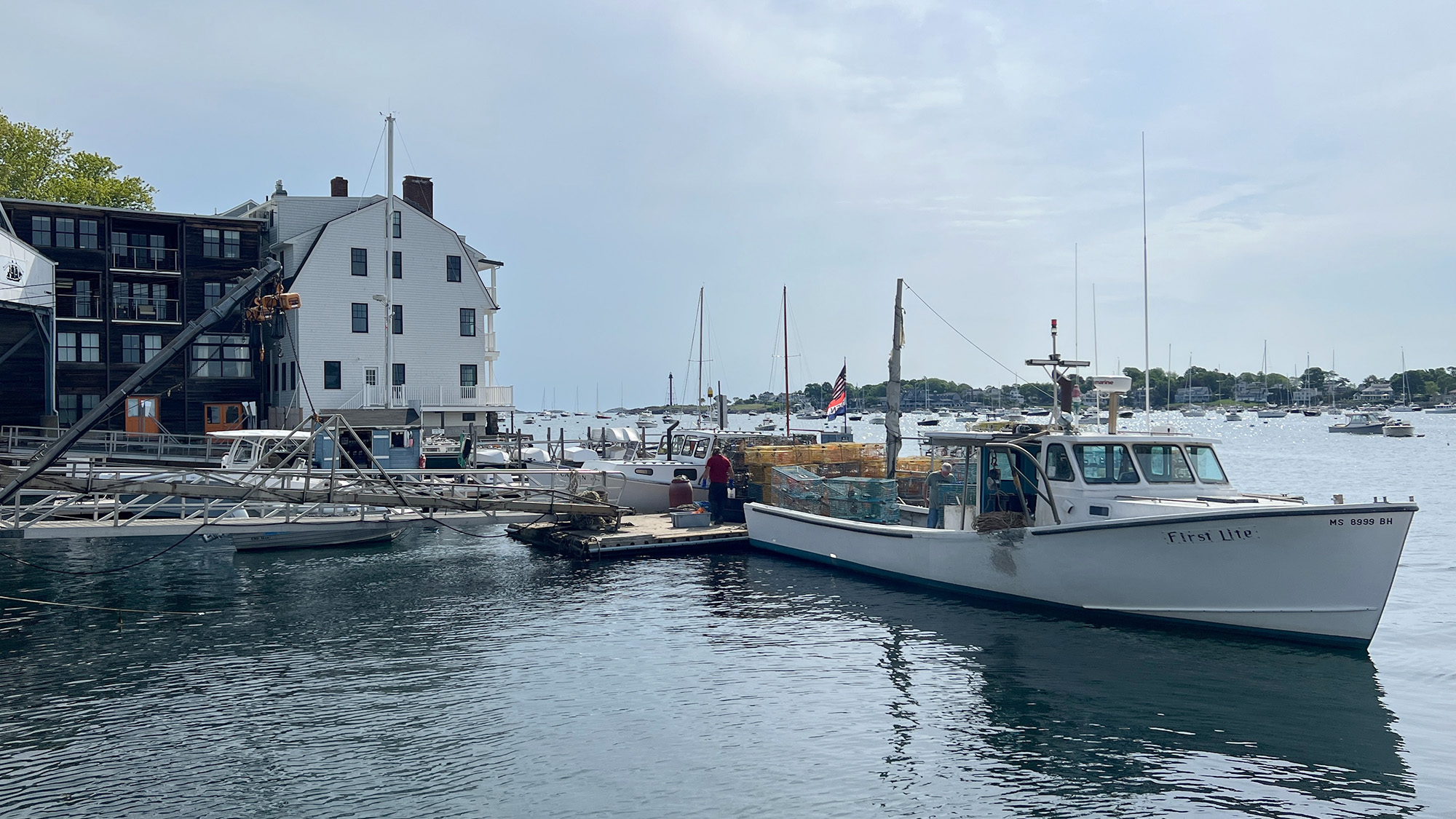
Marblehead's 20,000-some residents include fishermen, artists, wealthy transplants, semi-remote white-collar employees from Boston, and longtime residents who can trace their lineage to the town’s founding. Photo: Garrett Callahan.
As a result of the compromise, Marblehead’s 2026 town meeting, again held in the high school gym, went far more smoothly. No microphones were thrown, no slurs were hurled. Town meeting approved the revised plan by nearly an 11:1 ratio, with 881 in favor and only 82 opposed. Pending full approval from the state, the ordeal is likely over.
The town was, overall, happy to be in compliance. The leading public voice of the opposition movement, who was at the private September 2025 meeting, declined to speak for this article, but even he expressed contentment in town Facebook groups on the compromise.
Many residents felt that the vote was a triumph of the democratic process. Marblehead's citizens and elected officials had managed to find a solution that a clear majority could accept. The town had weathered a divisive storm and emerged with its democratic institutions intact.
Yet there was lingering dissatisfaction from some. One speaker from the 2026 meeting went viral after he questioned the plan’s commitment to creating housing. He argued Marblehead would have new multifamily zoning districts, but likely no new housing.
“So, this is a way to comply with 3A without doing any of the 3A stuff,” resident David Modica said. “Are we kinda being pricks?”
“We tried the other way, and it was rejected,” a planning board member replied.
You can’t make everyone happy in governance. But once there’s compromise, the test of a democracy may lie in a people's willingness to keep grappling with hard questions. And some of the town’s leaders believe that’s ultimately where headway will be made moving forward.
“We can have those conversations now,” Fox said. “You can also say we’ve all figured out a way to come to the middle with 3A. If we can use that to show that we might completely disagree, but maybe we can find somewhere in the middle and actually find progress versus neutrality.”
The solution, while not perfect, allows Marblehead residents to pursue their own visions of “Life, Liberty and the pursuit of Happiness,” as enshrined in the Declaration of Independence.
“Maybe what happened with the way the founders set this up; maybe it was sort of genius in some ways,” Fox said. “Because, especially when it’s a 50-50 [split], it almost made us work harder to bring people together.”
Dialogue made it possible to find common ground and acknowledge there would never be total agreement. Instead, many residents agreed that there needed to be more conversations and more listening, as opposed to speechifying debates. Some bitterness and grudges still linger inside the town’s Facebook groups. But, overall, there’s a sense that this issue is behind Marblehead.
Fox and his friend rekindled their friendship. Attridge long ago had a respectful conversation with the man who threw the microphone onstage. Magen, while still stung by the comments she received, has moved on and learned lessons of her own. “We need to go back to our humanity,” Magen said, underscoring that amid all of the fighting, “We kind of lost that.”
She said that the way forward is to talk. “You need to talk and stop demonizing people who think differently from you.”
It’s a lesson that didn’t have to wait long to be used. During the 2026 town meeting, the bigger issue was a proposed tax hike, after years of budget strains. In response, two citizen movements formed, lawn signs once again dotted the town, and Facebook groups awakened with new arguments. Back inside the high school gym, which has become the town meeting’s new home, nearly a dozen residents lined up at the microphone to speak at the 2026 town meeting. Afterward, arguments would still get tense at points online. But at least for that moment, it was a template for civic discourse, a community disagreeing without being disagreeable.
“While we may disagree on how to vote, let’s unite to increase [participation],” one resident said. “Let’s make democracy work for Marblehead.”
© 2026 Garrett Callahan
Garrett Callahan is a writer and reporter based in Massachusetts with experience covering lifestyle, sports, history, and general news topics.
Honoring excellence and leadership. Working across disciplines and divides. Advancing the common good. From 1780 to today.
Our Common Purpose, the Academy's ongoing and bipartisan work to strengthen democracy in 21st century America, produced recommendations, reflections, and reasons to pursue a more perfect reunion.
These initiatives, seeking structural and societal advances, were developed in recognition that a healthy democracy requires both responsive political institutions and a robust civic culture.