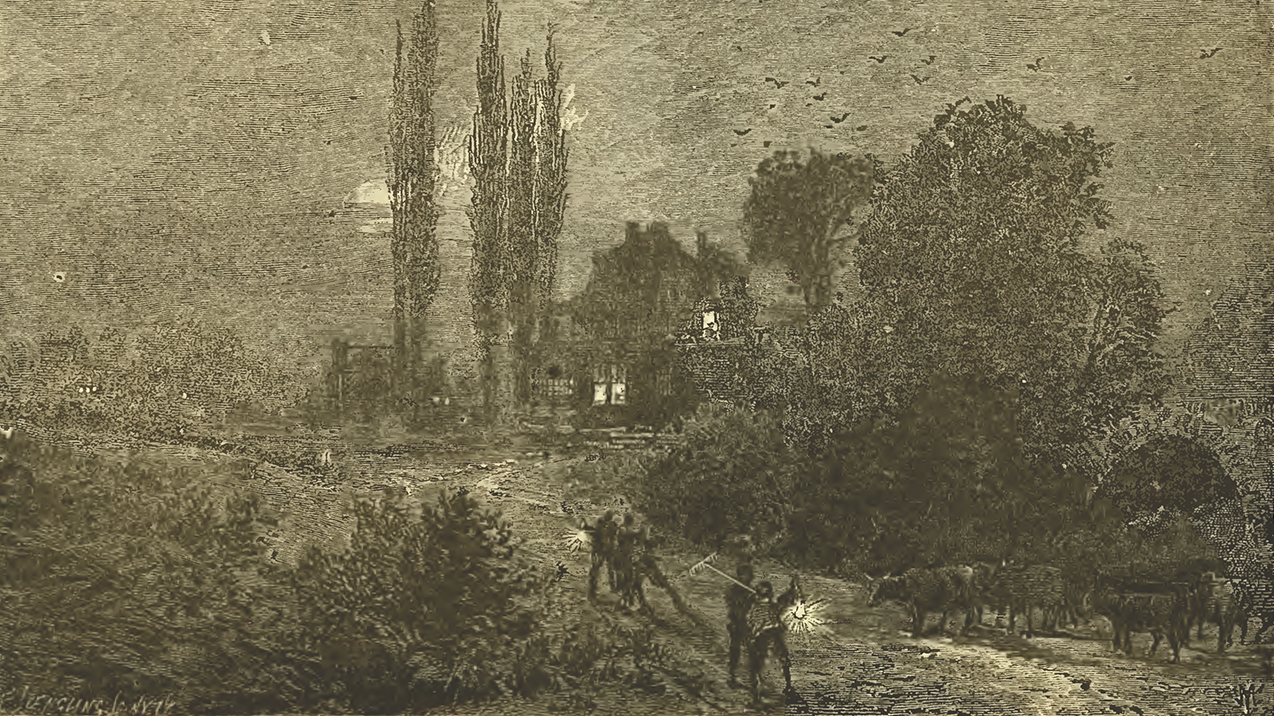
A rendering of New England’s dark day. Frederick Juengling, 1878.
Harvard Professor of Mathematics and Natural Philosophy and Academy charter member Samuel Williams, on the morning of May 19, 1780, encountered a truly startling scene in Cambridge, Massachusetts: A strange darkness had swept into the city, blanketing everything in a seemingly apocalyptic haze.
“People were unable to read common print—determine the time of day by their clocks or watches—dine—or manage their domestic business, without the light of candles,” Williams wrote in a paper submitted to the Academy.1 He crafted a rigorous and surprisingly comprehensive record of the event using his own observations and scientific expertise, as well as accounts from New Englanders in nearby states.
Some of Williams’ contemporaries were, understandably, more alarmist and reactionary. Members of the Connecticut General Assembly speculated that the end times were near,2 while early Shakers interpreted the event as a heavenly call to publicly assert their faith.3 New England physician and Academy charter member Cotton Tufts, in a letter to fellow charter member and future Academy President John Adams, mixed scholarly observation with histrionics, attesting to, “... a darkness greater than which I believe has not been experienced since the Children of Israel left Egypt.”4
Williams in his report to the Academy hypothesized that one or more large fires were to blame and provided detailed evidence to support his claim.5 More than two centuries later, researchers from the University of Missouri and the U.S. Forest Service discovered fire scars in trees linking the haze to wildfires in the northern U.S. and Canada, validating Williams’ work and lending it a disturbing and, now, all-too-relevant prescience.6