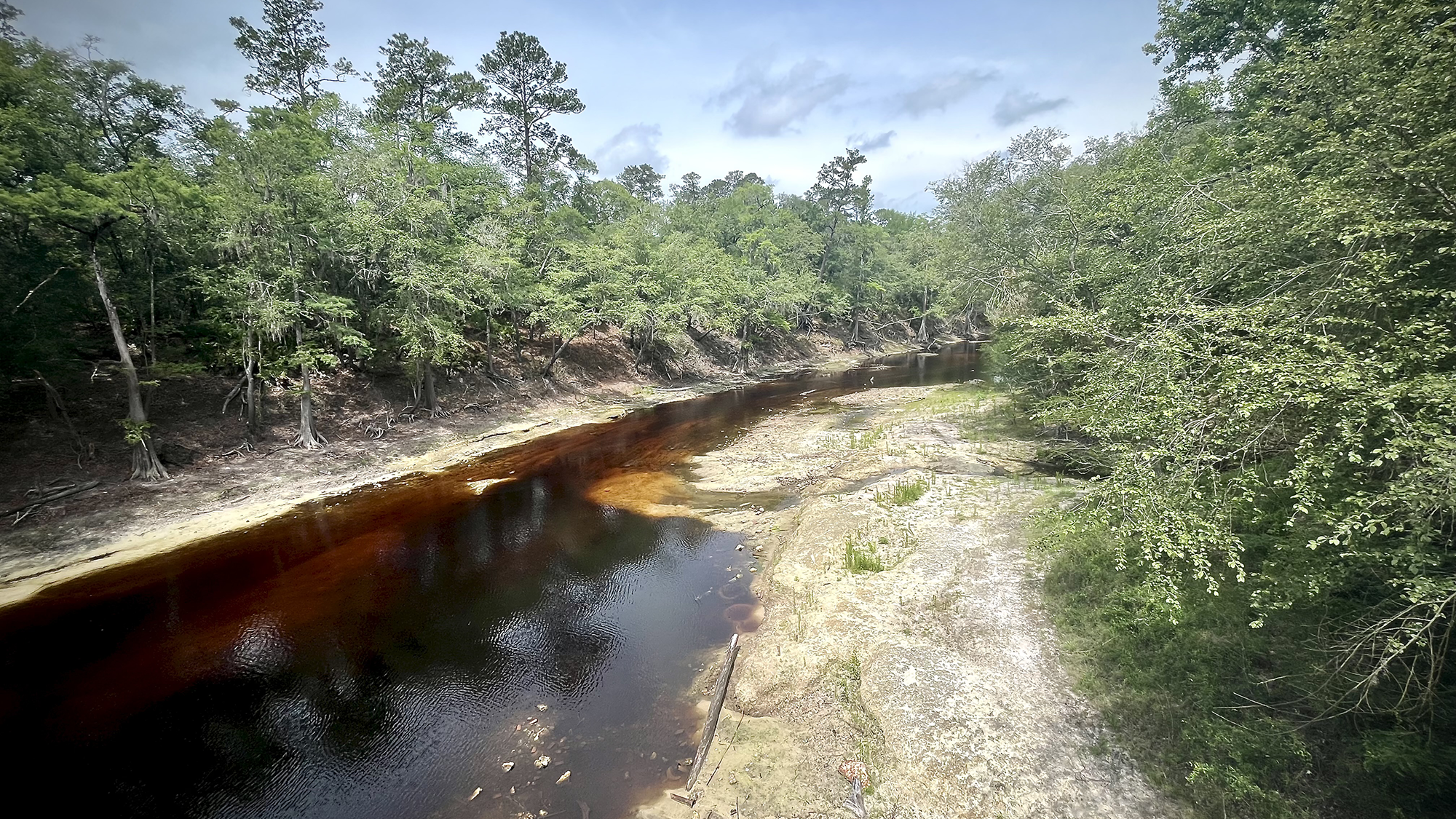
Along the Suwannee River in Florida, people are asking an old American question, albeit in the language of rivers and wells: What does self-government mean when the very water you rely on is governed from somewhere else? Photo: Stephenie Livingston.
In rural Florida, the Suwannee River is both real and imagined. It rises in Georgia's Okefenokee Swamp, dark with tannin, then winds south through limestone and cypress swamps to the Gulf of Mexico, one of the last largely free-flowing rivers in the Southeast. Beneath it lies a vast aquifer that feeds more than 300 springs, five rivers, and the wetlands of the Suwannee Basin. The same water supplies much of Florida and southern Georgia, some 10 million people.
Many Americans know the river first as a song—one written by a man who never saw it, who nonetheless turned the river into a national myth.
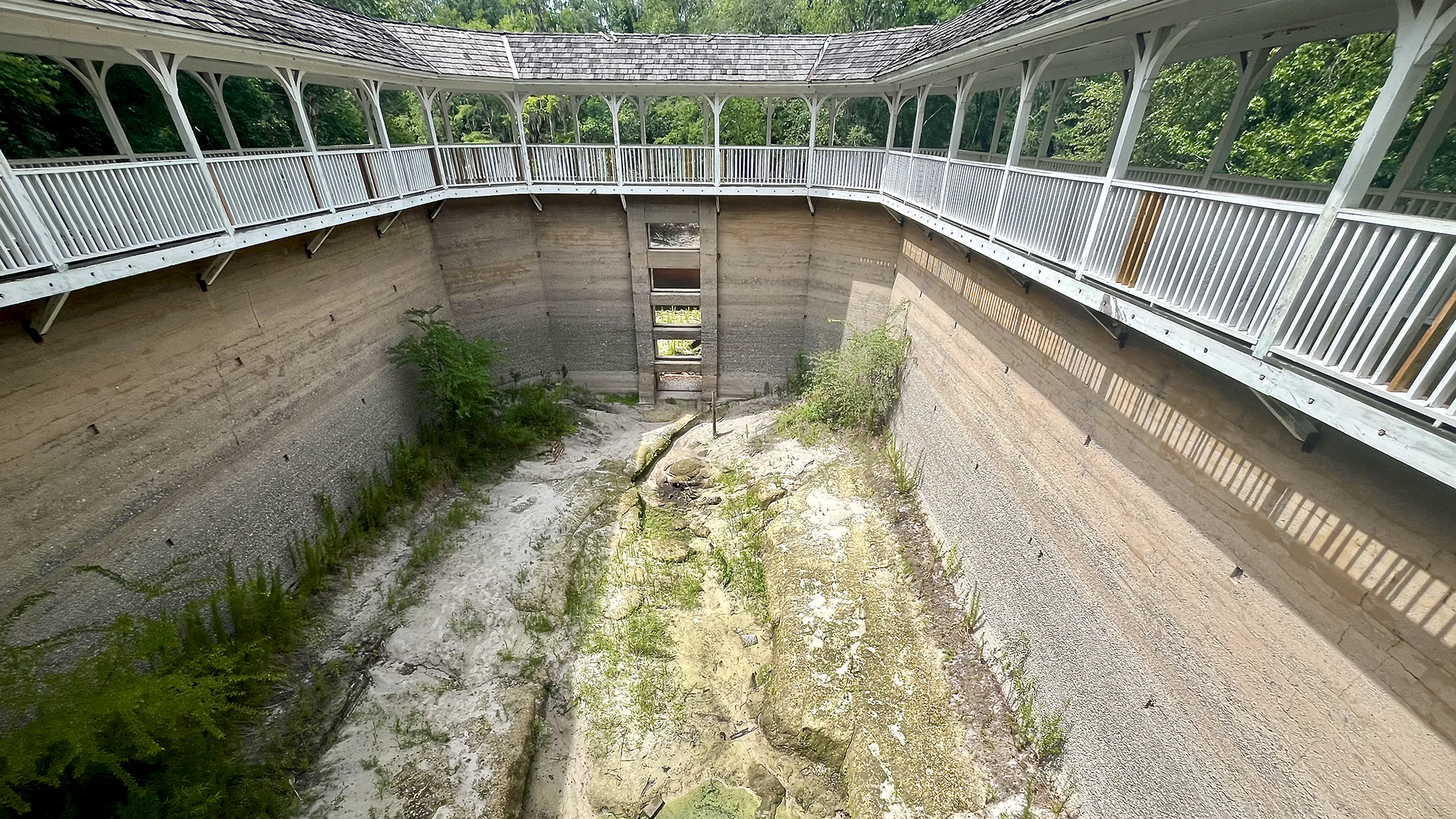
In White Springs, the myth and the river meet. The riverside town of less than 800 was once home to a famous sulfur spring, where tourists came to bathe in water advertised as healing quite literally any ailment. Today, the old four-story spring house that once served those seekers stands around a limestone pool that is often nearly dry. This year, as the country celebrated its 250th anniversary, the Suwannee Basin was in its worst drought in 25 years. The Declaration of Independence began as a complaint against distant authority. Along the Suwannee, people are asking an old American question, albeit in the language of rivers and wells: What does self-government mean when the very water you rely on is governed from somewhere else?
This year, that question revolved around a proposal to move treated wastewater from Jacksonville into the aquifer system that feeds the Basin’s springs and rivers. Its backers call it restoration. Many in the Basin see a familiar imbalance: a rural region asked to absorb a problem created by a larger, wealthier city.
That imbalance hung over White Springs during an unusually hot Memorial Day weekend. A fife and snare drum threaded through the live oaks at the town’s Stephen Foster Folk Culture Center State Park, carrying the melody of "Old Folks at Home." “Way down upon the Swanee River,” the old melody goes—Foster shortened Suwannee to “Swanee” to fit the meter. Every year, thousands gather here for the Florida Folk Festival, held since 1953. This spring, as the festival celebrated the 250th, visitors stared down from the Suwannee’s banks at shallow water and sand.
The festival holds an uneasy contradiction. It is one of the nation’s longest-running celebrations of folk culture, with a historically inclusive lineup: Greek dancers from Tarpon Springs, Haitian musicians, a Black man from Polk City named Moses “The Doorman” Williams, who played slide guitar on a hollow-core wooden door strung with broom wire, and this year Flamenco, Ukrainian folk dancing, a shrimp net maker. But it unfolds inside a park dedicated to Foster, who wrote that melody in the minstrel era, with its roots in blackface caricature that mocked and degraded African Americans. Florida adopted it as the state song and, in 2008, removed some racial slurs while retaining its plantation nostalgia. But the Folk Festival celebrates many more tributaries into the state’s culture.
. . .
Diversity was part of the festival’s model from the start, says folklorist Peggy Bulger, who came to White Springs in the 1970s to survey the state's folk traditions. What gets called Southern culture, she likes to remind people, is already braided from many sources. The banjo, for one, came from Africa.
When news of the Declaration reached St. Augustine in 1776, a loyalist crowd burned Samuel Adams and John Hancock in effigy. The document spoke for a "we" that did not include the people living here, in a territory where enslaved people made up a large share of the population, and among Native peoples it cast as “merciless Indian savages.”
For Bulger, that is why folklore matters. As one of Florida’s early state folklorists, she helped build the fieldwork and archives behind the Florida Folklife Program, giving the festival a way to present the state’s many inheritances side by side.
When she asks those who keep these traditions alive what threatens their crafts, the answers often point back to the land and water on which those traditions depend. Instrument makers who once worked with local wood now must import it, as deforestation and development make local timber harder to come by. On Apalachicola Bay, the oyster harvesters have watched their beds collapse. As metro Atlanta draws more water upstream from the Chattahoochee River, less freshwater reaches the bay; as a result, in the saltier water that remains, predatory snails move in and overrun the oysters. Crafts, food, herbal medicine—all of it, Bulger says, depends on the health of the land. And, of course, the water.
The Spring House
The park’s spring house sits on the Suwannee, simple and oddly beautiful, built around what was once one of the most popular mineral springs in the South. I had expected, entering the structure, some flow, the smell of sulfur, the sound of water finding its way up through limestone. Instead, a small puddle of algae-green water sits encircled by sand and rock, like a spring's corpse.
The spring stopped flowing reliably in the late 1970s and ceased for the most part around 1990, decades before this year's drought lowered the river outside.
Chief Arthur Bennett of the Talimali Band of Apalachee Indians, a Louisiana-based tribe that traces its origins to Florida, says the spring drew nations before it drew tourists. For his ancestors, White Springs was a traditional place of healing and neutral ground among tribes. "It is considered a sacred site by our people," he said.
European colonization ravaged Florida's Native communities with disease, violence, removal, and migration—Bennett's own people among them. Later, the Suwannee region became a refuge for the Seminole, a people formed from Indigenous Floridians and displaced tribes, alongside African-descended freedom seekers who escaped slavery and built allied communities with them. Author Vincent Adejumo, who taught African American studies at the University of Florida and is a public lecturer for Florida Humanities, says Black Seminoles were people “counter to the power structure.” Free, armed, and growing, their settlements were exactly what a slaveholding nation to the north could not abide.
In April 1818, Andrew Jackson led more than 3,000 U.S. and allied troops toward Bowlegs Town, a Black Seminole stronghold on the lower Suwannee. As Jackson’s army closed in, far outnumbered Black Seminole fighters held the riverbank while their families fled, then plunged into the Suwannee under fire. Jackson burned the villages and declared victory. In the decades that followed, as Native peoples were forced from their homelands across the South, many Seminoles and Black Seminoles were driven out of Florida. But no battle ever forced a formal Seminole surrender. Today, the tribe calls itself the Unconquered, a word Florida absorbed into its mythology and gave to a football team. Adejumo traces that defiance through John Horse, who escaped from Bowlegs Town on a log raft, and later helped lead the Black Seminole resistance, and, in 1850, led his people across the border to freedom in Mexico.
John Horse was one of the unconquered, Adejumo said, but “you won’t hear his name anywhere in Florida history.”
Later, Jim Crow drew its lines through Florida’s springs. In a 2015 oral history, White Springs resident Bernard Williams recalled the spring house of his childhood in the 1940s. "We couldn't go in it, you know," he said, and laughed. "But the German prisoners were able to go in there during the war." Inside the park's Stephen Foster museum, dioramas from the 1950s present visitors with the version of the river Foster imagined. In one scene, enslaved people appear content beside a cotton field as a paddlewheel boat passes; in another, a Black man sleeps near a slave cabin while a river runs behind him and another man plays banjo for a dancing child.
But the question still hanging over White Springs is simple enough: How does a spring famous enough to warrant a four-story house simply vanish?
Dennis Price tried to answer it from the front seat of his truck. We drove west from the spring house, past pine farms, dry creek beds, and phosphate land, with maps scattered between us: old drainage lines, creek basins, mining boundaries, the paper geography of water that had once moved in different shapes and directions. Price came to White Springs to work at its phosphate mine in the 1970s and never really left. He worked at the mine, then for state environmental and water management agencies. To say he knows every inch of these woods is an understatement, since he knows what’s beneath them, too.
The spring house stayed behind us, but the absence it contained seemed to repeat itself in every ditch and creek bed Price pointed out. At Roaring Creek, named for the sound it makes falling six feet into the Suwannee, the name felt almost accusatory. Today it was not roaring. Price was not sure if it was even flowing.
He reads the landscape the way some people read old letters, finding in culverts and clay layers the record of decisions made and left behind. For generations, he said, the region was engineered to move water off the land. Loggers ditched the great cypress swamps to reach the timber; paper companies dug canals to dry wetlands into timber farms; roads became drainage. Water that should have lingered in swamps for months, recharging the aquifer drop by drop, now leaves in days.
"We've had a history of draining everything off these uplands," he said.
Phosphate operations—today run by the fertilizer giant Nutrien—will eventually churn through roughly 100,000 acres near White Springs, close to a third of Hamilton County, Price said. On one of the maps between us, the mine was not a single wound but a wide, gaping disturbance. Strip mining digs through the shallow clay layer that holds rainwater near the surface; where the clay is gone, the creeks above lose their source and can stop flowing to the river.
The deeper trouble is the Floridan aquifer, a honeycombed, subterranean matrix of limestone channels that holds billions of gallons of new and ancient water that feeds Suwannee Basin springs, rivers and wells. A 2010 Suwannee district report and earlier U.S. Geological Survey work found that the underground pressure that once pushed the famous spring at White Springs up through the limestone had been dragged down and disrupted for decades—by industries like paper mills in Brunswick, Georgia, and Florida’s Fernandina Beach and, above all, by Jacksonville, which pumps more every year. The aquifer had fallen below the pressure threshold that made the old spring flow.
"We're just a giant water tower over here for Jacksonville," Price said.
The Pipeline
Florida's five water management districts are each governed by a board appointed by the governor, with authority over all major wells and permits in its region. No one in the basin votes for the people who decide how its water is used, an inversion of the Declaration’s premise that legitimate authority rests on the consent of the governed. As a result, the Suwannee district's eventual decision about Jacksonville's wastewater would land among Basin residents like a match dropped into pine straw.
More than 70 miles east of White Springs, Jacksonville has discharged its treated sewage into the St. Johns River for decades. In 2021, the state Legislature passed Senate Bill 64, ordering utilities statewide to eliminate "nonbeneficial" discharges of treated wastewater into surface waters by 2032. That mandate fell hard on JEA, Jacksonville's city-owned utility; complying would be expensive. But lawmakers later amended the law to carve out an exception: Treated wastewater could be used to rehydrate wetlands or shore up a river system's legally mandated minimum flows. That exception, Suwannee Riverkeeper John Quarterman argues, gave JEA a cheaper way out—piping its wastewater into a North Florida aquifer-recharge project as relief for failing river flows.
The plan’s paper trail was public for months, but easy to miss. In November 2025, the Suwannee district board approved its “2025 Implementation Strategy for the Lower Santa Fe and Ichetucknee Rivers and Priority Springs.” Buried in the board’s description of the strategy was Water First North Florida, a planning-phase regional project. The project called for pumping 40 million gallons a day of reclaimed wastewater from JEA’s Buckman plant and one other facility, sending it through wetland treatment, and then moving it to aquifer-recharge sites in the Suwannee Basin. The estimated construction cost was about $1.1 billion, excluding land, easements, permitting and upkeep.
Quarterman posted the district’s own documents describing the project on Facebook. As word spread on social media, so did the opposition.
On the WWALS Watershed Coalition's Facebook page, an environmental advocacy group led by Quarterman, residents vented in rather plain terms. "Keep your old funky water. NO ONE WANTS IT," one commenter wrote in April of this year. Another, identifying herself as living downstream, called the prospect of "poop water injection" frightening.
By spring, at least seven county commissions in the Basin had passed resolutions or letters opposing the project. So had the 12-county Middle and Lower Suwannee River Task Force, unanimously, while the North Central Florida Regional Planning Council urged Jacksonville to pursue desalination instead. At a Suwannee County Republican town hall in February, nearly everyone opposed the plan. At the district’s March open house, billed as a chance to answer questions and clear up misinformation, the line stretched into the parking lot.
At one meeting, Quarterman recalled a Suwannee County commissioner asking a Suwannee district representative if they would get a vote on the project. He had to ask three times. “They finally gave a straight answer,” Quarterman said. “No.”
Opponents saw a larger, wealthier city exporting its wastewater problem to a rural watershed already struggling to protect its springs and groundwater from nitrate pollution and falling flows. It cut across political and class lines in a way that slow ecological decline rarely does. An aquifer is buried. Nitrate is colorless. A wastewater pipeline from Jacksonville, however, was a little too on-the-nose.
"I can understand that toilet water coming through a pipe from Jacksonville is bad," said Hailey Hall, a hydrologist from a Suwannee region farm family and project manager at AquiferWatch, a nonprofit that offers free well tests to rural residents in north Florida. "I can wrap my head around that.”
Hall became one of the clearest scientific voices against the proposal. Her job involves identifying nitrate hotspots in the region's groundwater. Washed for decades off fertilized fields, dairies, septic tanks, and sewage spills, nitrogen seeps through Florida's porous ground into the aquifer as nitrate: colorless and tasteless in a well but unmistakable in a spring, where it feeds algae that smothers eelgrass and turns blue water green. Many of the basin's springs are already so nitrate-loaded that state agencies classify them as "impaired."
The federal drinking-water standard for nitrate is 10 milligrams per liter as nitrogen, set to protect infants from blue baby syndrome, in which nitrate interferes with the blood's ability to carry oxygen. More recent research raised concerns about long-term exposure at lower levels, particularly for colorectal cancer. Florida's legal restoration target for its impaired springs is 0.35 milligrams per liter. The project did not promise to meet it. "If you're drinking 9 [milligrams per liter], you're drinking poison," Hall said. "The transfer of any mass of nitrogen or any pollutant into an impaired basin—that's not how you restore a river."
The project would test water only at the wetland entry point, not at the private wells of people living nearby, Hall said. The Floridan aquifer is among the most transmissive in the world. "By only testing for drinking water standards," she said, "you're missing out on pharmaceuticals, you're missing out on a whole slew of forever chemicals." She added, "Don't act like that's the same as the rain coming down."
After the district moved a promised public meeting from the county to a new location in a different county, commissioners in Hamilton County—home to White Springs—voted unanimously on March 24 to oppose Water First North Florida. They released a letter to the Suwannee district citing contaminants and closer alternatives—the county sits far from Jacksonville, while JEA's own wellfield sits far closer—but its sharpest language was about consent, a clear echo of the Declaration’s principles. "In our national, state and local systems of self-government," it read, "the people are entitled to participate in governmental decisions." The project's backers "care little about allowing the citizens a voice," it continued. It charged the district and JEA with "utter disrespect." In the end, through their own resolutions and those of regional bodies, all nine counties fully in the district stood opposed.
Hamilton County Commissioner Robby Robertson wants to see the Suwannee River Water Management board elected by residents of the river counties. Currently the board is appointed by the governor and confirmed by the Senate, a structure that produced a board that pursued Water First North Florida.
"It's our river," he said. "We ain't got a whole lot here. But we do got some pretty woods, some beautiful rivers, some beautiful springs.”
The Deficit
Yet, Water First North Florida was responding to a real problem. The watershed is impaired by decades of aquifer pumping, agricultural runoff, wastewater spills, recurring drought, and the legacy of phosphate mining. Parts of the Basin sit at or below the "minimum flows and levels" the district's own science says the rivers need, which chokes off new groundwater permits for farms and growth. Supporters said the project would replenish the Floridan aquifer—the below-ground water that feeds the region's springs and supplies most of its wells—and thereby prompt dried-up springs to flow again. In White Springs, that promise had an obvious monument: the old spring house.
At 40 million gallons a day, opponents countered, the project fell short of the flow deficit and would take more than a decade before any measurable gain reached the rivers and springs it was meant to restore.
In late spring, the project's opponents got what looked like a victory. On May 12, state senator Corey Simon, who represents much of the Basin and had opposed the plan, posted a letter announcing that Water First North Florida was "canceled in its current form," and that he had asked all parties to "go back to the drawing board." The news spread across the area like the drought-fueled wildfires that swept through just weeks before.
But a letter from a single senator carries no legal force. What the announcement actually covered was narrower than the word "canceled" suggests. The same afternoon, as the Legislature opened a special budget session, the Florida Senate removed a $20 million line item it had set aside for the project, matching the House, which, Representative Chuck Brannan of Macclenny says had been kept at zero all session. By May 14, the two chambers' budgets were aligned and the appropriation was gone. That was the cancellation: the state's line item contribution for the year, zeroed out.
The far larger commitments were never the Legislature's to cancel, and as far as anyone knows, none of them were, says Quarterman. Funding for the project included JEA's $400 million, the St. Johns district's $125 million, and a $2.1 million contract St. Johns had already awarded an engineering firm to begin siting the wetlands and routing the pipe. The Suwannee district's board met the very morning Simon's letter appeared, heard from residents still lined up to oppose the project, and never addressed whether it had been canceled. Asked by local news outlets to confirm the canceled project, the district declined to provide a direct answer.
Brannan, for his part, was blunt during an interview with the Columbia County Observer about who had driven the plan. It "has always been driven by the water management districts," he said, "cooked up by them… with the Florida Department of Environmental Protection." The project, he said, had flown "below the radar."
Quarterman, who had spent months fighting it, would not call it over. "It ain’t dead yet!" he posted on Facebook in early June.
A few days later, the district finally explained what "canceled in its current form" had left vague. At the June 9 board meeting, Executive Director Hugh Thomas said research into treating Jacksonville’s wastewater was still ongoing in the St. Johns district, and the intent was still to use that water. The treated wastewater, he said, would now be used to replenish the underground water supply “over in the St. Johns district.”
That research is happening under the Buckman Ozone Treatment Wetland Pilot Study, which is testing whether ozone and constructed wetlands can further clean reclaimed water from JEA before release. In 2025, Buckman was operating under a state consent order for repeatedly exceeding toxicity discharge limits since 2019.
As for the Suwannee Basin, Thomas said there’s no current or future work planned in the district.
For the Basin's own deficits on the Lower Santa Fe and Ichetucknee River, part of the Suwannee system, he said, the district's staff were developing "other regional, smaller—benefit-wise and price-wise" projects to bring to the board as they took shape.
During that meeting, board member Larry Thompson walked back the project. He said Water First North Florida “was always a conceptual project," adding, "It was never anything that was gonna be put in force." The public perception that the board had approved bringing wastewater to the area, he said, "was totally untrue. Totally untrue."
But in nearly the same breath, Thompson spoke approvingly of the resource he had just minimized. He said he supported the ongoing research into treating Jacksonville's wastewater, and while it might be years before it was clean enough to use, he made the case for it anyway. "The potential of having 40 million gallons a day," he said, "relieves a lot of pressure on development, ag producers and the like, that we as a board need to be looking out after, right?"
Price thinks local alternatives remain understudied, such as plugging historic drainage, holding stormwater in swamps, and using gravity-fed recharge wells where water already moves naturally into the aquifer. At the June Suwannee district meeting, Moses Klepper stepped to the microphone in overalls, his hair pulled back in a braid. He described himself as a blue-collar man with no public speaking experience. But at the previous month’s meeting, after demanding that the board “shut down” the project, he had summed up the strange politics of the fight: “I’m standing side by side with a bunch of liberals trying to fight this dadgum poisoning of our water. So, if that don’t tell you something.” Now he acknowledged the district’s water troubles but urged the board to trust the lived knowledge of local people in finding solutions.
But on whether Water First North Florida was a good option, he had already made up his mind.
"It's never going to be. It's not going to be," he repeated, seven times, until it sounded less like a statement than a refusal.
Our River
Pedro Zepeda, a citizen of the Seminole Tribe of Florida, had come to the Florida Folk Festival to accept an award for carving dugout canoes, a tradition tied to Southern rivers for centuries. One of his canoes sat on display at the festival, carved from naturally fallen cypress harvested by hand from South Florida’s Big Cypress swamps. It rested on dry ground near a river nearly too low to float it. He says water in Florida has become a commodity—measured in permitted gallons and allocated among utilities and industries. To him, water is something you're "literally connected to" when you carve a canoe for it, water you can see and feel, a spring Indigenous people once drew from, a bend in the river where a family lived and a child was born.
A river is never only water. When it is diminished, it signals an impaired system, and the loss falls hardest on the people who depend on it most. Photo: Stephenie Livingston.
"People don't want to believe that we have a finite amount of water in Florida," he says. "Too many people are using the water. And now once it dries up, that's it."
When Zepeda carves, he can smell how different woods smell and feel how they cut. He said modern conservation can sometimes keep people at a distance from the natural world, treating landscapes as something to observe rather than to know through use, care and practice, which he calls “window-shopping of nature,” a phrase that might also be used for the people looking to profit from public natural resources.
The Declaration announced a people’s right to govern themselves, but in Florida, as elsewhere, those most connected to the land and water have not always had the most say over it.
Adejumo, who lectures on the Black experience in Florida, hears the same exclusion in the way Florida remembers itself. Invoking nostalgia is a political tool, he says—the song, the spring house, the riverboat scenes, all these falsehoods blurred and buried the harder truths. They turn a selective version of history into heritage, hiding the violence and exclusion that shaped the place. Once that version of the past feels beloved, the present order can seem worth defending, too, even if it excludes people. “Nostalgia is the status quo,” he told me. “And the status quo is what keeps the power to those who have always had the power.”
That matters when the story moves from public memory to water. The board that oversees the Suwannee River Water Management District is all white and, but for one woman, all male, with six of its eight members drawn industries related to construction, timber, and agriculture. The backlash to Water First North Florida filled meeting rooms in the Basin and convinced some people to speak up on environmental issues for the first time, but the rooms were often overwhelmingly white. Adejumo did not read that absence as indifference. In poor rural communities, he said, “the first thought isn’t going to be environmental, the first thought is gonna be survival.” Nor, his argument suggested, can people be expected to defend a river whose public story has rarely told the truth about them.
For Adejumo, that does not mean erasing Foster. It means adding more information, including facts about the world that made minstrel performances possible, as well as filling out the story with people like John Horse and the Black residents once barred from or segregated at Florida’s springs. Only then, he explained, will “we get a total, complete picture.”
If one thing is agreed upon in north Florida, it is that Suwannee Basin water is in trouble. American Rivers recently named the Suwannee the 10th most endangered river in America, and Quarterman says the fight for its future will require people who do not agree on much else to work together. “I’ve never found anybody who likes to drink dirty water,” he said. “Doesn’t matter your political, religious, or other persuasion.” Protecting rural Florida’s water, he said, “is going to take everybody.”
A river is never only water. When it is diminished, it signals an impaired system, and the loss falls hardest on the people who depend on it most: those who know the river’s name because if it flows, so do the crops; if it’s clean, so are the wells; and when it dries up, so does the tourism a song helped create.
To describe the loss, Zepeda reached for an Indigenous saying that roughly goes: only when the last tree is cut, the last river poisoned, the last fish caught will we realize—
The full version escaped him, but the ending did not.
"You can't eat money," he said.
© 2026 Stephenie Livingston
Stephenie Livingston is a science and environmental writer covering situations where human decisions collide with the natural world.
Honoring excellence and leadership. Working across disciplines and divides. Advancing the common good. From 1780 to today.
Our Common Purpose, the Academy's ongoing and bipartisan work to strengthen democracy in 21st century America, produced recommendations, reflections, and reasons to pursue a more perfect reunion.
These initiatives, seeking structural and societal advances, were developed in recognition that a healthy democracy requires both responsive political institutions and a robust civic culture.