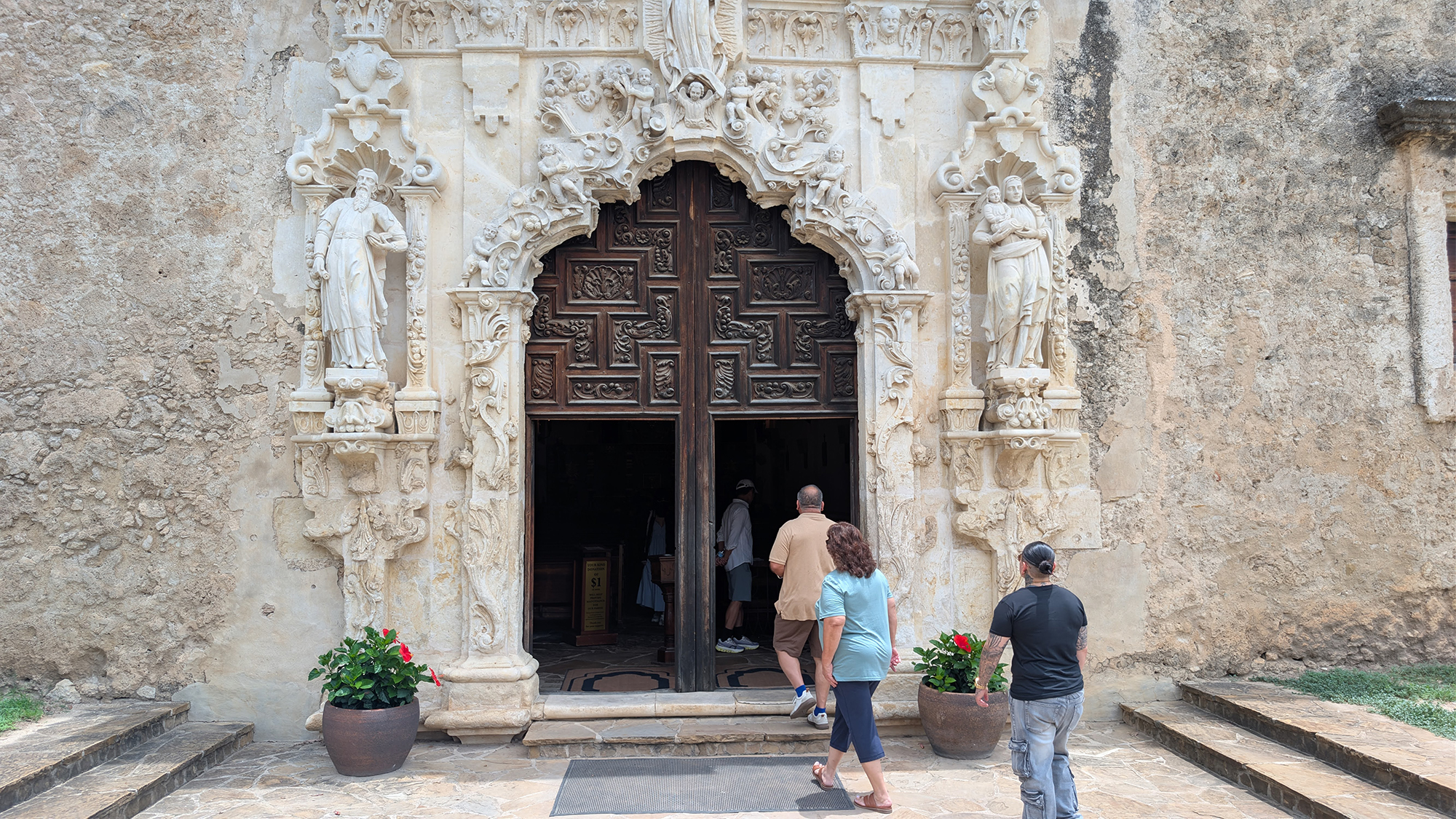
Incorporating the Missions—and all whom it has served—into America's narrative offers a much fuller view of this nation’s history. Image: Jessica Merritt.
On a Sunday morning at Mission San José, a photographer positioned an engaged couple under the historic graffiti of the church's carved stone door. Cyclists passed by on the Mission Reach trail behind the church. Inside, parishioners rose to receive communion. Most visitors saw a historic site, but mission descendants saw their ancestral home.
Walking the mission grounds, the Moreno family—descendants of Damacio de la Cruz, the last Indigenous gobernador (governor) of Mission San José—stopped to greet friends, including other mission descendants. As they did so, Margot, Diana, and Nehemias Moreno weren't moving through an archaeological ruin but through a neighborhood, an active parish, and a family archive.
They paused near the walls at a doorway where de la Cruz lived, and described him as a leader who had cared for his people.
Visitors of San Antonio Missions National Historical Park could easily pass by the doorway without knowing its significance. The same was true of the statue of Fray Antonio Margil de Jesús, often considered the patron saint of Texas and founder of Mission San José, tucked away around the corner from the church.
"Many people miss it," Diana said of the statue. There's been discussion of moving it somewhere more visible.
That question of what's visible and what's overlooked extends beyond a door and statue.
As the U.S. marks 250 years since the signing of the Declaration of Independence, the country decides which people, places, and events define its history. Descendants of the early San Antonio Missions communities—and other mission stakeholders—are working to bring into more prominent public memory the Indigenous communities that built the missions and helped establish the city. And in doing so, whether they know it or not, they are living out the Declaration’s principles: identifying grievances with their existing governance and working together to correct those.
Of course, the Declaration’s signers could not have imagined the Missions as sheltering under their words. Incorporating the Missions—and all whom it has served—into America's narrative offers a much fuller view of this nation’s history.
The Missions in 1776
In 1776, San Antonio was part of New Spain. Mission San José had already stood for more than half a century. Mission Concepción, Mission San Juan, and Mission Espada occupied sites along the San Antonio River.
Indigenous people there lived under the mission system, which was intended to spread Spanish authority and Catholicism while transforming them into subjects of the Spanish crown. Everyday mission life involved skilled labor and worship—and disrupted existing cultures amidst pressure to survive on the colonial frontier.
The Texas cattle economy developed by Tejanos—Hispanic residents of Spanish colonial Texas—and mission Indians, such as those at Rancho de las Cabras, associated with Mission Espada, clashed with Spanish taxes and regulations. A legal battle united local cattlemen and missionaries against the Spanish government when the Spanish crown claimed ownership of wild, unbranded cattle and taxed residents who rounded them up.
After Spain declared war on Great Britain in 1779 to aid the American Revolution, Texas cattlemen and Spanish colonial missions rounded up 10,000 head of cattle to feed Spanish forces in Louisiana. That slight overlap in regional histories reveals another of the many concurrent histories that unfolded across the continent—and that continue to do so today.
"We built the missions that built San Antonio"
For the de la Cruz descendants who led me through their ancestral home of Mission San José, the missions aren't just examples of Spanish architecture in Texas, but the foundation of the city itself.
The mission inhabitants made the missions livable with stonework, farming, ranching, irrigation, and textiles. What became the city of San Antonio developed around the missions and relied on the infrastructure first created by the mission communities.
"We built the missions that built San Antonio," said Nehemias of his ancestors.
Visitors to the missions may admire the missions' beauty without fully seeing the human lives behind them, said Ramón Juan Vasquez, a Spanish mission descendant and the executive director of an organization called the American Indians in Texas at the Spanish Colonial Missions. He says visitors "don't think about the children running, skinning their knees like they do every Sunday morning today when they go to church. You don't see men and women falling in love like they do when they're walking out in the fields and getting married in the church. These people—they all have last names. They're clearly documented in history and in the books.” And, he explains, their families continue to live here today.
Many San Antonio residents live near the missions without realizing their ancestry runs through them. The San Antonio Mission Indian Descendants, led by the descendants of de la Cruz, are developing the Legacy Project to help people understand their connections to mission families.
Supported by local institutions, the project combines genealogy, archival evidence, and sacramental records—identifying families as a way to counter generations of disappearance.
"When we stop talking about our ancestors, that's when they truly disappear," Margot said.
But the Legacy Project is about more than genealogy. It restores the memory of a community that descendants say has often been left out of historical narratives.
"We're still here," Vasquez said. The Morenos echoed the same sentiment while walking through Mission San José. The people who built the missions didn't disappear; their descendants still worship at the churches, live nearby, and work to preserve their history.
Vasquez considers the work of his organization as reversing a narrative of extinction. Even as mission descendants lived in the region, much twentieth-century scholarship classified mission Indians as culturally and biologically extinct.
Brandon Seale, a podcaster, documentarian, and president-elect of the Texas State Historical Association, explained that following Texas independence, Indigenous people generally couldn't own property, vote, or participate in society as citizens. But Tejanos could. As a result, mission inhabitants often chose to be identified as Mexican rather than Indian. He said, "The price of Texas Indian survival is invisibility."
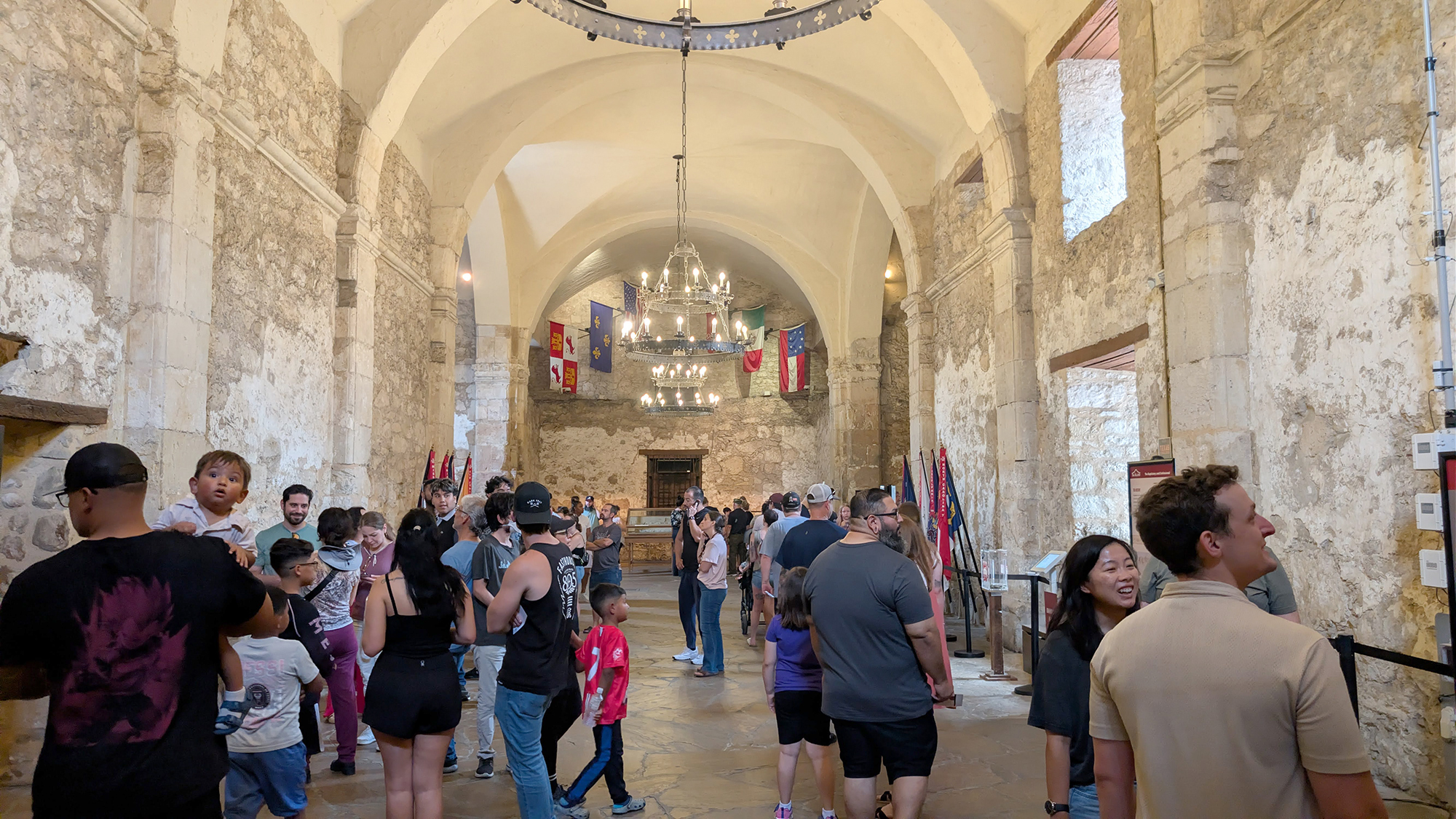
Visitors to the missions may admire the missions' beauty without fully seeing the human lives behind them, said Ramón Juan Vasquez, a Spanish mission descendant and the executive director of an organization called the American Indians in Texas at the Spanish Colonial Missions. Image: Jessica Merritt.
Living Churches, Not Museums
The mission churches span generations. Four of the five San Antonio missions are active Catholic parishes, and many families attend mass and celebrate sacraments in the churches their ancestors helped establish.
Rebecca Simmons, executive director of Las Misiones, part of the Archdiocese of San Antonio focused on preserving the missions, said the descendants helped keep the churches functioning, even when the buildings deteriorated and public attention faded. When sections of Mission San José fell into disrepair, worship continued in a more stable portion of the church. Parish communities at Mission Espada and Mission San Juan worked with clergy to repair damaged buildings.
The missions might not have survived without people remaining on the land and sustaining their relationship with the churches, Simmons said.
Connected by Landscapes
Mission communities depend on more than the churches.
The San Antonio River and the acequia irrigation channels, built by mission inhabitants, were their lifeblood, said Tommy Mitchell, watershed and park operations manager for the San Antonio River Authority. The missions were developed along the river corridor, as the water supported drinking, agriculture, and livestock.
Some mission-era acequias remain operational. The River Authority still diverts water into the San Juan and Espada systems, where families continue to live and farm.
The Mission Reach restoration project has reconnected the missions through trails, public spaces, and restored habitat. More than 20,000 native trees and shrubs and dozens of native plant species were introduced through the restoration, where cyclists and pedestrians can travel along the river and enter mission sites through portals.
Mitchell said Mission Reach isn't an ecosystem that visitors admire from a distance, but one they're invited into.
Many Stewards of Shared Missions
In 2015, the San Antonio Missions became a UNESCO World Heritage Site—a recognition of their architecture, art, acequias, and unusually extensive evidence of the Spanish colonial mission system.
Receiving that designation required coordination across the National Park Service, the San Antonio Catholic Archdiocese, city, state, Bexar County, River Authority, and other local organizations. Their cooperation continues through a management plan that governs preservation, land use, and visitor access.
But residents sought a public story that extended beyond the tangible remains.
Colleen Swain, director of San Antonio's World Heritage Office, remembered the straightforward point of community members: "We're still going to church there." The mission communities wanted visitors to understand the missions as living legacies, not just buildings.
The missions stand apart from many historic sites because they still serve some of their original purposes, Swain said. They are parishes and communities, not museums.
Each stakeholder provides support, but from a slightly different perspective. The mission descendants emphasize remembrance and recognition. The Archdiocese furthers the missions of worship and religious tradition. NPS, the city, and World Heritage officials protect the sites and share their history while preserving public access, while the River Authority maintains an ecological and recreational corridor.
The Battle and the Community
A few miles north of San Antonio Missions National Historical Park, Mission San Antonio de Valero is remembered as the Alamo.
A center of San Antonio history and tourism, the Alamo's exhibits include the mission period but emphasize the 1836 battle, a key point in Texas identity. During the Texas Revolution, the Alamo saw Texian defenders hold the mission against a much larger Mexican army for 13 days before defeat. "Remember the Alamo" became a rallying cry for Texas independence, which was ultimately won at the Battle of San Jacinto. Texas later joined the United States as the 28th state in 1845.
"Battles tend to trump normally functioning civil society in history books," Seale said. Remembering the Alamo battle has a cleaner narrative than that of the missions, with its legacy of centuries of community development.
The Alamo was absorbed into downtown San Antonio relatively early, while the four missions farther south remained distinct communities.
For Vasquez, the emphasis on the battle has problematic consequences, as visitors may leave understanding the battle without realizing the history before 1836, when generations of Indigenous people lived, worked, worshiped, and were buried there. Those lives deserve to be remembered, he said.
An American Story
Every generation decides what it remembers. The Indigenous mission descendants' hope is that when America tells its story, their community is included.
Stone walls and churches make their history visible. In the tradition of the Declaration’s insistence that those who are living far from their government be seen and heard as full citizens with natural rights, the descendants ask America to see all the people who have been here navigating empire, commerce, faith, and survival—including them.
© 2026 Jessica Merritt
Jessica Merritt is a freelance journalist covering travel, food, entertainment, and personal finance who regularly contributes to U.S. News & World Report and other publications.