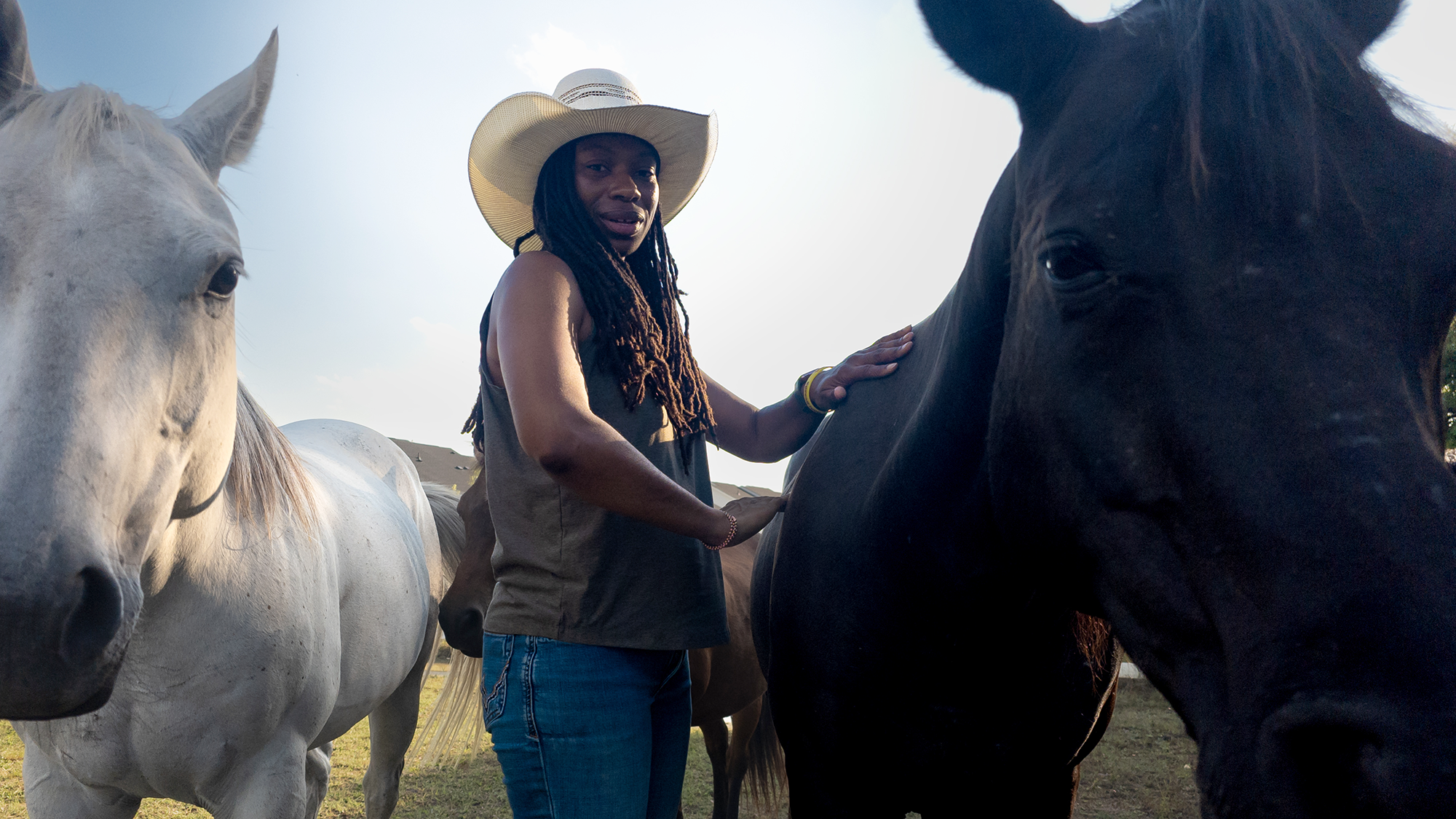
Caitlin Gooch Standing between two of her horses, Ruth and Ardent (Wendell, NC formerly Eagle Rock, NC). Photo: Dare Coulter.
Donal Gooch is not pleased about the trash on his arena floor. “Shit, it’s pitiful,” Donal says.
Donal leans back against his concert stage in Eagle Rock, North Carolina, at the fringes of the ravenously-growing Research Triangle Park. His ringtone blows, the sound of a train horn. He ignores it. Horses swish their tails under loblolly pines, chickens peck at the feet of a gap-toothed barn. Donal stares at hundreds of empty Modelo cans and crushed Styrofoam plates. There’s not enough of them.
“This is terrible,” Donal says. “It means we didn’t make enough money.”
Many people fought to expand the Declaration of Independence, which originally aimed to protect land-owning white men, into a big tent that covers every American. Now pursuing liberty and pushing for a life free from government overreach is, in theory, anybody’s game. Including Donal’s.
Donal came of age in the Black side of Eagle Rock when Eastern Wake County was tobacco country. Now 69, he’s entering his silver years at a time when subdivisions have become the dominant cash crop. Donal’s daughter, Caitlin Gooch, and three of her children live in a house at the other end of the 12-acre plot of land that includes the high-roofed arena, the weathered barn, and a quarter-horse racetrack. The land has been in the family since the 1940s, historically bordering woods and other small farms, much of it owned by distant relatives. Now, just a bare dirt hill and a thin sheet of trees separate it from still-growing subdivisions.
The need to turn a dollar is putting a squeeze on the tight-knit, rural Black culture that raised Donal and Caitlin. North Carolina’s tech and healthcare boom are bringing model homes and warehouses. The growth is also bringing transplants and immigrants—from other states, from Mexico, from India, and beyond—to North Carolina, making a New South. The adjoining woods and fields that once kept community close with farming and horse riding and cookouts are now weighed against the possibility of a financial windfall. Neither Donal nor Caitlin want their family patch to turn into culs-de-sac, so they’ve had to get creative.
Liberty and the pursuit of happiness require a bedrock of financial stability.
With suburbanization compartmentalizing neighbors from each other and cutting out open spaces, the farm’s greatest asset is the land’s use as a gathering space. The Gooches host an annual Black trail ride, horse boarding, food truck rodeos, sporadic horse races. Donal holds rowdy Mexican concerts at the arena twice a month. He says this isn’t because he speaks Spanish, but because he knows how to talk money. ICE raids, which started burning through the country last year, have taken a swing at the concert business’s financial footing. The revenues from the events keep the farm in family hands, and the land gives the Hispanic community a place to gather. But Donal doesn’t have the final say on who attends. The nearby town of Wendell, where the Gooch family cannot vote, sets the rules for how people may gather on their land. The policies of two governments, one local and one federal, influence the Gooch arena’s success at wooing concertgoers.
In summers, Caitlin runs a camp teaching the basics of equestrian care. Year round, she teaches children how to read, with the assistance of her miniature horse Man Man, for her nonprofit Saddle Up and Read. It’s landed her on Good Morning America, but hasn’t brought her any financial security. She still landscapes on the side and used to drive for Uber till the price of gas negated the profits.
Also crammed in are a crooked tower for horse race callers; a boxy affair known as the “boom-boom room” from trail riding parties of yore; a sizable treehouse that Donal used to live in; a horse pasture; a small office decked out with faded racing posters and trophies; a low-slung strip of horse stalls; a “bookstore” loaded with books for Caitlin’s nonprofit; a thicket of woods; and a large garden. Topping it off is a smaller pasture slated to be an open-air arena for bull riding, barrel racing, and other arena games.
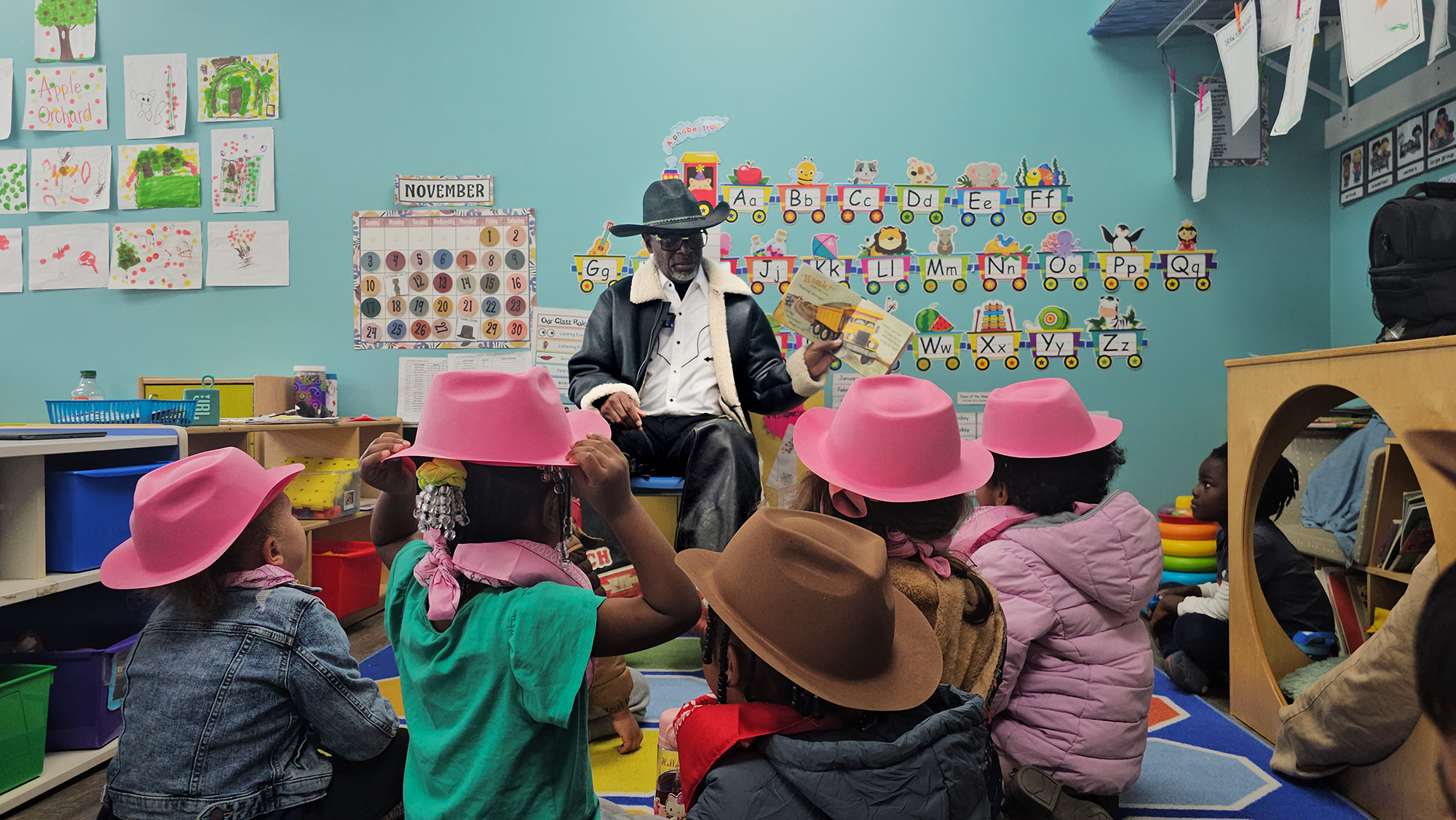
Donal Gooch does story time for a group of kids while dressed in full cowboy gear (Wendell, NC formerly Eagle Rock, NC). Photo: Dare Coulter.
Donal has the restlessness of an American entrepreneur, constantly churning out business ideas. Castaways from these efforts jewel the land. There’s a jumbo restaurant sign reading “Thai Orchid,” replete with a pink flower, although he doesn’t eat Thai food and “nothing with garlic.” There’s a rusted-out toothpaste-green vintage Cadillac convertible that he insists had a cover on it before Caitlin’s goats chewed it clean off; she disputes this. Nowhere to be found are 10 aqua blue porta potties that were taken away in broad daylight.
The land’s small acreage hides a larger cultural footprint. Donal’s side of the family, the Goodsons, has held it since 1944, when three siblings (a stockbroker, a carpenter, a farmer) bought 68 acres from a white family. Other relatives bought bordering land as the years went on. Donal’s wife’s side of the family, the Halls, had owned nearby land for as long as anybody can remember. The register of deeds shows a 1950 title, but no prior purchase date. The two families’ land kissed since before Caitlin’s parents did.
Caitlin used to ride horses down a pasture trail from one side of her family to the other. Two families have had it since before the fall of Jim Crow. It’s a legacy Caitlin is deeply proud of. “Where can you go and find somebody where both sides of their family were in the same area and they both had land?” Caitlin says. “And I’m Black.”
Caitlin squats in small dunes of sawdust, pulls out a pocket knife, and slits the netting off of a hay bale. Her daily routine is split. There’s the quiet she finds in her farm tasks and her gardening. Then there’s the duties of a single mom—crisscrossing the map between three of her daughter’s schools, fussing at her two youngest for scribbling on the walls with crayons, the hamster wheel of laundry and dishes.
She thinks about when their land bled into that of distant relatives and local families, creating an extra-communal space with free reign of the woods. Now, where those woods were, there’s a Sheetz gas station and a medical center and a Publix grocery store. The family now hosts their trail rides in the woods that are left, in a nature preserve down the road.
For decades, the closeness of the community in these woods created a security that the government was not providing, a place for its Black residents to live at peace. Caitlin’s cousin on the Hall side, Annette Holman, 68, fondly recalls childhood summers spent in Eagle Rock, when this community provided a buffer from the prejudice and discrimination that surrounded them. She regrets that her children and grandchildren are facing many of the same issues, but without this foundation.
“All you can do is hope and pray that things change and it get better, but our kids are saying, our grandchildren are saying that it’s not getting any better,” Holman says. “They know that life isn’t fair and things isn’t getting better and you’re judged by the color of your skin and not what you know.”
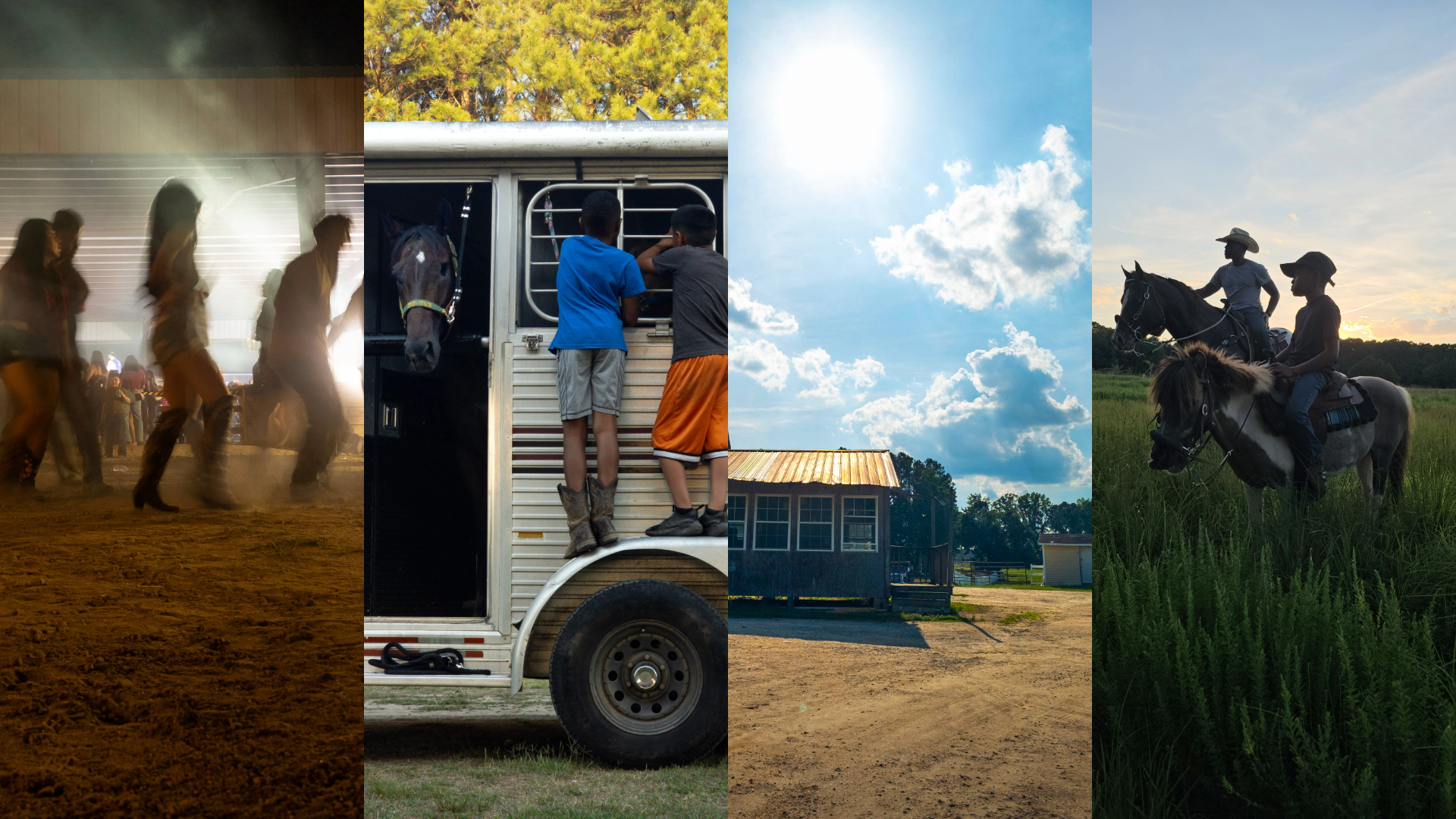
(Left to right) A group of teenagers dancing in a circle outside of Gooch Sports Arena; Harrison Todd's son and his best friend peek in the window of the horse trailer; the barn at Gooch Arena on a sunny day; Harrison Todd and his son on horseback as the sun goes down (Eagle Rock, NC). Photos: Dare Coulter.
The trail between the Goodson and Hall land still exists, but it looks different now. Gone is the classical Southern forest, thick quilts of green stitched with golden light. Now, Caitlin drives past back porches and empty lots and freshly asphalted roads. The car delves into a spit of woods that is still owned as heirs’ property by the Hall side of the family but is now landlocked by development, with no legal entrance or exit point. Caitlin points out an overgrown cabin where family elders used to live, then stops the car to say hello to a yard-long snake wriggling across the path. Her SUV rolls heavily over a curb on the way out.
Like many Americans, Caitlin started learning more about government after the governing process happened to her. There’s no buffer between the side of her house and the freshly planted subdivision. Curious transplants walk onto the farm to gawk at the horses. The time to advocate for a buffer would have been during zoning and permitting meetings in years long gone. Caitlin didn’t know about the zoning meetings. In fact, she says that she hadn’t known the land had been sold until her father told her it was time to move her horses off her distant cousins’ land.
Caitlin now regularly shows up to town halls across Eastern Wake County. With her ancestors excluded from government, she pushes her peers to pull the levers of change however they can. “I don't see anybody going to one unless something happened, and they were like, ‘Well, shoot, I need to pay more attention,’” Caitlin says.
Since the Declaration’s signing, American institutions for social order have included various levels of government as well as nonprofits, religious groups, and all kinds of associations. For many Black communities across the South, the church has often taken pride of place. That’s where you’ll find Donal’s cousin Ron Goodson, 77, sitting beside a crucifixion mural in the basement of Eagle Rock Christian Church. Goodson owns 25 acres across the street from Caitlin’s house, giving him a direct say. Developers keep reaching out, wanting to plop 200 townhomes on the plot for a few million dollars. He holds onto it because he sees it as a bridge between past and future generations.
“If I could get, you know, five and a half million for my property, I would think about it seriously,” Goodson says. “But, if say, a hundred thousand dollars was on the table to not ever develop it, I would take it just like that.”
Goodson says that, with tobacco gone and subdivisions a no-go, he admires how Caitlin and Donal have pushed the land’s possibilities. Giving up the land for a pile of cash would be a conventionally American way to incarnate liberty. Instead, they have used the land to launch other forms of community. That includes the arena Donal built. The Hispanic community’s growth allowed a Black family to hold onto their land—and the Black family’s land symbiotically became a gathering space for a growing immigrant community.
Donal’s arena project grew from another profoundly all-American phenomena: a 1980s cocaine problem.
Donal spent much of that decade as a dancer in nightclubs across the state and up in Washington, D.C., where “you do a couple lines, your ass zooted, and you at your best. You think you are anyway.” The cocaine continued during years as a star car salesman, which he quit because he “got tired of getting fired.” Donal says he had a clear-as-day vision in a 1996 drug treatment stint that he should use his family land for “cowboy entertainment.” In college, Donal founded a saddle club and hosted private parties on the weekends.
In the years after rehab, Donal worked construction, where he saw immigrants outworking everyone else and realized he would not be able to compete.
Instead, Donal aimed for cooperation. He knew cowboys, horses, and entertainment. And he saw a growing Hispanic community with a love for the first two and a need for the third.
In 2003, Donal says he walked up to a Mexican concert promoter, Cuco, at the county fairgrounds in Wilson, a 40-minute drive deeper into tobacco country. Donal said that he had some land where Cuco could throw big concerts. Cuco had spent a dozen years playing accordion and keyboard on tour, and knew the circuit front-and-back. He was skeptical at first, telling his business partner, “I don’t think he’s got shit.” But he decided to check out the land.
The partnership started with coleadero, where vaqueros try to pull bulls down by their tails, a key event in Mexican charrerias, an analog to rodeo. This turned to concerts under the pounding sun, until Donal built an arena to beat the heat. Then the town of Wendell stepped in.
Gooch arena and the farm are bound by Wendell’s Extra Territorial Jurisdiction, which allows the town to enforce its rules outside of its boundaries. While Caitlin and her family aren’t able to vote in Wendell’s elections, the town’s choices—including amplified music only on Saturdays between 1 p.m. and 11:30 p.m. and hiring off duty law enforcement officers for security—are the law of the land. “So, what that means is they can tell us what to do. We don’t have no jurisdiction, we don't have no vote, no nothing in the city of Wendell,” Donal says.
Like the Founding Fathers, Gooch has grievances against an unrepresentative government that gets between him and his money, even if he’s unlikely to start a revolution.
Cuco’s nephew and coworker, Daniel Ponce, is on the road over 45 weekends of the year and talks quick as a man with no time to be tired. He admires Donal’s offering “his family’s farmland for the community to come and have a good time.” Ponce, 38, grew up on the circuit with a promoter father, and views the concerts as a “destressor” for the community to “blow steam from the 45, 60 hour week that they just had.” About Donal, Ponce says, “He might be African American but I think everybody that comes in this place just sees him as another Mexican.”
Business had been booming for Cuco, Ponce, and Hispanic live music. But in 2025, with the second Trump administration, ICE arrests in North Carolina doubled. A few hours away in Charlotte, the largest city in North Carolina, a Bloomberg report found that business in sections of city, from sales to foot traffic remained down half a year after ICE’s citywide “Operation Charlotte’s Web” raids. On the night of this interview, Ponce said his company had just canceled a concert in South Carolina due to ICE activity.
“We’re not gonna penalize somebody or force somebody to come out when they’re afraid,” Ponce says.
Ponce helps arrange touring visas for bands from across Mexico. But since 2025, bands have had trouble securing visas and others have had their visas pulled. The bands still touring stateside raised their rates. At the low end, Gooch arena concerts cost $180,000 to put on, Cuco says. Hiring more expensive bands pushes the number past $300,000. The U.S. government is conducting raids against massive chunks of the American workforce and raising the cost of goods across the board through a foreign war that pokes at the country’s economic balance. Ponce and his concertgoers feel this acutely.
“I’m not only talking about ICE, immigration, and the raids,” Ponce says. “I’m also talking about the economy, the cost of gas, the war that we’re facing overseas, all that’s impacting the economy.”
The concerts are a small-scale economic engine. On quieter nights, Donal says, the arena might sell 1,500 or 2,000 tickets. Other nights, sales climb past 5,500. Donal boasts that on those nights, nearby gas stations sell out of fuel and food, hotels get more bookings, and “everybody makes money off me.” Donal also noted that when raids pick up across North Carolina, construction slows at the Wendell Falls subdivision.
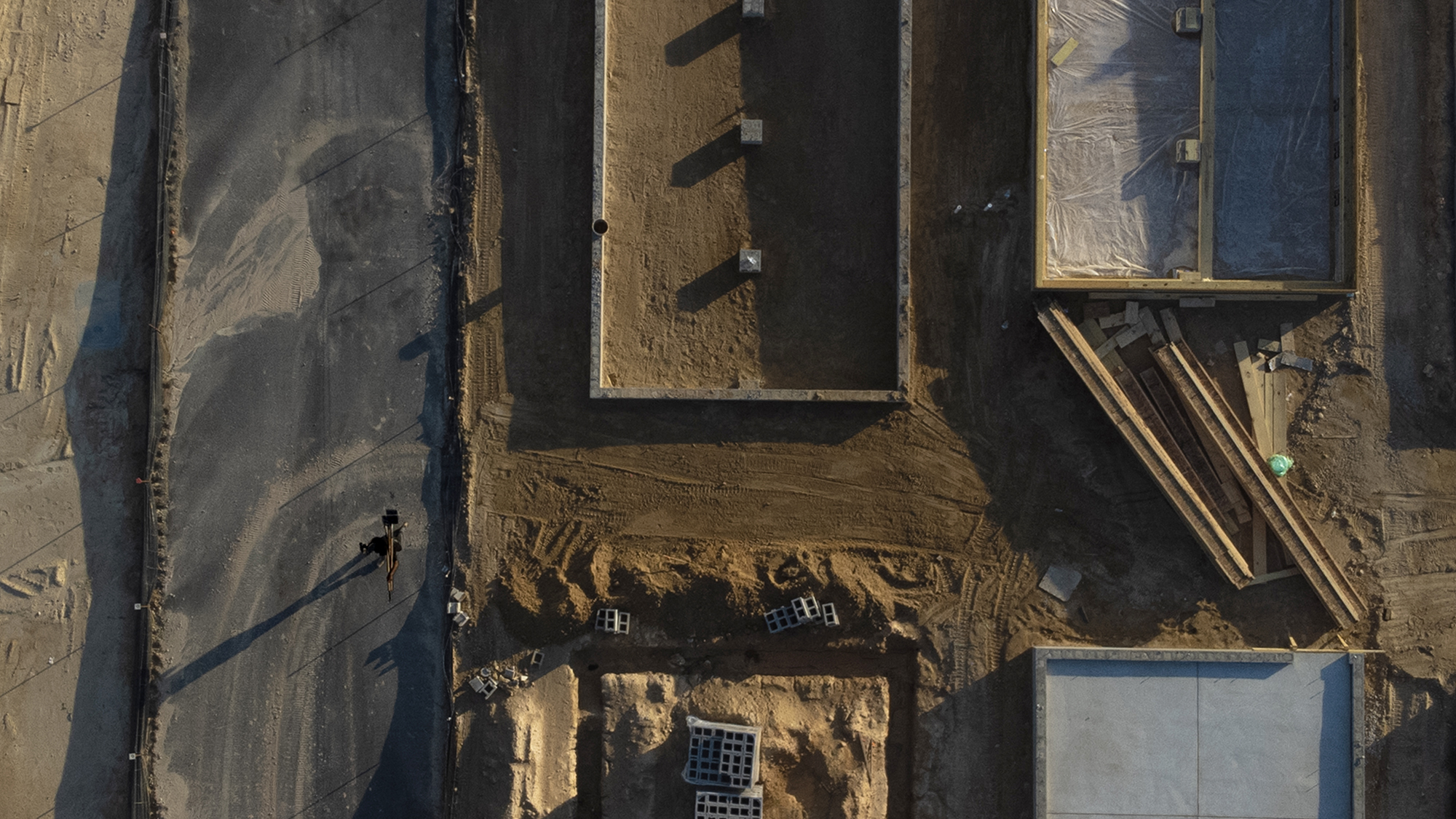
A worker carries shovels and tools over his shoulder as he cleans up the site at the end of the work day; they're working on site in the Wendell Falls development that adjoins Caitlin's home (Wendell Falls, NC). Photo: Dare Coulter.
Juliet Rodriguez, 26, is one of 12 members of her family who work for Donal on concert nights. On non-concert days, members of the Rodriguez family tend horses and work on Gooch’s carousel of side projects. Friends of hers who moved a half-day’s drive to Georgia still show up for every concert.
“Many places we go we always hear about, did you go to Gooch Sports arena?” Rodriguez says.
On the nights before concerts, you can often find three generations of the Rodriguez family sitting far below the high arena roof around a table loaded with takeout. Children run through the forest with water guns. Green and yellow flags from October’s San Judas Tadeo festival hang year-round. Rodriguez says she’s been working on the land for over a decade now. Her family keeps the arena and the farm running, making the concerts and the horse boarding and the land’s many ways of gathering possible. The work gives them the stability to live freely.
“Gooch and his family are really friendly. We just like being here,” Rodriguez says. Harrison Todd, 37, likes being on the farm as well, and says the plot of land has changed his life. Standing by the side of his horse trailer, COUNTRY tattooed on his left bicep, BOY on his right. Todd grew up as one of the “young guns” on the trail riding circuit with Caitlin. The horse boarders renting out the low-slung stalls by the arena are all Mexican. Todd is not surprised by this and appreciates a new form of horse culture he’s seeing, borne out of the growth of Hispanic communities alongside Black ones, in the South.
“I can say it's kind of all one. It's getting to the point now where we all do things together,” Todd says, and pointed toward his son and his son’s friend, who is Mexican. “They like brothers.”
Todd, Caitlin, and Donal all mourn the sense that, more and more, people might attend a trail ride the way they would ride a carousel: looking for entertainment and spectacle, not connecting to a way of life. Caitlin feels uneasy commodifying the culture that raised her. She doesn’t want to see a world of crowded Instagram-ready trail rides and suburban kids who are strangers to the woods around them, so she’s pushing to change her own corner of the world. She hosts her local 4H club, with children lugging buckets of water to the horse stalls. She’s started a summer camp teaching the basics of horse care, which to her is far more important than a child learning how to ride a horse with the same knowledge base they would a bicycle.
“People having an actual connection with horses is more important than people learning how to ride,” Caitlin says.
Having built a social media following, Caitlin is now the most public-facing member of her family. But her viral videos and Vogue profiles haven’t brought financial stability. Caitlin says that a Wake County employee denied her a daycare financial assistance voucher, citing the number of followers on her YouTube channel. Caitlin’s trying to figure out how to preserve her land and her well-being while giving up less of herself and staying financially stable.
Donal keeps forging ahead with his endless stream of new ventures. He recently constructed a V-VIP deck that stands to the right of the Gooch Arena stage and charges a premium for the tickets. He intends to transform an old Baskin Robbins ice cream trailer that’s on his land into a bar. He wants to air condition the "boom-boom room" as the summers grow hotter. He’s planning to start a wedding venue on his land in Middlesex, a 15-minute drive down the road. And he wants to brush the dust off Eagle Rock Downs, the horse-racing track just next to the arena, in full force.
“You can’t retire. You’ll die,” Donal says.
While Donal pursues liberty, Caitlin pursues community—in her own way, living out the Declaration’s insistence that people themselves must decide on the kind of government and civic life they believe will “effect their Safety and Happiness.” Unlike her father, the land’s ongoing metamorphosis doesn’t make Caitlin dream of new business ventures. She’s using it, in her own ways, to create a civic space in ways that the government and other large forces do not provide.
In her online following, she finds a hunger for concrete community. Whether she’s talking children through farm tasks or showing up at their schools with a miniature horse or encouraging her followers to show up at their town halls, she’s constantly pushing others to get involved in creating their own world, socially and civically. She pulls inspiration from the Black Panther Party’s free lunch programs when she hosts events like the 4-H meetings or the new annual Saddle Up and Read Fun Day to bring people together. There’s the rich rural, Black culture that raised her and the immigrant-heavy South that defines her land now. In between are the makings of a new America, one that she hopes to continue shaping.
“Something, somebody has to pull people in,” Caitlin says.
And she’s not waiting for anybody’s permission to start.
© 2026 Cy Neff
This story was co-published and supported by the Economic Hardship Reporting Project. It was also co-published in The Guardian.
Cy Neff is a North Carolina-born-and-raised, Berlin-based freelance writer whose journalism ranges from human-driven features to investigations. Neff and Dare Coulter, the photographer who provided images for this piece, both know the Gooch family personally.
Honoring excellence and leadership. Working across disciplines and divides. Advancing the common good. From 1780 to today.
Our Common Purpose, the Academy's ongoing and bipartisan work to strengthen democracy in 21st century America, produced recommendations, reflections, and reasons to pursue a more perfect reunion.
These initiatives, seeking structural and societal advances, were developed in recognition that a healthy democracy requires both responsive political institutions and a robust civic culture.