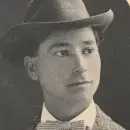
Alexander Lawrence Posey
Alexander Lawrence Posey (1873–1908) was a poet, humorist, journalist, and politician in the Muscogee (Creek) Nation. He served as secretary to the Sequoyah Constitutional Convention and drafted much of the constitution for its proposed Native American state.
Born near Eufaula, Creek Nation in Indian Territory (present-day Oklahoma), Muscogee was his first language. He was educated at Indian University (later Bacone Indian University) in Muskogee, Oklahoma. In 1895, Posey was elected to the lower chamber of the Creek National Council and embarked on a long career of public service, including as administrator to tribal schools. During this time, he worked as superintendent of the Creek Asylum for Orphans at Okmulgee and as superintendent of public instruction for the Creek Nation. He also served as an interpreter for the Dawes Commission.
Posey’s journalistic career began in 1892 when he wrote for the Indian University Instructor and served as the Bacone reporter for the Eufaula Indian Journal. In 1902, he bought the paper and served as its editor until he sold it in 1904. As one of the first Native Americans during the early twentieth century to own a newspaper, he gained national recognition as a journalist who used wit and humor to interest his readers. For several years he published editorial letters known as the Fus Fixico Letters. Narrated by a Creek character named Fus Fixico (meaning “Warrior Bird” or “Heartless Bird”), the letters offered humorous political and cultural commentary written from the perspective and in the dialect of Indian speakers. The letters discussed land allotment, tribal termination, and the threat of impending statehood to Native ways of life.
In addition to journalism and politics, Posey was a poet influenced by writers such as Henry David Thoreau and Robert Burns. Writing under the pen name Chinnubbie Harjo, he published poetry that reflected his love of nature. His verses appeared in Twin Territories: The Indian Magazine and the Eufaula Indian Journal. In 1903, Posey was named poet laureate of the Indian Territory Press Association. Posey died tragically in 1908, when he drowned crossing the floodwaters of the North Canadian River. The Poems of Alexander Lawrence Posey were published posthumously in 1910. In April 2017, the University of Central Oklahoma established the Alexander Lawrence Posey Speaker Series in his honor.
A Testimonial about the significance of Posey by Jason Salsman, the Press Secretary to the Principal Chief of the Muscogee (Creek) Nation and journalist:
I vividly remember driving through the streets of Eufaula with my full-blood Muscogee grandmother as a young boy, and we’d often marvel at some of the history that was still present in the town. One particular day I began to talk about an assignment I was given at school, where we were to pick a subject of the town’s history and research it for a paper. I told her since our daily newspaper, The Indian Journal, was still Oklahoma’s oldest daily editorial, and was still there on Main St., that it seemed like a good place to start. That’s where I first learned about Alexander Posey, the paper’s first editor and founder of the first Indigenous-published daily newspaper in the country. I was fascinated by his humor, his storytelling, and his ability to make conversations come to life with an authenticity in his writings. I learned about the Fus Fixico Letters and how they made literary history that withstood the test of time, and how they were a statement against the romanticized versions and tales of Indigenous peoples, that lacked any semblance of what a real Muscogee would recognize in those days.
As we headed out of town I noticed we were passing by the big white gazebo that was the centerpiece of Posey Park. I mentioned to my grandmother, the park was named after Alexander Posey too. She must have sensed my enthusiasm, and finally couldn’t hold it in any longer. In that typical Muscogee-elder style, she said flatly, “you know he’s kinfolk right?” My eyes lit up. I had heard her say this a million times before, about a million different people. But this was different. On Alexander’s Posey side, there was both Scotch and Muscogee heritage, and we were linked from my grandmother’s maternal side, which were Covey’s. I always knew I was a bit of a humorist and someone that could spin a pretty good yarn as a storyteller. Before, I had never found those traits to be anything special, but now I felt like maybe there was a connection and something to strive for to make myself a future.
I began to write for the paper, I worked at the local radio station, and journalism became my goal. I attended the University of Oklahoma and graduated with a degree in Journalism in 2005. Upon graduation, I heeded the words of my grandmother who always told me, “No matter what you do, make sure you give back to your people.” I felt a calling to return to the Muscogee Nation and make a mark on the community through journalism. I pitched the idea to the Muscogee Communications Department, to get me some camera and editing equipment, and for the first time the tribe would have its own television program, telling its own stories. That grew into the state of Oklahoma’s first and only all-Indigenous news-based format on network television, Native News Today, and we ran strong for 13 years and over 650+ consecutive weekends of episodic television.
Now, I’m the first Press Secretary in the history of the Muscogee Nation, and have served two terms under the administration of Principal Chief David Hill. My grandmother is still here! 90 years old and just as feisty and fierce as ever, and still 100 percent Mvskoke! She got such a thrill to hear that I was being asked to remember Alexander Posey in this way, with this personal touch added to his recognition from the American Academy of Arts and Sciences. And we got to talk more about our ancestors and our deep roots, which always brightens her day. I’m proud that Alexander Posey is kinfolk, but I’m more grateful that his example was there to push me and motivate me to achieve more for our people. I talk to so many people that tell me it meant so much to them to finally see a news show that included OUR stories and what it was like to see Indigenous people represented on television and media all those years. Now we are seeing a renaissance and an awakening with shows like Reservation Dogs and Dark Winds, bringing to life authentic Indigenous communities and stories to a global audience. I can’t help but smile and think of how ol’ Fus Fixico would hardly believe it.