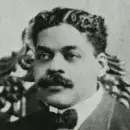
Arturo Alfonso Schomburg
Arturo Alfonso Schomburg (1874–1938) was a historian, writer, curator, and activist, whose collection of literature, art, slave narratives, and other materials of African and African Diasporic history became the basis of the Schomburg Center for Research in Black Culture—a research center of the New York Public Library branch. Today the Schomburg Center holds millions of items and is considered the premier archive dedicated to the history and culture of peoples of African descent.
Born in San Mateo de Cangrejos, Puerto Rico, Schomburg was a Puerto Rican of African descent who moved to New York City at the age of seventeen in 1891. There, he began researching and promoting awareness of the contributions of Afro-Latin Americans and African Americans. He was an important intellectual figure in the Harlem Renaissance. He became a member of the Club Borinquen and an active advocate of the independence of Puerto Rico and Cuba from Spain. In 1892, Schomburg co-founded Las Dos Antillas (The Two Islands), a political club advocating the independence of Cuba and Puerto Rico, and was a member of José Martí’s Partido Revolucionario Cubano. Schomburg’s membership in the Afro-Cuban Masonic lodge El Sol de Cuba Lodge #38 in Brooklyn connected him to transnational Caribbean revolutionary networks that shaped his later Pan-African organizing approach. Over the years, he ascended in Masonic leadership, eventually becoming associate editor of the Masonic Quarterly Review and editor of the Transaction, both Black Masonic journals. In 1918, he became the grand secretary of the Great Lodge of the State of New York. In 1911, with John Edward Bruce, Schomburg co-founded the Negro Society for Historical Research, an institute supporting scholarly efforts that brought together African, West Indian, and Afro-American scholars. In 1914, with Bruce’s sponsorship, Schomburg joined the American Negro Academy, serving from 1920–1928 as the fifth and last president of the first major African American learned society.
In 1926, with funding from the Carnegie Foundation, the New York Public Library purchased Schomburg’s private collection of more than four thousand items for $10,000. This purchase greatly expanded the Division of Negro History, Literature, and Prints at the 135th Street branch, which would later grow into the Schomburg Center. In 1929, Fisk University President Charles S. Johnson invited Schomburg to curate the Negro Collection at the university’s library in Nashville, Tennessee. By the end of Schomburg’s tenure at Fisk he had expanded the library’s collection from 106 items to 4,600. After Fisk, he returned to New York as the curator of his collection at the 135th Street Branch Library. An active member of the Association for the Study of Negro Life and History (today the Association for the Study of African American Life and History), he served as an associate editor of the Journal of Negro History. A residence hall at Stony Brook University is named for Schomburg.