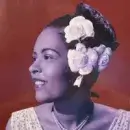
Billie Holiday
Billie Holiday (1915–1959) was a jazz and swing music singer, whose vocal style, strongly influenced by jazz instrumentalists, inspired a new way of manipulating phrasing and tempo. Holiday’s best-known songs include “Don’t Explain,” “Any Old Time,” “You’re My Thrill,” and “Solitude.” Perhaps her most famous song, “Strange Fruit,” was based on a horrific account of a lynching in the South. Many scholars now consider it one of the first protest songs of the civil rights movement.
Born Eleonora Fagan in Philadelphia, Holiday became part of the Harlem Renaissance scene, performing in nightclubs and jazz clubs in New York. At eighteen, she recorded her first record as part of a studio group led by Benny Goodman. Her career quickly grew as she recorded songs with Teddy Wilson and began a long partnership with Lester Young, who gave her the nickname “Lady Day.” In 1938, she joined the Artie Shaw Orchestra, becoming the first Black woman to sing with an all-white band. Throughout the 1930s and 1940s, Holiday achieved mainstream success with labels such as Columbia Records and Decca Records. By the late 1940s, however, her career was overshadowed by legal troubles and drug addiction. After serving a short prison sentence, she returned to the stage with a sold-out concert at Carnegie Hall. She remained a popular concert performer throughout the 1950s, with two additional sold-out shows at Carnegie Hall. In 1956, Holliday published her autobiography, Lady Sings the Blues, co-written with William Duffy. The book became a bestseller for its candid portrayal of her life, and was later adapted into the 1972 film Lady Sings the Blues, starring Diana Ross.
Despite her professional success, Holiday endured numerous personal hardships throughout her life, including struggles with addiction, imprisonment, and bisexual relationships that challenged the social norms of the time. Years of drug and alcohol abuse contributed to the health complications that led to her death in 1959. Holiday won four Grammy Awards, all of them posthumously. In 1985, a statue of Holiday was erected in Baltimore, where she spent much of her youth. Holiday is also commemorated in a mosaic by Romare Bearden at the Upton Metro Station in Baltimore. She is memorialized in Frank O’Hara’s poem “The Day Lady Died” and the song “Angel of Harlem” by U2. In 1994, the U.S. Postal Service honored Holiday with a stamp in its “Legends of American Music” series. Her legacy was also celebrated in the play Lady Day at Emerson’s Bar and Grill, which starred Audra McDonald (elected to the Academy in 2015) and was adapted into an HBO film in 2016.