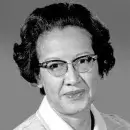
Creola Katherine Johnson
Creola Katherine Johnson (1918–2020) was a mathematician whose calculations of orbital mechanics were critical to the success of the first and subsequent U.S.-crewed spaceflights. During her thirty-three-year career at NASA and its predecessor, the National Advisory Committee for Aeronautics, she earned a reputation for mastering complex manual calculations and helped pioneer the use of computers to perform tasks previously requiring humans. NASA has noted her “historical role as one of the first African American women to work as a NASA scientist.”
Born in White Sulphur Springs, West Virginia, she was educated at West Virginia State College (B.S., summa cum laude, in mathematics and French, 1937) and was the first African American woman to attend graduate school at West Virginia University in Morgantown (1939–1940). At NASA, Johnson’s work included calculating trajectories, launch windows, and emergency return paths for Project Mercury spaceflights, including those for astronauts Alan Shepard and John Glenn (elected to the Academy in 2013), and rendezvous paths for the Apollo Lunar Module and command module on flights to the Moon. Her calculations were also essential to the beginning of the Space Shuttle program. She also worked on plans for a human mission to Mars.
In 2015, President Barack Obama awarded Johnson the Presidential Medal of Freedom. In 2016, she received a NASA Group Achievement Award. She was portrayed by Taraji P. Henson in the 2016 film Hidden Figures. In 2019, the United States Congress awarded Johnson the Congressional Gold Medal and NASA announced the establishment of the Katherine Johnson Independent Verification and Validation Facility in her home state of West Virginia.