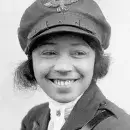
Elizabeth “Bessie” Coleman
Elizabeth “Bessie” Coleman (1892–1926) was a pioneering civil aviator who became the first African American woman and first Native American to hold a pilot’s license. In 1921, she also became the earliest known Black person to earn an international pilot’s license from the Fédération Aéronautique Internationale.
Born in Atlanta, Texas, she attended the Oklahoma Colored Agricultural and Normal University in Langston (now Langston University) for one semester (1910–1911) but left because of financial difficulties. By 1919, she had moved to Chicago, where she worked as a manicurist. Inspired by stories from her brother about women pilots in France while he was there during the war, she decided to pursue aviation. She applied to almost every American flying school but was rejected because of her race and gender. Coleman sought the advice of Robert S. Abbott, the editor and publisher of the Chicago Weekly Defender, who recommended Coleman learn French and apply to French aviation schools. From 1920–1921, she attended France’s most prominent flying school, the Ecole d’Aviation des Frères Caudron at Le Crotoy in the Somme, and completed a seven-month training program. She qualified for her international pilot’s license in June 1921 from the Fédération Aéronautique Internationale (FAI), the only organization at the time whose recognition granted the right to fly anywhere in the world. She continued to train with veteran war pilots in France and Germany.
Coleman returned to the United States in September 1921 and began traveling across the country to perform as a stunt pilot. On September 3, 1922, in a borrowed Curtiss JN-4D Jenny at Curtiss Field on Long Island, Coleman made the first public flight by a Black woman in the United States. Known as “Queen Bess, Daredevil Aviatrix,” Coleman impressed audiences with “loop the loops” and figure 8’s in the sky, exploits captured in newsreels. In February 1923, she was seriously injured in a plane crash in California but returned to flying and parachute jumping after several months of recovery. Speaking at schools and churches, she encouraged African Americans to pursue aviation. Coleman died in 1926 during a rehearsal for an aerial show in Jacksonville, Florida.
Coleman’s legacy inspired the Bessie Coleman Aero Flying Club and the Challenger Pilots Association. Her achievements have been recognized through schools, streets, and institutions named in her honor, including a road at O’Hare International Airport and a public library in Chicago. The U.S. Postal Service issued a stamp honoring Coleman in 1995, and the U.S. Mint issued a quarter with her image in 2023. She was inducted posthumously into the National Women’s Hall of Fame in 2001, the National Aviation Hall of Fame in 2006, and the International Air & Space Hall of Fame in 2014.