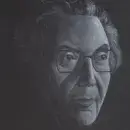
Elizabeth Catlett
Elizabeth Catlett (1915–2012) was a sculptor and printmaker known for portraying experiences of people whose perspectives, like hers, had historically been excluded from artistic representation. Over a career spanning more than six decades, Catlett created sculptures and prints inspired by her experiences as an African American woman, mother, and émigré living in Mexico. Her work combined political activism with personal experience and influenced younger generations of artists, including many associated with the Black Arts Movement of the 1960s and 1970s.
Born in Washington, D.C., she was educated at Howard University (B.A. with honors, 1937) and the University of Iowa (M.F.A., 1940). Catlett also studied ceramics at the School of the Art Institute of Chicago and lithography at the South Side Community Art Center (Chicago) and the Art Students League of New York. In 1946, Catlett received a Rosenwald Fund Fellowship to travel to Mexico to study at the Taller de Gráfica Popular. In 1948, she entered the Escuela Nacional de Pintura, Escultura y Grabado “La Esmeralda” to study wood sculpture with José L. Ruíz and ceramic sculpture with Francisco Zúñiga.
Her political activism in Mexico led to her arrest in 1949 and subsequent surveillance by the U.S. authorities. In 1962, Catlett renounced her American citizenship and became a Mexican citizen. In 1971, after a letter-writing campaign to the U.S. State Department by colleagues and friends, she was issued a special permit to attend an exhibition of her work at the Studio Museum in Harlem; she regained her U.S. citizenship in 2002.
Catlett taught at Dillard University in New Orleans in the 1940s and at the George Washington Carver School in Harlem. She was also affiliated with the Escuela Nacional de Artes Plásticas (now the Faculty of Arts and Design) at the National Autonomous University of Mexico, where she became the first female professor of sculpture and later was appointed head of the sculpture department. Although Catlett had an individual exhibition of her work in Washington, D.C., in 1948, her work gained wider recognition during the social movements of the 1960s and 1970s.
She received numerous honors over her lifetime, including First Prize at the 1940 American Negro Exposition in Chicago, induction into the Salón de la Plástica Mexicana in 1956, a fifty-year traveling retrospective of her work in 1998, an NAACP Image Award in 2009, and a joint tribute after her death from the Salón de la Plástica Mexicana and the Instituto Politécnico Nacional in 2013. In 2017, the University of Iowa named Catlett Residence Hall in her honor.