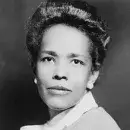
Ella Josephine Baker
Ella Josephine Baker (1903–1986) was a community organizer and political activist who established or played leadership roles in many of the major civil rights organizations of the mid-twentieth century. She is widely recognized as one of the key leaders of the American civil rights and human rights movements. In New York City and in the South, she worked alongside W. E. B. Du Bois (2024 Legacy Recognition honoree), Thurgood Marshall (2024 Legacy Recognition honoree), A. Philip Randolph, Baynard Rustin, and Martin Luther King, Jr. (elected to the Academy in 1966). She also mentored many emerging activists and leaders in the Student Nonviolent Coordinating Committee (SNCC), such as Diane Nash, Stokely Carmichael (later Kwame Ture), and Bob Moses.
Born in Norfolk, Virginia, and raised in Littleton, North Carolina, she was educated at Shaw University in Raleigh, North Carolina (B.A., 1927, valedictorian). After moving to New York, Baker joined the staff of the National Association for the Advancement of Colored People (NAACP) in 1938, first as a field secretary and later as national director of the NAACP’s various branches. Unhappy with the bureaucratic nature of the NAACP and newly responsible for the care of her young niece, she resigned from her director position in 1946 but worked with the New York branch to integrate local schools and improve the quality of education for Black children.
Inspired by the historic bus boycott in Montgomery, Alabama, in 1955, Baker cofounded the organization In Friendship to raise money for the civil rights movement in the South. In 1957, she met with a group of Southern Black ministers as they were forming the Southern Christian Leadership Conference (SCLC) to coordinate reform efforts throughout the South. Martin Luther King, Jr. served as the SCLC’s first president and Baker served as associate director. She left the SCLC in 1960 to help student leaders of college activist groups organize the Student Nonviolent Coordinating Committee. With her guidance and encouragement, SNCC became one of the foremost advocates for human rights in the country and a model for activism.
Her influence was reflected in the nickname Bob Moses gave her, “Fundi,” a Swahili word meaning a person who teaches a craft to the next generation. From 1962–1967, Baker worked for the Southern Conference Education Fund (SCEF). In 1967, Baker returned to New York City, where she collaborated with Arthur Kinoy and others to form the Mass Party Organizing Committee. In 1972, she traveled the country in support of the “Free Angela” campaign, advocating for Angela Davis. Baker also supported the Puerto Rican independence movement and spoke out against apartheid in South Africa.
Having confronted chauvinism across her career, she worked with a number of women’s groups, including the Third World Women’s Alliance and the Women’s International League for Peace and Freedom. She was honored after her death in several ways: She was inducted into the National Women’s Hall of Fame in 1994, the Ella Baker Center for Human Rights in Oakland, California, was founded in 1996, a U.S. postage stamp was issued in her honor in 2009, and the University of California, Santa Barbara established a visiting professorship in her name in 2014. The vocal group Sweet Honey in the Rock memorialized her with “We Who Believe in Freedom,” which has become a movement anthem.