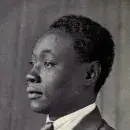
Festus Claudius “Claude” McKay
Festus Claudius “Claude” McKay (1890–1948) was a key figure in the Harlem Renaissance in the 1920s. His work ranged from vernacular verse celebrating working-class life in Jamaica to poems and novels that protested racial and economic inequities. His philosophically ambitious fiction, including tales of Black life in both Jamaica, America, and Europe, addresses instinctual/intellectual duality, which McKay thought central to the Black individual’s efforts to cope in a racist society.
Born in Sunny Ville, Jamaica, McKay apprenticed as a woodworker at age seventeen but soon left to work as a constable in Kingston, the Jamaican capital. For his poetry collection Songs of Jamaica (published in London, 1912), McKay received an award and stipend from the Jamaican Institute of Arts and Sciences. He used the money to finance a trip to America. He enrolled at the Tuskegee Institute (now University), where he studied for approximately two months before transferring to Kansas State College. In 1914, he left school entirely for New York City and worked various jobs. In 1917, under the pseudonym Eli Edwards, McKay published two poems in the periodical Seven Arts. Critic Frank Hattis admired his work and included some of McKay’s other poems in Pearson’s Magazine. Among McKay’s most famous poems from this period is “To the White Fiends,” a vitriolic challenge to white oppressors. A few years later, McKay befriended Max Eastman, communist sympathizer and editor of the magazine Liberator, in which McKay published “If We Must Die,” which defended Black rights and called for resistance against prejudice and abuse. In 1920, he published his third verse collection, Spring in New Hampshire, notable for containing “Harlem Shadows,” a poem about the plight of Black sex workers in an urban environment. McKay returned to the United States in 1921 and involved himself in various social causes. In 1922, he published Harlem Shadows, a collection of many of his most acclaimed poems—including “If We Must Die”—which assured his stature as a leading member of the Harlem Renaissance.
He redoubled his efforts on behalf of Blacks and laborers by his involvement in the Universal Negro Improvement Association and produced several articles for its publication, Negro World. He also traveled to the Soviet Union and attended the Communist Party’s Fourth Congress. His novel, Home to Harlem (1928), perhaps his most recognized title, concerning a Black soldier, became the first commercially successful novel written by a Black author. His next novels included Banjo: A Story without a Plot (1929), about a Black vagabond living in the French port of Marseilles, and Banana Bottom (1933), in which McKay presented a more incisive exploration of the Black individual’s quest for cultural identity in the face of racism.
McKay became an American citizen in 1940, and moved in 1944 to Chicago, where he converted to Catholicism. His honors include the 1912 Musgrave Medal and the 1929 Harmon Foundation Award for Harlem Shadows. In 1977, the government of Jamaica named Claude McKay the national poet and posthumously awarded him the Order of Jamaica for his contributions to literature. Two works of McKay’s fiction were published posthumously: Amiable With Big Teeth: A Novel of the Love Affair Between the Communists and the Poor Black Sheep of Harlem (written in 1941, published in 2017), and the novella, Romance in Marseille (written in 1933, published in 2020).