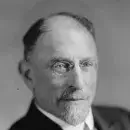
Henry Morgenthau, Sr.
Henry Morgenthau, Sr. (1856–1946) was a lawyer, businessman, and the U.S. Ambassador to the Ottoman Empire during World War I. Morgenthau was one of the most prominent Americans who spoke out against the Greek (1913–1923) and Armenian (1915–1917) genocides.
Born in Mannheim, Baden (now Germany), he emigrated with his family to the United States in 1865 and was educated at City College of New York and Columbia Law School (LL.B., 1887). Morgenthau was a successful lawyer, amassed a fortune through real estate investments, and served as a leader of the Reform Jewish community in New York. In 1899, he left his law practice to become president of the Central Realty, Bond & Trust Company. He was president of the Henry Morgenthau Company from 1905–1913 and active in the Democratic Party, serving twice as chairman of its finance committee during Woodrow Wilson’s (elected to the Academy in 1911) 1912 and 1916 presidential campaigns.
In 1913, President Wilson appointed him U.S. Ambassador to the Sublime Porte (Turkey). After the outbreak of World War I, Morgenthau represented the interests of several Allies in Constantinople. He held high-level meetings with the leaders of the Ottoman Empire to highlight the treatment of the Armenians, but his appeals were ignored. Morgenthau and several other Americans then formed the Committee on Armenian Atrocities (later renamed the Near East Relief) to raise funds for the Armenian victims. Morgenthau ensured that The New York Times covered the massacres. He resigned the ambassadorship in 1916.
In June 1917, Felix Frankfurter (elected to the Academy in 1932) and Morgenthau were sent on a secret mission to explore the possibilities of detaching Turkey from the Central Powers, but the British government learned about the mission and, through Chaim Weizmann, prevented the mission from going forward. At the Paris Peace Conference in 1919, Morgenthau advised on Eastern Europe and the Middle East. A key figure in organizing, leading, and fundraising for the American National Red Cross, he also served as chairman of the Greek Refugee Settlement Commission in 1923, led a mission investigating abuses against Poland’s Jews (Morgenthau Commission), and headed the League of Nations commission that resettled Ottoman Greeks in Greece.
In 1933, he was the American representative at the Geneva Conference. Morgenthau authored several books, including Ambassador Morgenthau’s Story (1918), All in a Lifetime (1922), My Trip Around the World (1928), and I Was Sent to Athens (1930). His numerous honors include Grand Officer of the Legion of Honor, Honorary Knight of the Grand Cross, Civil Division, Order of the British Empire, and the Order of the Holy Savior of Greece.