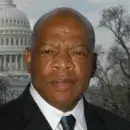
John Robert Lewis
John Robert Lewis (1940–2020) grew up on a farm near Troy, Alabama, the son of sharecroppers, in a world that told him at every turn what he could not do. He found a different answer in faith and in the examples of people he encountered at a young age. Meeting Rosa Parks when he was seventeen and Dr. Martin Luther King, Jr. at age eighteen left a mark on him that never faded. He was ordained a Baptist minister when he was eighteen, and he carried that calling not as a title, but as a way of moving through the world into every fight he picked for the rest of his life. That fight started early.
As a student in Nashville, Lewis threw himself into the sit-in movement of 1960, then became one of the original thirteen Freedom Riders in 1961, facing down mob violence to challenge segregated interstate travel. By age twenty-three, he was chairman of the Student Nonviolent Coordinating Committee (SNCC) and the youngest person to speak at the 1963 March on Washington. As one of the era’s defining voices, he stood alongside Dr. King as one of its “Big Six” organizers. Then came Selma. On March 7, 1965, Lewis led marchers across the Edmund Pettus Bridge, where state troopers beat him and fractured his skull in the assault that became known as Bloody Sunday. He kept marching. The footage of that day helped move a nation and push the Voting Rights Act of 1965 into law. But for Lewis, it was never just a moment in a textbook. It was a debt he spent the rest of his life trying to repay, registering voters, building institutions, and insisting that ordinary people had the power to bend the arc of the country.
He studied at American Baptist Theological Seminary and Fisk University, then spent years as director of the Voter Education Project, helping add nearly four million minority voters to the polls. From there, public service became his life’s second chapter: an at-large seat on the Atlanta City Council in 1981, and in 1986, election to represent Georgia’s 5th Congressional District, a seat he would hold for seventeen terms and thirty-three years. In the House of Representatives, he became one of its moral anchors and the conscience of Congress. He was a leader within the Democratic Party, but also a pillar of wisdom the institution turned to when the stakes went beyond party lines. He fought for the renewal and protection of the Voting Rights Act decade after decade, championed civil rights and health care legislation, and pushed colleagues to see policy not as abstraction but as a measure of who gets to live with dignity in this country.
Lewis never stopped telling his story and the movement’s story. His 1998 memoir, Walking with the Wind, written with Mike D’Orso, won the Robert F. Kennedy Book Award, the Anisfield-Wolf Book Award, the Christopher Award, and the Lillian Smith Book Award, and was named a New York Times Notable Book. In 2013, he became the first member of Congress to publish a graphic novel, with the bestselling March trilogy—a deliberate choice to reach young readers in a language they understood, because he believed the work of “getting in good trouble” was theirs to carry forward, too. The honors that followed include the Wallenberg Medal, the Four Freedoms Award, the Profile in Courage Lifetime Achievement Award, the Presidential Medal of Freedom in 2011, and the Congressional Gold Medal in 2016.
When he died in 2020, he became the first African American lawmaker to lie in state in the U.S. Capitol Rotunda. Atlanta renamed a stretch of road the John Lewis Freedom Parkway, and a high school once named for a Confederate general became John R. Lewis High School—small, visible signs of a country still working through the very history he gave his life to. John Lewis liked to say that freedom is not a state; it is an act. He spent sixty years proving it.