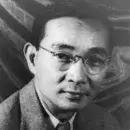
Lin Yutang
Lin Yutang (1895–1976) was a prolific writer in both Chinese and English, known for introducing a humorous prose style to modern Chinese literature and for bridging Chinese and Western cultures, most notably through My Country and My People (1935) and his English translations of classic Chinese texts. As a linguist, he compiled a series of ESL textbooks for Chinese learners in the 1930s and later produced an English-Chinese dictionary in the 1970s. As an inventor, he designed a Chinese typewriter, patented in the United States in 1952, though never mass-produced. From 1940–1973, Lin received six nominations for the Nobel Prize in Literature.
Born in Fujian Province in China, he was educated at St. John’s University in Shanghai (B.A., 1916), Harvard University (graduate study in comparative literature, 1919–1920), and the University of Leipzig in Germany (Ph.D. in philology, 1923). From 1923–1926, Lin was a professor of English at Beijing University, where he supported student protests against the Chinese government’s weak response to foreign aggression and became involved in street fights alongside his students. When he learned that he was on a list of fifty radical professors who were to be arrested and killed, he fled south and taught at Amoy University (now Xiamen University) and in Hankou in 1926 and 1927. For six months in 1927, Lin served as assistant to the minister of foreign affairs in the Nationalist government before abandoning active politics, moving to Shanghai in 1928, and devoting himself to writing. In 1932, he founded a humor magazine, Lunyu banyuegan (Analects Fortnightly), which became one of the most popular magazines in China, especially among college students. In 1934 and 1935, Lin started two other magazines in which he encouraged individualistic expression through brief informal essays. The irony and sarcasm with which Lin commented on life and politics in China won him the title Master of Humor and also provided a technique for social criticism that kept him out of jail. Lin satirized the Nationalist government, its Communist critics, and traditionalists longing to retreat into the imperial past, angering all parts of the political spectrum.
In 1935, Lin published the first of his many English-language books, My Country and My People. It was widely translated and for years was regarded as a standard text on China. The following year he moved to New York City. In 1939, he published his renowned English novel Moment in Peking and in 1942, The Wisdom of China and India. During World War II, Lin devoted much time to United China Relief. From 1954–1955, Lin served briefly as president of Nanyang University in Singapore. A member of the Academia Sinica as foreign language editor and research fellow in philology, he was also the inventor of an index system for Chinese characters and aided in the formulation of a Romanization system of written Chinese. In 1966, Lin left the United States for Taiwan. On the island and after moving to Hong Kong in the early 1970s, he concentrated on his lifelong ambition to produce a Chinese-English dictionary of modern usage, which was finally published in 1972.