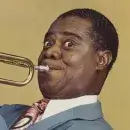
Louis Armstrong
Louis Daniel Armstrong (1901–1971), nicknamed “Satchmo,” was a jazz trumpeter and vocalist and among the most influential figures in jazz and American popular music. His numerous awards include the Grammy Award for Best Male Vocal Performance for Hello, Dolly! in 1965 and a posthumous Grammy Lifetime Achievement Award in 1972. He was inducted into the DownBeat Jazz Hall of Fame, the Rock and Roll Hall of Fame, and the National Rhythm & Blues Hall of Fame, among others.
Born in New Orleans, Armstrong dropped out of school at age 11 to begin working for the Karnofsky family to help support his mother and sister. In 1913, he was arrested and sent to the Colored Waifs Home, where he learned to play cornet and eventually became leader of the home’s brass band. Armstrong was mentored by the city’s top cornetist, Joe “King” Oliver. After Oliver moved to Chicago in 1918 as part of the Great Migration, Armstrong took Oliver’s place in trombonist Kid Ory’s popular jazz band. In 1919, he spent the first of three seasons performing on Mississippi riverboats. Armstrong followed Oliver to Chicago in 1922 to play second cornet in Oliver’s Creole Jazz Band. In November 1925, Armstrong began his most influential series of recordings with his studio groups, the Hot Five and later the Hot Seven. Between 1925 and 1928, Armstrong emerged as a preeminent jazz soloist and vocalist, helping to popularize scat singing on his 1926 recording of “Heebie Jeebies.” Having switched to the trumpet in this time, Armstrong moved from Chicago to New York City in 1929 and performed “Ain’t Misbehavin’” in the theatre review Connie’s Hot Chocolates.
As one of the first Black pop stars, Armstrong spent the first half of the 1930s touring America and Europe as a trumpet soloist accompanied by big bands. In 1936, Armstrong became the first Black jazz musician to publish an autobiography, Swing That Music, and the first Black actor to receive featured billing in a Hollywood film with his role in Pennies from Heaven; Armstrong would go on to appear in over thirty films throughout his career. In 1937, he became the first African American to host a nationally sponsored radio show when he took over the Fleischmann’s Yeast Show for thirteen years. In 1947, Armstrong formed an integrated small group, the All Stars, which included renowned jazz musicians such as pianist Earl Hines and trombonist Jack Teagarden.
His overseas tours in the late 1940s, 1950s, and 1960s earned him the nickname “Ambassador Satch.” The U.S. State Department sent him on a tour of Africa in 1960 as a “Jazz Ambassador.” This was three years after Armstrong put his career on the line to speak out against racial injustice, criticizing President Dwight Eisenhower and the U.S. government for the way they handled the “Little Rock Nine” high school integration crisis in 1957. In 1964, Armstrong’s single of “Hello, Dolly!” knocked The Beatles off the top of the charts and became the biggest selling recording of his lifetime. Three years later, he recorded “What a Wonderful World,” which has become Armstrong’s most iconic recording, certified 5x Platinum in 2023. Queens College opened the Louis Armstrong Archives in 1994 and the Louis Armstrong House Museum in 2003. In 2001, New Orleans’s main airport was renamed Louis Armstrong New Orleans International Airport. In 2002, Louis Armstrong’s Hot Five and Hot Seven recordings (1925–1928) were preserved in the U.S. National Recording Registry.