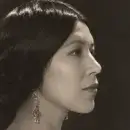
Mary Alice Nelson (Molly Dellis, Molly Spotted Elk)
Mary Alice Nelson (Molly Dellis or Molly Spotted Elk) (1903–1977) was a Penobscot dancer, actress, and writer renowned for her traditional dances and performances in vaudeville and film—notably the 1930 silent movie The Silent Enemy—that led to acclaim in both the United States and Paris.
Born on Indian Island, Maine, she learned traditional Penobscot legends and dances and danced for tourists, while also studying ballet in Bangor. She attended Swarthmore Preparatory School and the University of Pennsylvania, where she studied anthropology for three semesters, from 1924–1925. While living with the family of anthropologist Frank G. Speck, she contributed to Speck’s classic study of her tribe, Penobscot Man (1940). After moving to New York, she took the stage name Molly Spotted Elk and gained fame in the 1920s and 1930s as a talented performer in vaudeville and film, most notably starring as Neewa in The Silent Enemy (1930), a silent-film docudrama depicting the harsh winter faced by a pre-Columbian Ojibwe community.
Known for performing both traditional and popular dances in vaudeville troupes, chorus lines, Wild West shows, and nightclubs, she combined traditional culture with modern performance. Dellis/Spotted Elk is the author of Katahdin: Wigwam’s Tales of the Abnaki Tribe, a collection of twenty-three legends and traditional tales first published in 2003 by the Maine Folklife Center. This publication includes A Dictionary of Penobscot and Passamaquoddy Words with French and English Translations, a scholarly work that documents the legacy of Wabanaki language and culture. She also wrote poetry, adventure stories, and literary fiction.
In 1931, she was the American Indian representative to the Ballet Corps at the International Colonial Exposition in Paris, France. She also worked as a journalist during the Paris expo, writing a long account of her experiences for a Portland, Maine, newspaper. In France, she married Jean Archambaud, a journalist for Paris Soir, and traveled between France and the United States. In 1938, Elk and her daughter moved back to Paris to be reunited with Archambaud, but their reunion was brief. Following the Nazi invasion during World War II, she and her daughter were forced to flee German-occupied France. They became separated from Archambaud and never saw him again. Together mother and child crossed the Pyrenees Mountains on foot to Spain. From there they returned to the United States, where Elk spent the rest of her life on the Penobscot Reservation.
Her work in dance across two continents, in film, and in documenting Penobscot legends and language served as an important bridge between Western and Indigenous cultures, helping to break the stereotypes that dominated her time.
Reckoning with Academy History
The Legacy Honoree distinction is an opportunity to elevate people who should have been better recognized and lauded in their lifetimes. It is one way the Academy reckons with its past in general. More specifically, it is important when honoring Molly Spotted Elk that the Academy acknowledge the decades-long involvement of James Bowdoin – who was the Academy’s first president – as a government leader who contributed to and at times presided over aggression against the native populations of Massachusetts, including the Penobscot. Work is underway at the Academy to share legacies of our historic leaders that include their accomplishments and their failings. Read more.