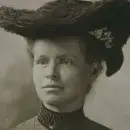
Nettie Maria Stevens
Nettie Maria Stevens (1861–1912) was a pioneering geneticist who discovered sex chromosomes.
Born in Cavendish, Vermont, she was educated at Westfield Normal School (now Westfield State University, 1881–1883), Stanford University (B.A., 1899; M.A. in biology, 1900), and Bryn Mawr College (Ph.D. in cytology, 1903). Her graduate work included a year of study (1901–1902) at the Zoological Station in Naples, Italy, and at the Zoological Institute of the University of Würzburg, Germany. Following the completion of her Ph.D., she remained at Bryn Mawr as a research fellow in biology for a year, as a reader in experimental morphology for another year, and as an associate in experimental morphology from 1905 until her death in 1912.
In 1904–1905, Stevens was awarded a postdoctoral research assistantship at the Carnegie Institute of Washington, which published her major sex determination work in the two-part monograph, “Studies in Spermatogenesis” (1905 and 1906). In 1908, Stevens received the Alice Freeman Palmer Fellowship from the Association of Collegiate Alumnae, now the American Association of University Women. During that fellowship year, Stevens conducted research again at the Zoological Station in Naples and at the University of Würzburg, in addition to visiting laboratories throughout Europe. At Bryn Mawr, Stevens bred and studied Drosophila melanogaster and worked with fruit flies as subjects of her research for some years before her mentor Thomas Hunt Morgan (elected to the Academy in 1928) adopted them as his model organism.
After her untimely death, her male contemporaries Morgan and Edmund Beecher Wilson (elected to the Academy in 1902) were credited with her scientific breakthroughs, and Morgan received the Nobel Prize in 1933 for her discovery of sex chromosomes. Her record of thirty-eight publications includes several major contributions that advanced the emerging concepts of chromosomal heredity. The data from her experiments led her to conclude that chromosomes have a role in sex determination during development. As a result of her research, Stevens provided critical evidence for Mendelian and chromosomal theories of inheritance. In 2017, Westfield State University named the Dr. Nettie Maria Stevens Science and Innovation Center in her honor.