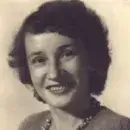
Tatiana Avenirovna Proskouriakoff
Tatiana Avenirovna Proskouriakoff (1909–1985) was an archaeologist who contributed significantly to the deciphering of Maya hieroglyphs. A true pioneer of Maya archaeology, she stood out as a woman in a field dominated by men.
Born in Tomsk, Russia, she came to the United States in 1916, became a U.S. citizen in 1924, and was educated at Pennsylvania State College School of Architecture (now Pennsylvania State University; B.S. in architecture, 1930) and the University of Pennsylvania (graduate study). In 1936–1937, she took part in two seasons of an archaeological expedition sponsored by the University of Pennsylvania Museum to Piedras Negras (Guatemala). In 1939, she made scientific trips to Copán and Chichen Itza. From 1940–1958, she was a staff member of the Carnegie Institute and developed methods of dating ancient Mayan monuments based on the peculiarities of the fine arts style. From 1950–1955, she worked at the excavations of Mayapan. In 1958, she moved to the Peabody Museum at Harvard University, where she worked until her retirement in 1977.
Proskouriakoff’s most significant scientific contribution is the consistent application of the structural method to Mayan inscriptions of the classical period, in which she proved that historical events were recorded on the monuments. She recognized that inscriptions on Maya monuments were not exclusively calendrical and astronomical in nature but rather that they were historical records of events in the life of historical characters.
Her work laid a solid foundation for understanding Mayan historical texts and reconstructing the political history of Mayan city-states. She also revolutionized Maya scholarship by establishing a method of dating Maya monuments that was based on morphology and sculptural style rather than on an examination of aesthetic values. Through a systematic and rigorous analysis of approximately four hundred monuments that included inscriptions with dates, she put together a process to date any monument without an inscribed date to within twenty or thirty years. In 1974, she prepared a catalog of a thousand jade products from the Sacred Cenote at Chichen Itza, kept in the Peabody Museum. Proskouriakoff worked for over twenty years on the consolidated history of the Maya, which was published posthumously in 1994.
Proskouriakoff was a member of the American Philosophical Society (1981) and the American Anthropological Association. She was honored with the Order of the Quetzal, Guatemala’s highest honor, in 1980.