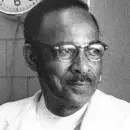
Vivien Theodore Thomas
Vivien Theodore Thomas (1910–1985) rose above poverty without any education beyond high school to become a cardiac surgery pioneer and a teacher of operative techniques to many of the country’s most prominent surgeons. Along with surgeon Alfred Blalock (elected to the Academy in 1955) and cardiologist Helen B. Taussig (elected to the Academy in 1957), he played a major role in developing a procedure now called the Blalock–Thomas–Taussig shunt that is used to treat blue baby syndrome (cyanotic heart disease). He served as a supervisor of the surgical laboratories at Johns Hopkins for thirty-seven years. In 1976, he was named an Instructor of Surgery in the Johns Hopkins School of Medicine.
Born in Lake Providence, Louisiana, Thomas graduated from Pearl High School in Nashville in 1929 and learned carpentry from his father. After working as a carpenter at Fisk University, he became a surgical research assistant for Dr. Blalock at Vanderbilt University. Together they did groundbreaking research into the causes of hemorrhagic and traumatic shock. This work later evolved into research on crush syndrome, which saved the lives of thousands of soldiers during World War II. In hundreds of experiments, the two disproved traditional theories that held that shock was caused by toxins in the blood. When Blalock was offered the position of Chief of Surgery at Johns Hopkins in 1941, he requested that Thomas accompany him. In the Johns Hopkins lab, because no instruments for cardiac surgery yet existed, Thomas adapted the needles and clamps used in the animal lab to treat blue baby syndrome. During the surgery, at Blalock’s request, Thomas stood on a step stool beside him, guiding him step by step through the procedure, which Thomas had performed hundreds of times on dogs, while Blalock had done it only once as Thomas’s assistant. Within a year, the operation known as the Blalock–Thomas–Taussig shunt had been performed on more than two hundred patients at Johns Hopkins.
Thomas’s surgical techniques included one he developed in 1946 for improving circulation in patients whose aorta and pulmonary artery were transposed, a complex operation called an atrial septostomy. After Blalock’s death in 1964, Thomas remained at Johns Hopkins for another fifteen years. As director of Surgical Research Laboratories, he mentored numerous African American lab assistants and Hopkins’ first Black cardiac resident, Levi Watkins, Jr. (2026 Legacy Recognition honoree), assisting him with his pioneering work on the automatic implantable defibrillator. After working at Johns Hopkins for thirty-seven years, Thomas was appointed to the faculty of the School of Medicine as Instructor of Surgery.
In 2020, Johns Hopkins Children’s Center opened the Blalock–Taussig–Thomas Pediatric and Congenital Heart Center, bringing together specialists in pediatric cardiology, cardiac surgery, and anesthesiology. Several awards continue Thomas’s legacy: the Vivien Thomas Young Investigator Award, given by the Council on Cardiovascular Surgery and Anesthesiology since 1996; the Vivien Thomas Scholarship for Medical Science and Research, established by the Congressional Black Caucus Foundation in 1993 and sponsored by GlaxoSmithKline; the Vivien T. Thomas Medical Arts Academy, opened by the Baltimore City Public School System in 2004; and the Vivien T. Thomas Award for Excellence in Clinical Research, created by Vanderbilt University Medical Center.