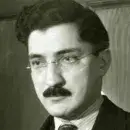
William D’Arcy McNickle
William D’Arcy McNickle (1904–1977) was a prolific fiction writer and historian, as well as a leading advocate for tribal sovereignty and self-determination. He is widely regarded as one of the most important intellectual and political figures of twentieth-century Native America.
Born in St. Ignatius, Montana, on the Flathead Nation of the Confederated Salish and Kootenai Tribes, McNickle was educated at the University of Montana (1921–1924) and at the University of Oxford (1925–1926). Back in the United States, he secured a position with the Works Progress Administration in 1935 and with the Office of Indian Affairs in 1936. At the same time, he pursued his dream of becoming a writer. He published his first novel, The Surrounded, in 1936, which offers a poignant portrayal of Indigenous struggle and survival and became a key work in the American Indian literary renaissance. Since its republication in 1978, it has remained continuously in print. McNickle’s involvement in Indigenous politics deepened, as did his engagement in community development, education, and capacity building. He was a founding member of the National Congress of American Indians in 1944. In 1952, McNickle left the Bureau of Indian Affairs to become the executive director of American Indian Development. In 1960, he led the drafting of the “Declaration of Indian Purpose,” a statement on federal Indian policy that was formalized at the American Indian Chicago Conference in 1961 and presented to President John F. Kennedy (elected to the Academy in 1955) the following year.
In addition to numerous popular essays, scholarly articles, and two novels, he published They Came Here First: The Epic of the American Indian in 1949, widely recognized as the first comprehensive historical survey of Native-European relations and Indigenous history written by a Native American author, and The Indian Tribes of the United States in 1962 (expanded into Native American Tribalism: Indian Survivals and Renewals in 1973). He co-authored a historical overview for the American Indian Policy Review Commission in 1977, which pushed for federal Indian policy that prioritized Indian peoples’ desires.
Despite not finishing his B.A., McNickle was awarded a Guggenheim Fellowship in 1963 and an honorary doctorate from the University of Colorado in 1966. That same year, he became head of the anthropology department at the University of Saskatchewan, Regina. In 1972, he was appointed the first director of the Newberry Library’s Center for the History of the American Indian. In 1984, it was renamed the D’Arcy McNickle Center for American Indian History and is currently the D’Arcy McNickle Center for American Indian and Indigenous Studies.