Introduction
Since 2009, the American Academy of Arts and Sciences’ Humanities Indicators (HI) project has provided quantitative data about the status and outcomes of humanities degree programs in the United States, including through its Humanities Department Survey (HDS).1 As part of the ongoing HI project, the Mellon Foundation funded a multiprong study to fill a gap in our knowledge related to the structure of undergraduate humanities programs and how that structure impacts students’ choice of major. One prong of this study involved exploratory research into the concerns of humanities department chairs to ensure that the next round of the HDS covers all potential factors that impact students’ choice of major. The Academy engaged Ithaka S+R to identify the most pressing concerns of humanities department chairs and explore how they are reconceiving their work in the current climate of retrenchment and technological change.
Ithaka S+R approached this engagement with the following research questions:
How do chairs characterize the status of humanities departments within their institution and in the wider society?
What factors affect faculty and staff turnover?
How do chairs characterize their undergraduates, and how have they tried to increase enrollment? What is the impact of interdisciplinarity as a strategy for sustainability?
How has artificial intelligence (AI) affected humanities teaching?
From April 22 to June 18, 2025, we conducted seven virtual focus groups with a cross-section of thirty humanities chairs. Participants were given the following information about how we would use their data:
We will not share information that identifies individuals or specific institutions with other individuals in your institution, or in public reporting, without your explicit permission. We will anonymize any public outputs.
See the Appendix for demographic information on the departments represented. Two coders qualitatively analyzed the notes from these focus groups; findings across coders showed a high degree of consistency.
Overall, the chairs in this sample expressed a high level of concern about the status of the humanities. Approximately half had a strongly pessimistic outlook about the future of their department: “We are perceived as a necessary evil,” said one. “Where’s the respect for my expertise?” asked another. One-third of chairs expressed that their department was currently stable but that they were worried for its future. “We’re seen as troublemakers,” one stated; another characterized the humanities as “persecuted.” Only six of the thirty chairs had an overall optimistic outlook about the status of their department at their institution, describing it as “a happy story” or “well supported.”
Of thirty chairs, twenty-two pointed to societal views of the humanities and politics outside their institution as specific concerns. Almost two-thirds of chairs also expressed concerns about the attitudes of administrators within their institution toward the humanities. Chairs were less likely to express concerns about students’ views of the humanities; a little over a third did so.
Trend in Bachelor’s Degree Completions in the Humanities, 1949–2024
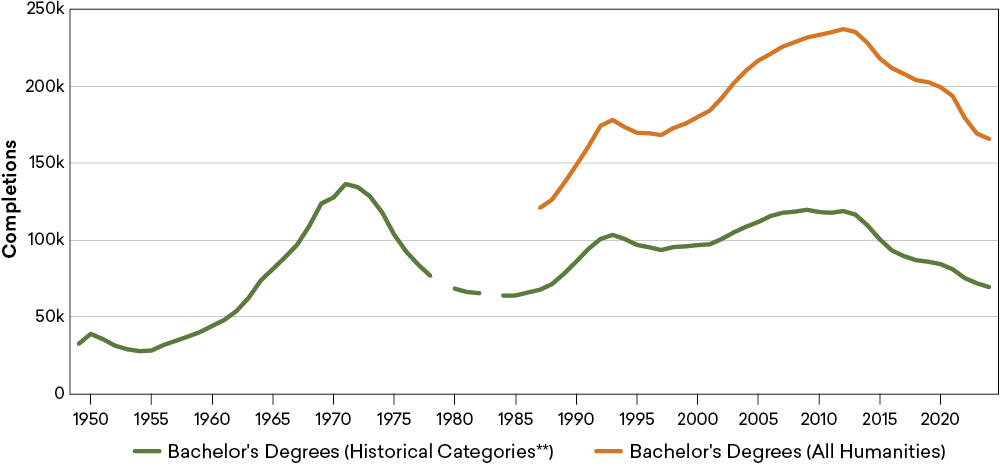
**Data on the entire range of humanities disciplines is available only back to 1987, but an extended historical perspective is available for several of the largest disciplines (classical studies, English language and literature, history, languages and literatures other than English, linguistics, and philosophy), which are labeled “Historical Categories” on the graph.
Source: Office of Education/U.S. Department of Education: Survey of Earned Degrees; Higher Education General Information System; and Integrated Postsecondary Education Data System. Data analyzed and presented by the American Academy of Arts and Sciences’ Humanities Indicators.
We did not specifically ask chairs about their institution’s budget allocation practices and the impact these had on their department’s overall outlook. Nonetheless, more than a third of chairs referenced cost and efficiency metrics, and roughly another third alluded to evaluations based on the number of enrollments or majors. However, few chairs spoke explicitly about the relationship between declining enrollments and decision-making around allocations to humanities departments in the context of tight budgets at their institution and across higher education. That said, the downward spiral of declining enrollments, leading to smaller departmental budgets and fewer faculty, is a context we assume is in the background of many of the discussions with chairs we describe in this report.