Marketing
Society’s perceptions of higher education filter into the academy as well. One major theme that emerged from the focus groups is that humanities chairs do not feel understood. Half of the chairs we spoke with expressed this sentiment using remarkably consistent language with respect to both students (who “don’t understand what we [the philosophy department] do”) and administrators (whose “perception of the [gender studies] department is ‘What do you even do there?’”). As a history chair explained, “It’s a constant pedagogical initiative from the department to explain to administrators what we do.”
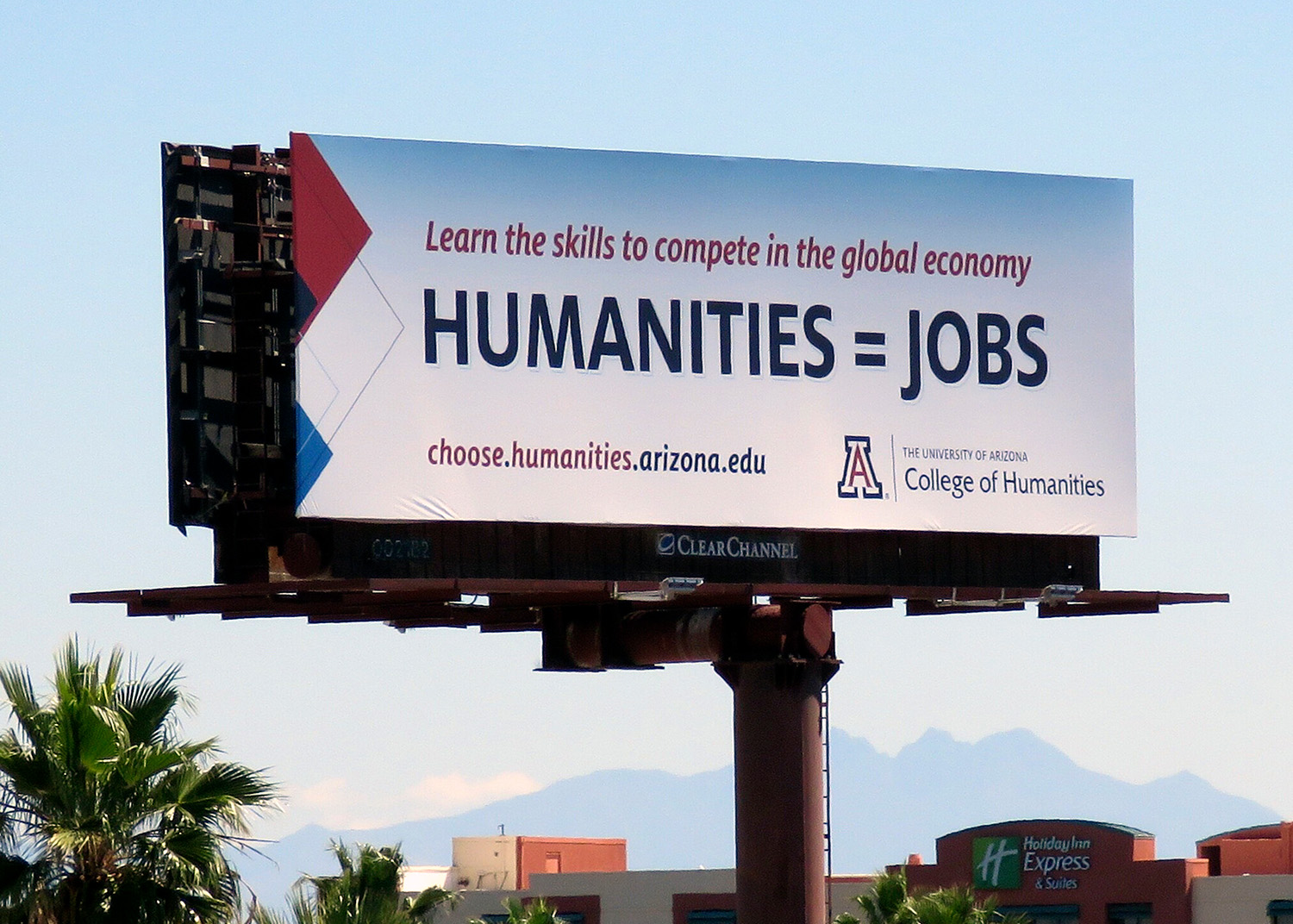
Source: A promotional billboard in the Phoenix area, paid for by the College of Humanities at the University of Arizona. Photo courtesy of the University of Arizona.
Multiple chairs articulated the career-relevant skills that students learn through a humanities education, though we did not ask them to do so. For example, according to an English chair, “Humanities are important for understanding the world, being able to analyze and write and evaluate and make decisions. There is personal and intellectual growth through reading and looking at evidence, skills of understanding and analysis, as well as knowledge of history, cultures, points of view besides your own. Humanities are crucial to taking an informed approach to issues of the day, important no matter which career you land in.” However, chairs’ ability to describe their activities seemed to be fundamentally disconnected from administrators’ and students’ ability to understand these descriptions. As a classics chair put it, “Humanities are relentlessly justifying themselves. We do a great job of articulating our value, but [the administration] needs to actually listen.”
This communication disconnect is likely related to an incompatibility in disciplinary approaches. Humanists focus on intrinsic human value. As an English chair put it, they attract students “whose own need to produce knowledge eclipses their economic pressures to be capitalists.” By contrast, many stakeholders (including some administrators, students, and members of the public) view learning as a commodity and people as products. As an ethnic studies chair explained, “the neoliberal powers that be are insisting that we become dehumanized cogs in the wheel [and attend to] market forces [like] ‘demand.’” The humanist worldview is at odds with the prevailing attitude among the public, creating a communication gap that humanists are unable to bridge alone.
Several chairs mentioned the need for a marketing campaign that would communicate the value proposition of the humanities within and beyond their institutions and help them connect with prospective students who might be receptive to that message. However, chairs often felt that they themselves were not able or well-suited to carry out such a campaign. In some cases, chairs thought they and their faculty were too overloaded with day-to-day work to take on marketing tasks and that those tasks should be the responsibility of other institutional units like admissions. In other cases, chairs felt that their articulations of the humanities’ value were failing to sink in. As a LOTE chair explained, “We are not good marketers in our industry. We need to get the message across better about the value of humanities. But I’m having trouble figuring out what it is I need to say to get the message across.” Another chair described tentative steps toward a cross-departmental humanities marketing campaign targeting students that would be rolled out at a spring recruitment event at their institution: “We just finalized the mission statement . . . we’re going to put up posters, [give out] T-shirts [promoting] the humanities [as a whole], not just English or history.” Chairs offered less evidence, however, that they had established how to enact successful marketing campaigns directed at administrators or the general public, even if they thought such efforts were necessary.