The Problem: Working-Class Americans Almost Never Go on to Hold Elected Office
In the United States, about half of all jobs are working-class jobs: manual-labor jobs like construction worker, service-industry jobs like home health care worker, clerical jobs like receptionist, and informal-sector jobs like day laborer. These jobs are held by men and women, young and old, from every race and religion, across every part of the country. (For more on how researchers define working class, see the Frequently Asked Questions section at the end of the report.) Working-class jobs are occupations that don’t provide employees with much material security, that don’t require capital or extensive formal education, and that don’t give employees much autonomy. These working-class jobs are indispensable to the economy and to our society: modern life in the United States is unthinkable without the people who pave roads, repair electrical lines, style hair, move freight, work in factories, deliver packages, stock shelves, build houses, repair cars, clean hotel rooms, answer phones, dig trenches, cook and serve food in restaurants, clean hospitals, ring up groceries, fix potholes, and empty garbage.
Although working-class jobs are essential to our way of life, people from working-class jobs almost never go on to hold elected political office. A 2013 study found that working-class jobs made up 52 percent of the labor force, but fewer than 10 percent of city council members had working-class jobs, fewer than 3 percent of state legislators held or had come from working-class jobs, and the typical member of Congress had spent less than 2 percent of their entire precongressional career doing the kinds of jobs that employ most Americans.1
Similar patterns have been documented in every systematic study that has ever been conducted on this topic. In 2025, researchers found that fewer than 2 percent of U.S. state legislators had working-class jobs as their main or most recent occupations.2 A 2019 analysis in The New York Times found that only 12 of the 535 members of Congress serving at that time had ever held a working-class job.3 A 1979 study by the Insurance Information Institute, an advocacy group for the insurance industry, found that just 5 percent of U.S. state legislators had working-class jobs.4 A 1954 study by a political scientist at the University of North Carolina found that just 2 percent of members of Congress had been low-salary workers, wage earners, servants, or farm laborers.5 Throughout all of U.S. history, there has never been a session of Congress in which more than 2 or 3 percent of legislators had a working-class job when they first got into politics.6
Figure 1 compares the share of working-class jobs in the U.S. labor force to the most recent data we have on the rates at which people from working-class jobs become city council members, state legislators, members of Congress, governors, Supreme Court justices, and presidents. Viewed this way, it is clear that people from working-class jobs are rare in the halls of power in the United States. If working-class people were a political party, that party would make up about half of the electorate but just tiny percentages of our political institutions.
Figure 1: Working-Class Americans Rarely Hold Public Office in the United States
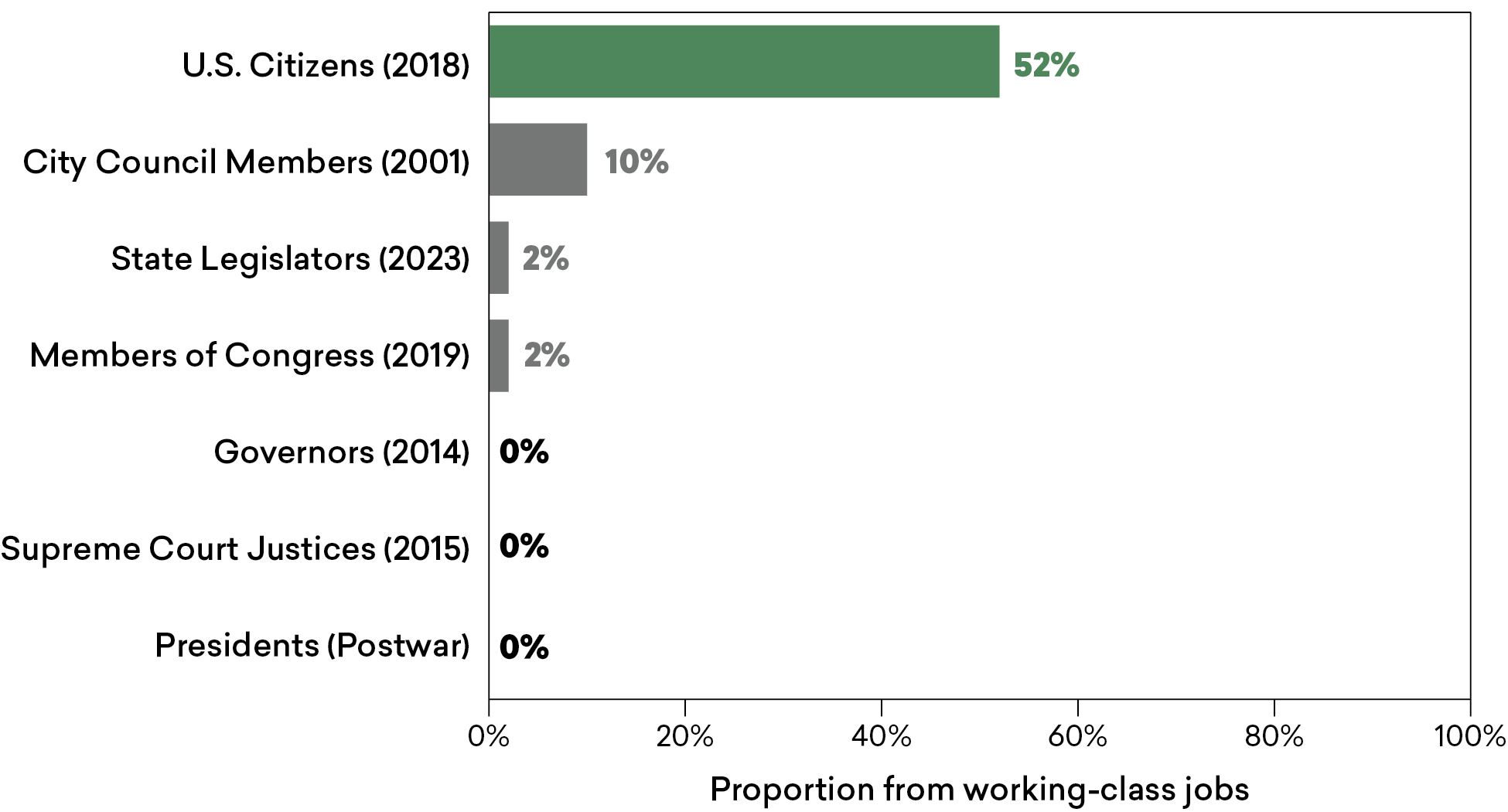
Notes: Gray bars represent the proportion of officeholders who last held working-class jobs prior to holding public office. Data for each office come from different years, which are noted in parentheses.
Sources: U.S. citizens: Nicholas Carnes, The Cash Ceiling: Why Only the Rich Run for Office, and What We Can Do About It (Princeton University Press, 2018); city council members: Nicholas Carnes, White-Collar Government: The Hidden Role of Class in Economic Policy Making (University of Chicago Press, 2013); state legislators: “Study: Only 2% of State Lawmakers Come from Working Class,” Carolina Journal, September 17, 2025; members of Congress: Sahil Chinoy and Jessia Ma, “Paths to Power: How Every Member Got to Congress,” The New York Times, January 27, 2019; governors and Supreme Court justices: Carnes, White-Collar Government; presidents: Carnes, White-Collar Government and authors’ data collection.
The shortage of workers in office is especially striking in light of how intensely scholars, journalists, parties, political observers, and politicians focus on working-class voters. During campaigns, parties and candidates of all ideological stripes work hard to convey their commitment to the interests of working-class people. And rightly so: Pundits routinely argue that working-class voters can swing the results of major elections, and research suggests that the working class is not monolithically attached to one major party or the other.7 As a group, workers are a consequential—sometimes pivotal—electoral “prize” for candidates and parties. But for all their rhetoric about working-class voters, politicians and pundits seem not to appreciate that running working-class candidates might help parties appeal to working-class voters.
The shortage of workers in office is also surprising given how much more inclusive our political institutions have become in recent decades. Progress has been slow and sometimes halting, but for the last half-century, women and racial and ethnic minorities have made up growing shares of elected institutions like Congress and state legislatures.8 Because women and people of color are overrepresented in working-class jobs in the general public (that is, white-collar and professional jobs disproportionately go to men and white people), we might expect the increasing gender or racial diversity in our political institutions to be accompanied by increasing worker representation. In practice, however, the women and people of color who have been elected have been disproportionately drawn from professional occupational backgrounds. In state legislatures, for instance, women’s representation skyrocketed from 8 percent to 24 percent from 1976 to 2007, and the share of lawmakers who were Black or Latino grew from 9 percent to 11 percent—but the share of lawmakers from working-class jobs decreased from 5 percent to 3 percent.9 Reformers have devised blueprints for making our political institutions more inclusive on some dimensions, but so far those efforts haven’t increased the representation of working-class Americans.
The Exceptions That Prove the Rule
Of course, there are exceptions to these broad patterns, rare politicians from working-class jobs who go on to have successful careers in electoral politics. Former Providence, Rhode Island, city councilwoman Carmen Castillo worked as a hotel housekeeper while serving in office. Maine Democratic gubernatorial candidate (and former state senate president) Troy Jackson worked as a logger for most of his life before and during his service in the state legislature. Former Republican Senator Orrin Hatch spent almost half of his precongressional career working as a janitor and security guard to support his family and pay his way through college and law school.
Examples like these are rare, and because they are so unusual, they often receive outsized attention in our political process, which can make working-class politicians seem more common than they really are.10 The rare candidates from the working class often showcase their work experience as part of their campaign; for instance, U.S. Representative Mike Michaud—a former forklift operator—featured forklifts on his campaign bumper stickers. Journalists rarely say much about the occupational backgrounds of most politicians, even in high-profile races, but they often devote significant attention to the jobs of politicians from the working class.11 Councilwoman Castillo, for instance, was the subject of a documentary film.12 Many Americans know that Alexandria Ocasio-Cortez worked as a bartender, but far fewer know what Nancy Pelosi did for a living before she entered politics.13
Keeping Workers Out Is Bad for American Democracy
The shortage of politicians from working-class jobs is bad for our country and strains democracy in the United States. It harms trust in government, runs contrary to our country’s core values, and diminishes the capacity of our political institutions to address the real problems facing working-class people.
- Symbolically, political institutions that all but exclude working-class people send the message that workers are not valued or included in meaningful ways in our political process. They subtly convey that government is by and for the privileged. Citizens take note. According to cross-national research, when politicians from working-class jobs are rare in public office, citizens are less likely to trust their government and to have faith in democracy.14
- Ethically, the shortage of working-class people represents a break from our country’s core values of representation and access. In a democracy, the links between citizens and their lawmakers should be strong; democracy should be of, by, and for the people. When less powerful groups have a place in a political system, it marks equality of opportunity in that system. When people from a class of jobs that makes up over half of the labor force almost never go on to hold public office—and when no other mechanisms exist to ensure that they have an equal place in our political system—we have departed from the basic promise of democracy.15
- Practically, when workers don’t hold office, policymakers are less likely to understand and respond to the problems workers face. Politicians bring occupation-specific expertise to public office: doctors and nurses better understand the problems facing the medical profession, teachers and principals better understand the challenges facing our schools, police officers and firefighters better understand the problems facing first responders, and so on.16 When people with working-class jobs almost never go on to hold office, our political institutions are less likely to recognize and understand the problems facing working-class Americans, tilting the policy agenda in favor of the interests of the most privileged and against the needs of workers,17 while also depriving institutions of the diversity of perspectives they need to respond to a dynamic and complex economy. Of course, politicians from white-collar backgrounds often care deeply about workers and work hard to promote policies that support the American working class. But there is simply no substitute for firsthand experience. Without former and current workers, our political institutions are cut off from the grounded knowledge they need to best serve working-class Americans. As the old adage goes, if you’re not at the table, you’re on the menu.