How Do the State Councils Define the Humanities?
How Do the State Councils Define the Humanities?
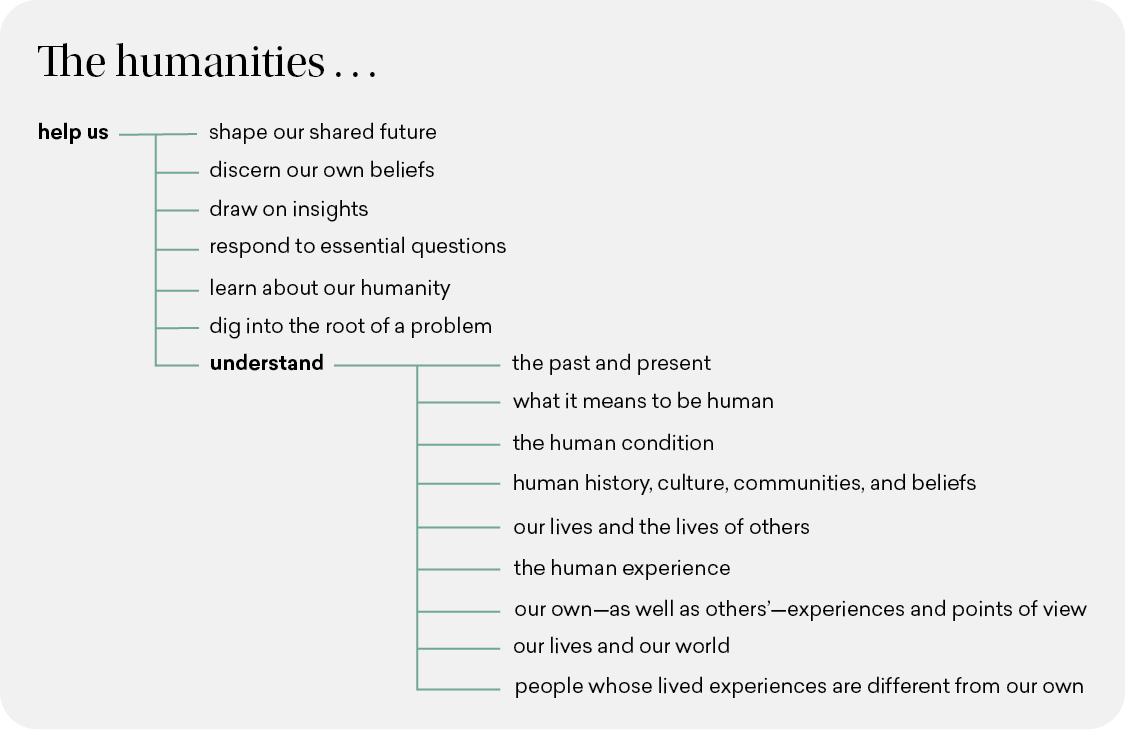
Through a simple text analysis of the humanities definitions provided by the state and jurisdictional councils, we can begin to get at what it means to practice the humanities in public life. To understand the doing of the humanities, we need to look at the active verbs being deployed by humanities councils. One of the most common verbs to appear across all definitions of the humanities is understand. According to the councils, the purpose of engaging with the humanities is to understand our shared past and present, what it means to be human, our lives and the lives of others, and people whose lived experiences are different from our own. Understand is often paired with verbs like define, appreciate, express, interpret, evaluate, and connect. Not only is the public meant to understand what makes us human; it is also meant to engage actively with that information, interpreting, evaluating, and using it to form meaningful connections. Other common verbs include connect, think, and explore. This stands in contrast to many academic definitions of the public humanities, which often center institutions of higher education as the primary agents of sharing knowledge and educating the public rather than emphasizing mutual participation that can foster a healthy civic life.
Perhaps the clearest indicator of an institution that centers its work on the public is that help is the most commonly used verb in councils’ definitions of their humanities work. Appearing in conjunction with help is almost always the pronoun us (meaning everyone, not just the council), followed by another action verb, most commonly understand. By sharing with the public the tools needed not just to understand but also define, appreciate, express, interpret, evaluate, and connect, state councils are positioning themselves not as organizations presenting humanities knowledge to the public but as facilitators in the cocreation of humanities knowledge. Among the verbs and verb phrases collocated with help are shape, discern, draw on, respond to, bridge, and dig into. Each is an action the public takes when engaging with humanities content and activities. Thus, regardless of previous experience or expertise, when engaging with the humanities as defined by the state and jurisdictional councils, you are truly doing the humanities. Approaching the same question from the academic perspective yields a very different view on what makes public humanities work.
In their 2022 essay for a Dædalus issue on the humanities in American life, Carin Berkowitz, executive director of the New Jersey Council for the Humanities, and Matthew Gibson, executive director of Virginia Humanities, explore some of the differences between academic and public definitions of the humanities.12 They note that academic engagement with the public humanities often involves first listing a series of disciplines that do not translate particularly well beyond the ivory tower and then conceptualizing the public versions of these disciplines as academics sharing their knowledge with various publics. While the councils have long worked with colleges and universities as partners in their work, they focus more closely on community-led humanities activities that build relationships across time and space. Berkowitz and Gibson note that public humanities work needs to be supported by higher education without being appropriated by it. However, many definitions of the public humanities from academia continue to center academics as knowledge producers and the university as the critical facilitator of the spread of humanistic knowledge.