Although declarations and prophesies of doom for the humanities abound, they provide no consistent facts about the current or past situation of the collection of academic interests loosely defined as the humanities. The Academy is trying to provide a body of information and of ideas that will support intellectual community and intellectual action.
"In 1956, while working in the summer as a fledgling reporter for the then family-owned Hartford Courant, I persuaded the editors to let me write what turned out to be a seven-part series exposing the extent of housing segregation in 'liberal' Hartford."
The first Stated Meeting in the 220-year history of the Academy to be held outside the United States took place at the residence of the US Ambassador to France on June 6, 2000.
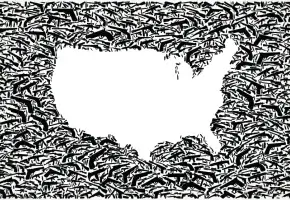
Arms trafficking has a long and influential history. At an Academy event held in Berkeley, California, historian Brian DeLay described how U.S. arms trafficking intervened at critical moments to destabilize Mexican governance. The program included commentary from historians Priya Satia and Daniel Sargent, as well as from political scientist Ron Hassner. The presentations explored how the history of arms trading may help to better understand the history of state-making and the power relations between the United States and the rest of the world.
With the signing of the 2020 National Defense Authorization Act (NDAA), the World Language Advancement and Readiness Act became the first piece of federal legislation in a generation to address the language needs of the nation. This act is the most high-profile achievement of Academy’s Commission on Language Learning since it released its final report in 2017.
A growing numbers of parents are either delaying or selectively administering immunizations – or choosing not to vaccinate their children at all. A new Academy report makes clear that reversing this trend requires dedicated research on how vaccine decisions are made and the best ways to communicate factual information to vaccine-hesitant parents.
On March 26, 2024, stem cell biologist Haifan Lin received the Francis Amory Prize of the American Academy of Arts and Sciences. First awarded in 1940, the Amory Prize recognizes significant scientific advances in reproductive biology and medical care. The award ceremony included remarks by Yale University President Peter Salovey and Academy President David W. Oxtoby, a reading of the Amory Prize citation by Dean of the Yale School of Medicine Nancy J. Brown, and a presentation by Professor Lin. An edited version of the remarks and presentation follows.
Robert Ballard tells the story of his passionate career in ocean exploration and discusses the educational initiatives he has created to engage a new generation of scientists.
On May 18, 2017, the American Academy, in partnership with the Carnegie Institution for Science, hosted a meeting at the Carnegie Institution in Washington, D.C., on “Communicating Science in an Age of Disbelief in Experts.”
Elizabeth J. Perry explains the means by which the Chinese Communist party-state maintains campus calm, despite the many unpopular and potentially unsettling higher education reforms.