Utility navigation

  • Dædalus
  • Archives
  • Give
  • Login

Main navigation

  • Our Work
    • Explore by Topic
      • Arts & Humanities
      • Democracy & Justice
      • Education
      • Energy & Environment
      • Global Affairs
      • Science & Technology
    • View
      • Projects
      • Publications
  • Members
  • News
  • Events
  • Get Involved
  • About

Main navigation

  • Our Work
    • Explore by Topic
      • Arts & Humanities
      • Democracy & Justice
      • Education
      • Energy & Environment
      • Global Affairs
      • Science & Technology
    • View
      • Projects
      • Publications
  • Members
    • Member Directory
    • Magazine: The Bulletin
    • Local Committees
  • News
  • Events
  • Get Involved
  • About
    • Governance
      • Board of Directors
      • Council
      • Trust
      • Committees
      • President
    • Staff
    • Affiliates
    • Prizes
      • Amory
      • Distinguished Leadership
      • Don M. Randel Humanistic Studies
      • Emerson-Thoreau
      • Excellence in Public Policy
      • Founders
      • Rumford
      • Sarton History of Science
      • Sarton Poetry
      • Scholar-Patriot
      • Talcott Parsons
    • Fellowships
    • Location
    • History
    • Advisors
      • Education
      • The Humanities, Arts, and Culture
      • Science, Engineering, and Technology

Footer

  • Daedalus
  • Login
  • Archives
  • Give
  • Careers
  • Contact
  • Private Events

136 Irving Street
Cambridge, MA 02138

Social Media

  • Facebook
  • LinkedIn
  • YouTube
Search results for

“WA 0859 3970 0884 Design Interior Backdrop TV Kamar Hotel Laweyan Surakarta”

Search

  • All (1844)
  • Events (23)
  • (-) News (342)
  • People (794)
  • Projects (23)
  • Publications (662)
Bulletin
|
Mar 1, 2012

Prospects and Challenges for the Global Nuclear Future: After Fukushima

On October 25, 2011, the Academy convened a panel of global experts at Stanford University. Scott D. Sagan, Harald Müller, Noramly bin Muslim, Olli Heinonen, and Jayantha Dhanapala considered the global nuclear future in light of the accident at Fukushima.
Bulletin
|
Jun 3, 2022

Honoring Charles L. Bennett with the Rumford Prize

The Rumford Prize, which recognizes contributions to the fields of heat and light, broadly interpreted, was first awarded in 1839 and is one of the oldest scientific prizes in the United States. Previous prize recipients include Thomas Edison in 1895, Edwin Land in 1945, and Enrico Fermi in 1953.

The American Academy awarded the 2021 Rumford Prize to astrophysicist Charles L. Bennett for his contributions to the field of cosmology. The virtual award ceremony included remarks by Academy President David Oxtoby, an introduction from theoretical physicist Marc Kamionkowski, a reading of the Rumford Prize citation by astronaut and scientist Kathryn Sullivan, and a presentation from Charles Bennett. An edited version of the speakers’ remarks follows.
Small Group Conversation for Civic Culture Publication
Press Release
|
Sep 26, 2024

Academy Releases Roadmap for Fortifying Civic Culture

An Academy working group has issued a new resource for repairing and strengthening civic culture in America. In a highly polarized political environment, the Academy’s new publication reminds us America is united by people who believe in its ideals and who balance their self-interest with the well-being of their community and country.
Bulletin
|
Mar 8, 2019

The 2020 Census: Unprecedented Challenges & Their Implications

On October 30, 2018, Kenneth Prewitt spoke about the 2020 Census at a gathering of Academy members and guests at the House of the Academy in Cambridge, Massachusetts.
Bulletin
|
Jun 1, 2016

Understanding Developmental Pathways from Adversity to Maladaptation, Psychopathology, or Resilience

"Early encounters with poverty and harsh conditions played a major role in fueling my research on child maltreatment. I have always preferred addressing complexity over simplicity, and this has led to a multilevel approach in my research."
Bulletin
|
Nov 29, 2024

American Institutions, Society & the Public Good

The American Academy of Arts and Sciences was founded by visionaries who foresaw that the nascent republic would benefit from the expertise of learned citizens to guide its development, health, and integrity through whatever challenges may arise.

Today, the clarity of that vision has never been more evident. We find ourselves in a time of deepening divides across lines of politics, race, religion, income, and opportunity. The institutions we have long turned to for leadership and information are under fire, as trust in the media, government, commercial enterprise, and academia declines. Strong and responsive institutions and a healthy civil society can carry us through crises and are vitally important in their aftermath.

Bulletin
|
Jan 1, 2013

Examining U.S. Energy Policy

The Academy organized a workshop in Washington, D.C. that gathered investigators from the government, academic, and industry sectors to discuss novel approaches to understanding and overcoming the social and behavioral barriers to the adoption of new energy technologies.
In the News
|
Feb 10, 2020

Three Success Stories Point to a “Bigger Future” for Students – and Higher Ed

Roger Ferguson, cochair of the Academy's Commission on the Future of Undergraduate Education, highlights videos showcasing innovative programs that address the challenges facing higher education today.
Source
LinkedIn
Bulletin
|
Aug 22, 2017

Technology in a Time of War: Humanitarian Aid at an Inflection Point

Reflections on the American Academy’s work on New Dilemmas in Ethics, Technology, and War and its engagement with international organizations
Data Forum
|
Nov 9, 2016

Assessment in the Humanities

In a forum essay, the HULA team (Danielle Allen, Maggie Schein, Christopher Pupik Dean, and David Kidd) describes its work, which start in the education sector but are now being extended to public humanities projects.
Bulletin
|
Feb 19, 2021

Does Meritocracy Destroy the Common Good?

In "The Tyranny of Merit: What’s Become of the Common Good?" Michael J. Sandel argues that the divide between winners and losers has poisoned our politics and pulled us apart. The problem, he contends, is not only that we have failed to live up to the meritocratic ideals we profess, but that a meritocratic society is a flawed aspiration. It produces hubris among the successful and humiliation among those left behind. In the first virtual Stated Meeting in the history of the Academy, Michael J. Sandel joined T. J. Jackson Lears and Anna Deavere Smith in a conversation about his new book and the destructive consequences of linking socioeconomic status with personal worth.
Bulletin
|
Nov 29, 2024

Members Elected in 2024, by Class & Section

Members Elected in 2024, by Class & Section
Bulletin
|
Dec 5, 2022

Members Elected in 2022, by Class & Section

A list of all active Members, arranged by Class and Section, Affiliation, or Year of Election, is available on the Academy’s website at www.amacad.org/directory.
Bulletin
|
Dec 1, 2023

Members Elected in 2023

Members Elected in 2023
Bulletin
|
Jun 1, 2016

The Journey Home

"Witnessing the death and destruction caused by Hurricane Katrina in my hometown of New Orleans a decade ago triggered an obligation to test the utility of all that I have learned in a long career as a public health scientist."
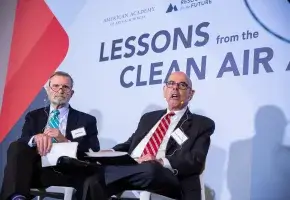
Former Representatives Phil Sharp and Henry Waxman discuss climate and energy policy
Bulletin
|
Aug 7, 2019

Lessons from the Clean Air Act: Building Durability and Adaptability into U.S. Climate and Energy Policy

Over five decades, the Clean Air Act has become a venerable, living institution that has been highly successful in improving the environment around the country. Its success results from its durability and flexibility, two concepts that often seem to be in opposition yet may be essential to establishing successful climate and energy policy.
Abstract image with bright blue lights against dark backdrop.
Bulletin
|
Dec 10, 2025

Science, Engineering & Technology

Academy projects in Science, Engineering, and Technology seek to strengthen the capacity of science, engineering, and technology to improve the common good. Leveraging the diverse expertise of its members and a wide network of external specialists, the Academy conducts in-depth studies to assess the implications of scientific and technological progress. These studies inform actionable policy recommendations for stakeholders across government, academia, the nonprofit sector, and industry.
Bulletin
|
Aug 22, 2017

The Time Inconsistency of Long Constitutions

Bulletin
|
Jun 1, 2010

Do Scientists Understand the Public? An Essay

This essay by Chris Mooney cogently distills off-the-record workshops for experts from the scientific community and representatives of the public to explore how scientists currently understand their obligation to the broader social and cultural contexts in which their work is received, and to examine ways to improve engagement between the scientific and public communities.
Bulletin
|
Jan 1, 2012

Induction Symposium: American Institutions and a Civil Society

The 2011 Induction weekend included a symposium on American Institutions and a Civil Society, which featured two panel discussions: The American Military and American Democracy and The Constitution, the Practice of Democracy, and Unintended Consequences.

Pagination

  • Previous page ←
  • 4 of 18
  • Next page →

136 Irving Street
Cambridge, MA 02138

617-576-5000

VEHICLE ENTRANCE

200 Beacon Street
Somerville, MA 02143

Main navigation

  • Our Work
  • Members
  • News
  • Events
  • Get Involved
  • About

Footer

  • Daedalus
  • Login
  • Archives
  • Give
  • Careers
  • Contact
  • Private Events

Social Media

  • Facebook
  • LinkedIn
  • YouTube
© 2026

American Academy of Arts & Sciences  |  Web Policy