2138th Stated Meeting | October 11, 2025 | Sanders Theatre, Harvard University
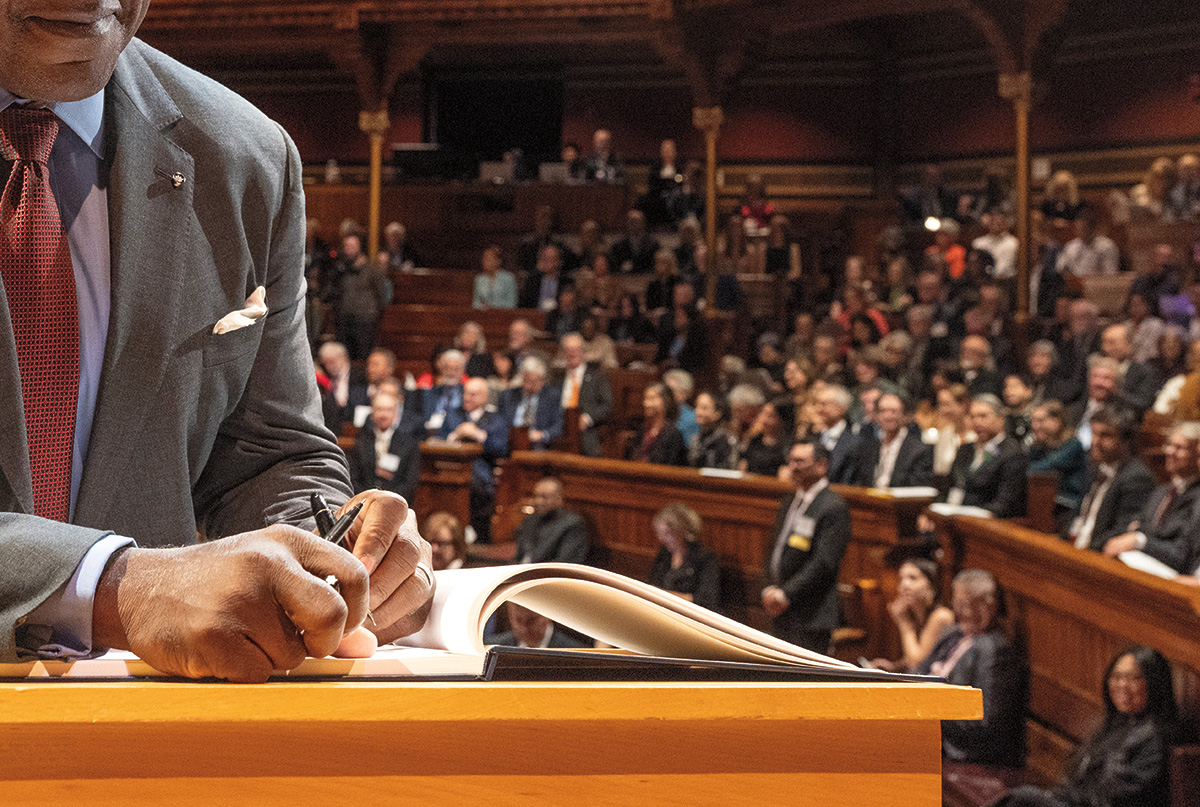
On October 11, 2025, the Academy inducted more than two hundred newly elected members during its annual Induction Ceremony. The program included brief remarks from five new members, each representing one of the Academy’s membership classes. Their talks addressed topics such as the transformative power of science, building trust in expertise in the age of biology, leading for breakthroughs, creating books that act as mirrors rather than windows, and the evolving impact of Title IX. The class speakers were Gregory H. Robinson (Class I: Mathematical and Physical Sciences), Ashish K. Jha (Class II: Biological Sciences), Brian Uzzi (Class III: Social and Behavioral Sciences), Jacqueline Woodson (Class IV: Humanities and Arts), and Christine Brennan (Class V: Leadership, Policy, and Communications). Edited versions of their remarks follow.
Gregory H. Robinson
Gregory H. Robinson is the UGA Foundation Distinguished Professor of Chemistry at the University of Georgia. He was elected to the American Academy of Arts and Sciences in 2025.
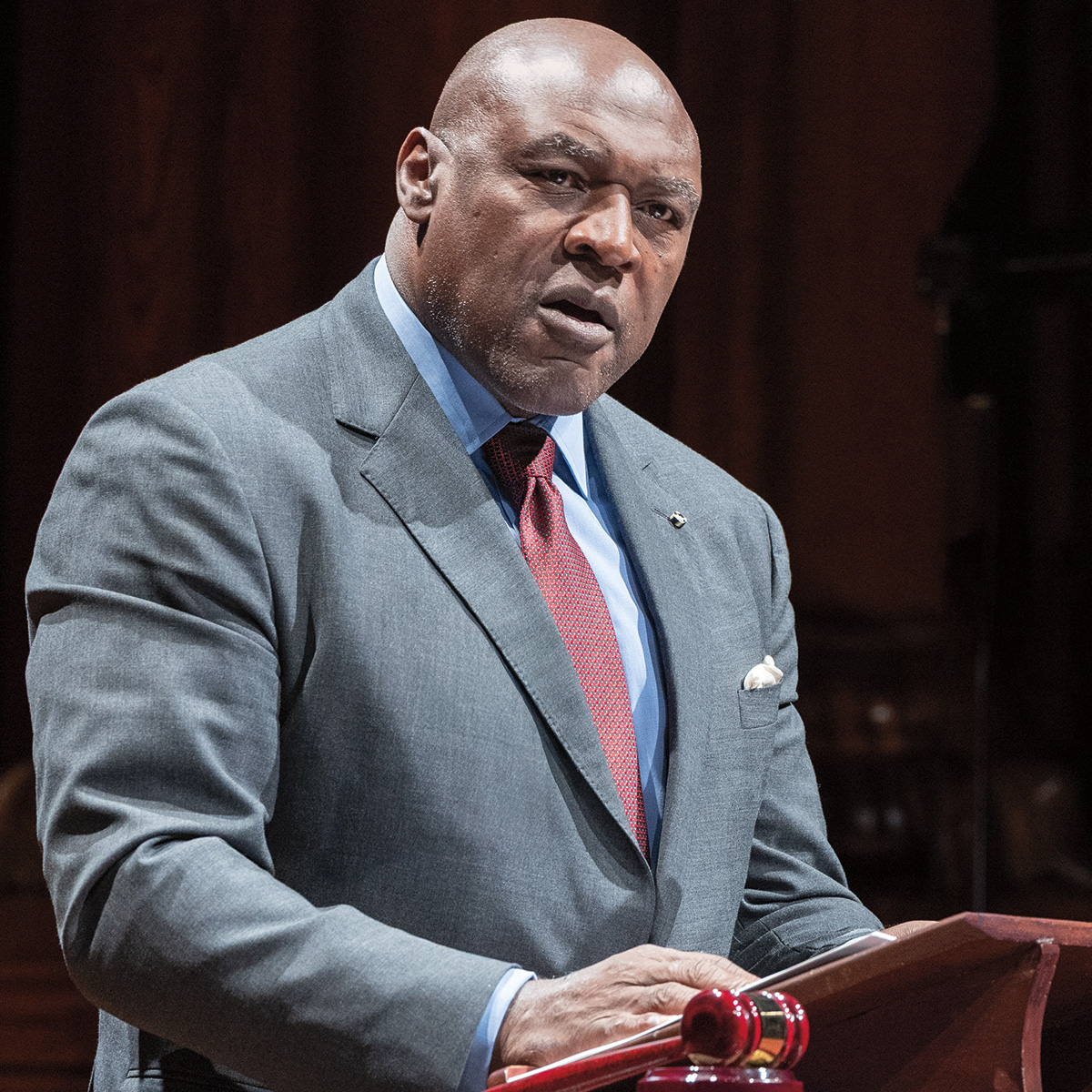
Let me begin by extending my heartfelt congratulations to the 2025 class of the American Academy of Arts and Sciences.
When I was asked to give some remarks, my first thought was to prepare a chemistry lecture, but then I realized maybe that was not the best move at this juncture! Two themes dominated my thoughts for these remarks: One was the extraordinary promise of America, and the second was the transformative power of science.
Centuries ago, the Egyptians, Romans, and Phoenicians used chemistry to isolate organic dyes from plants. The conversion of animal fat into soap by treatment with lye—sodium hydroxide—has also been known since ancient times. In our world today, each new wonder drug, each new advanced material, each new antiviral medication is deeply rooted in chemistry.
Notably, chemistry remains omnipresent in our daily lives. From the corner barista performing “aqueous extractions,” which we know as brewing coffee, to the neighborhood baker utilizing baking powder—sodium bicarbonate—which releases carbon dioxide in the baking of breads, cakes, and cookies are but two examples of everyday chemistry. Indeed, we remain hopeful that the worldwide fermentation industry, whose singular task concerns the chemical conversion of sugars to ethyl alcohol, may one day become a profitable enterprise. Perhaps Nobel Laureate Roald Hoffmann said it best: “A chemistry degree has never been required for one to practice chemistry.”
I was born in Alabama in 1958. At that time, the American South remained in the corrosive embrace of racial segregation and Jim Crow. I started school in 1964 and was excited to join my three older sisters as we caught the bus to go to school each morning. Each school day began in the same way: We all stood at attention; we faced the flag; we placed our hands over our hearts; and we recited the Pledge of Allegiance. I remember the last line of the Pledge: “With liberty and justice for all.” And then we began our school day.
Our school had four classrooms and four teachers for grades 1–9. Obviously, this racially segregated school was as woefully underfunded as it was overcrowded.
I first heard the word molecule when I was in the fourth grade. It was at recess, and a boy in the fifth grade asked me if I had ever heard about molecules. I said, “No, what are molecules?” He assured me that he couldn’t get into it right then but that I would learn about molecules in the fifth grade.
In the fifth grade, I recall interrupting the teacher one day in class to ask, “When are we going to learn about molecules?” She replied, “Who told you about molecules?”
Amazingly, we continued to attend this racially segregated school until 1970, almost sixteen years after the Brown v. Board of Education decision.
What attracted me to chemistry? With all of the electrons, atoms, protons, neutrons, isotopes, allotropes, and molecules, chemistry seemed to be a world unto itself. And, indeed, even at that young age, it seemed to me that the laws of science held much more logic than the laws of society. In my life, I’ve picked cotton, and I began my education attending a racially segregated school. In high school, I was the quarterback of our football team, but in college I was moved to defense, ostensibly because I was not smart enough to play quarterback. Perhaps like some of you, I’ve been fortunate to encounter some fantastic individuals who provided critical assistance to me along my journey. And working with a talented group of students and colleagues, I earnestly believe that my research team and I have advanced synthetic inorganic chemistry. And so I stand before you as a direct consequence of the extraordinary promise of America and the transformative power of science.
© 2026 by Gregory H. Robinson
Ashish K. Jha
Ashish K. Jha served as Dean of the School of Public Health at Brown University from 2020 to 2025. He previously served as a professor at the Harvard T. H. Chan School of Public Health and at Harvard Medical School. He was elected to the American Academy of Arts and Sciences in 2025.
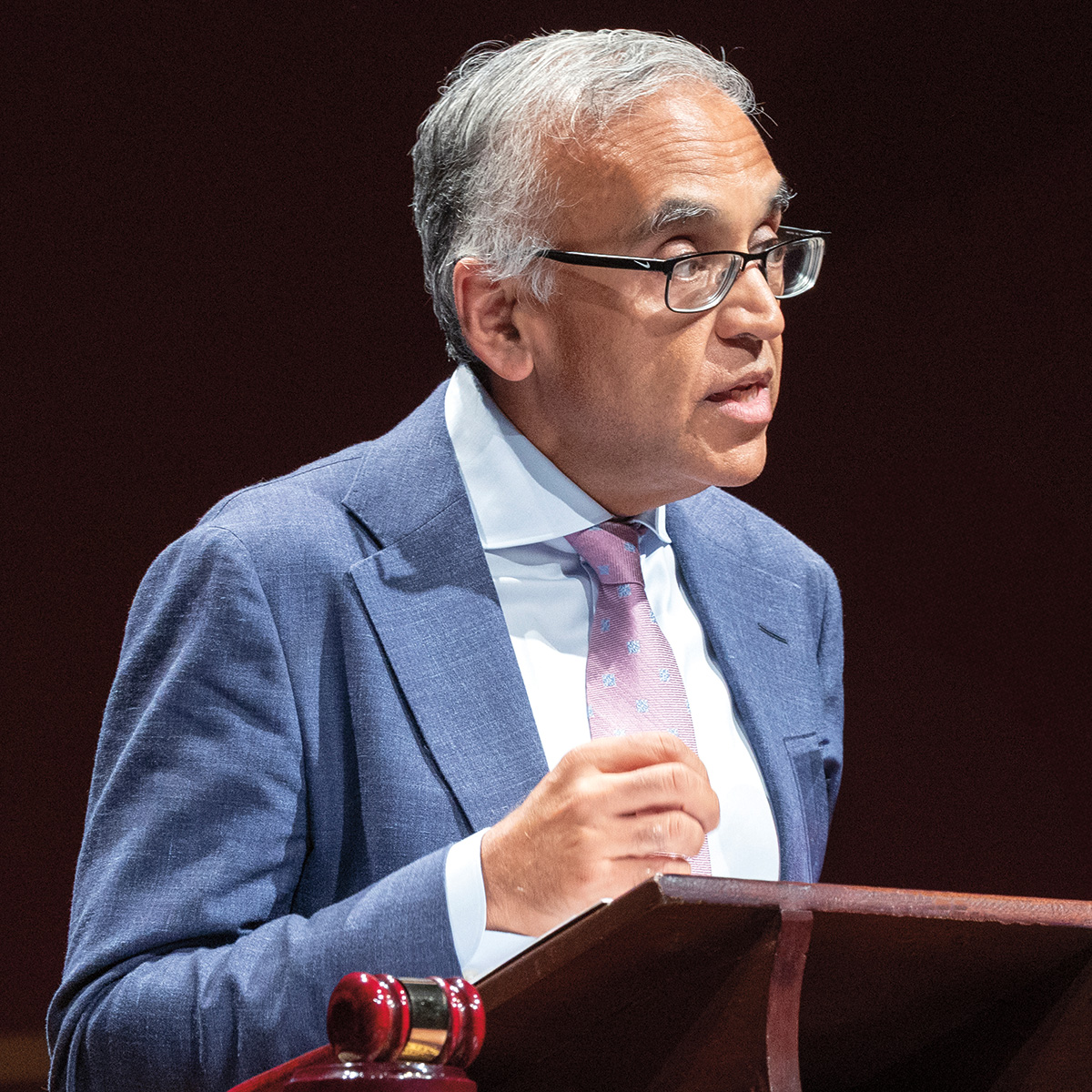
Thank you to the Academy, and congratulations to the new inductees.
A century ago, the world stood at the dawn of the age of physics. Discoveries in quantum mechanics and nuclear science promised boundless energy and a deeper understanding of the universe. But along with that promise came peril. The same knowledge that gave us nuclear power also created nuclear weapons. Humanity found itself on a knife’s edge.
In the years that followed, what made the difference between progress and catastrophe? It wasn’t science alone. It was trust: trust between scientists and the public; between governments and their citizens; and, yes, even between nations themselves.
Today, we are at a similar inflection point because we are at the dawn of the age of biology. Advances in genetics, AI, and synthetic biology hold the power to transform health and life itself. But just as in the last century, realizing that promise depends not only on discovery. It also depends on whether we can foster trust: trust in institutions; trust in science; trust in each other. History teaches us that the perils are real. In the early twentieth century, because of scientists like Nobel laureate Fritz Haber, we learned how to engineer chemistry. And with all its wondrous gains came the chemical weapons of World War I. In the decades that followed, great scientists—such as Bohr, Planck, Einstein, and Fermi—gave us the ability to engineer physics, and that gave us nuclear energy, but soon thereafter the nuclear weapons of World War II.
Over the last decade or so, extraordinary scientists like Jennifer Doudna and Katalin Karikó have taught us how to engineer biology. We are no longer mere readers of the genetic code of life. We are, for the first time in human history, its editors and writers. CRISPR, synthetic biology, and artificial intelligence are already transforming medicine. We can now cure sickle cell disease. We’re reshaping autoimmune disorders and tackling cancers that ten years ago felt unsurmountable. But it would be a historical anomaly if those same tools were not used for biological weapons. In fact, we know that they are.
So, yes, in this moment we must do science well. And looking out across this room I have no doubt we will. But that will not be enough, because if people don’t trust science, then the fruits of that science will not be widely used, and when the inevitable misuse of biology comes, our ability to counter it will be limited.
Trust is in a very difficult place because we are living through a profound fragmentation of our information ecosystem. Many of our fellow citizens no longer know what’s true and what’s fake, or whom to trust. The examples of this crisis are all around us. Childhood vaccine rates are falling, making 2025 the worst year for measles in more than a quarter century. One in four Americans say they have little or no confidence that scientists act in the public’s interest. Trust in physicians and hospitals has dropped by more than 30 percentage points in just the last five years. These may not be uniquely American problems, but they’re plenty bad here.
So what do we do? First, I would argue that we need to understand that trust is much like energy: it is neither created nor destroyed; it is transformed. When people lose trust in one institution, they place that trust elsewhere: in their families, in their faith communities, and, yes, even in online personalities who often peddle questionable information.
Now, it’s very easy to blame others for this predicament, but I think our work must begin at home. We have been too walled off, too comfortable in our own narratives, too complacent about engaging the broader public. Let me explain. Good information often sits behind paywalls or buried in technical jargon. Bad information, on the other hand, flows freely. It’s easily shareable. It’s emotional. It’s memeable. We’ve honed our narratives for each other, but rarely connected them to what matters most in people’s lives. We talk about climate change in degrees Celsius and sea levels, not in the number of kids who will have asthma or failing crops that will lead to hunger. We too often assume that if we simply declare the consensus, people will listen. They won’t because information is ubiquitous; it is trust that is scarce.
So how do we do better? First, we have to make science more transparent and more accessible. We have to share data, ideas, our uncertainties, and even our errors openly. I believe we should invite the public into the scientific process so they can see what we do, and why we do it. I know people say the scientific process is messy, and it is. It’s nonlinear and at times, maddening. Yet it is also beautiful, because within that chaos lies the power to transform the world.
Second, we must engage the public with humility and curiosity. Not to give them the right answer but to better understand their questions and show how our work matters to them. Third, we have to embrace diversity: intellectual, political, and cultural. Our scientific community too often thinks and acts in ways that are quite different from large parts of our society, and that gap limits our empathy and our ability to connect. Finally, we should commit to building trust through relationships. That means partnering with those who already hold trust: clergy, local leaders, and, yes, even some online influencers. We should be committed to work with them, not around them.
As we look at this age of biology, we are again on a knife’s edge. The age of biology could be an era of unprecedented human flourishing, or an era that is far, far darker. Science alone will not decide which. I believe trust will, and we in this room have a central role to play. Now, of course, we must continue to do the science; that is essential. But we must partner with each other—with both those inside and outside this room—to build the trust that allows science to matter. Our job is not only to discover, but to connect; not only to explain, but to listen.
So here is the real bottom line: if we can pair discovery with trust, as the scientists did seventy years ago after the advent of the atom bomb, then this age of biology will be remembered not for what we feared we might do to each other, but for what we had the courage to build together. And looking across the room today, I am more than hopeful that we will pick that latter path.
© 2026 by Ashish K. Jha
Brian Uzzi
Brian Uzzi is Richard L. Thomas Professor of Leadership and Organizational Change at the Kellogg School of Management at Northwestern University. He is also Co-Director of the Northwestern University Institute on Complex Systems and The Ryan Institute on Complexity, Professor of Industrial Engineering and Management Sciences at the McCormick School of Engineering, and Professor of Sociology at the Weinberg College of Arts and Sciences at Northwestern University. He was elected to the American Academy of Arts and Sciences in 2025.
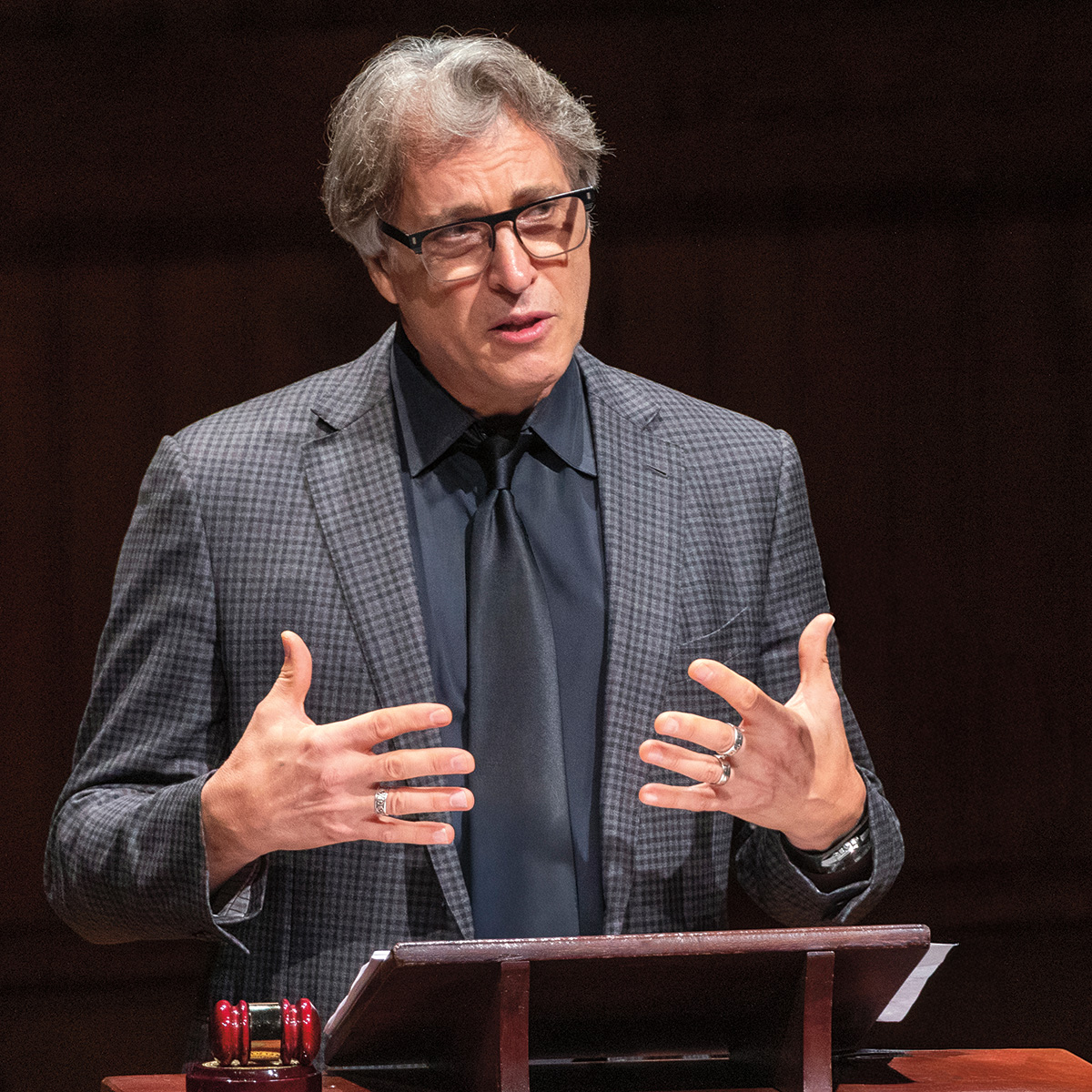
Thank you. It is an honor and a deeply heartwarming surprise to be inducted into this distinguished institution. I am equally honored to speak on behalf of my fellow inductees: scholars and innovators I hold in the highest regard. I want to give a special shout-out to another inductee who’s here today, Woody Powell. He was not my advisor, but he became a mentor after I graduated, and helped me in my career in so many different ways. I don’t think I’d be here today without you, Woody. So, thank you.
I am reminded that innovation and creativity in science and the arts are not solo pursuits of discovery, but a network of collaborators, tutors, and mentors that removes our blind spots and inspires our creativity. For me, today’s celebration is about honoring that lineage of ideas and people—the shoulders we have all stood upon on our way to making our individual achievements, which we are being honored for today.
My own scientific efforts have focused on understanding the dynamics of collaboration and creativity in science, the arts, and many things in between. I’ve studied what stimulates creativity, how you show others the merits of your good ideas, and how breakthroughs can turn into breakdowns in the same way that social media turned individually smart people into collectively dumb crowds.
It’s tempting, looking back, to imagine one’s work as a logical unfolding of ideas, a puzzle that slowly but inevitably comes together. But, for me, my journey has been one of fits and starts. I began in a two-year community college. My first experience in graduate school was a disaster. I loved science, but I was academically ill-prepared, and I felt quite misplaced. So after about two years, I decided to start exploring other things.
One evening, while wandering through the stacks in the library, I stumbled upon a book titled Getting a Job. How lucky was that? It was exactly what I was looking for. And, quite frankly, I really liked the book because it had only seventy-five pages and I could read it in an evening. But when I opened it, I realized it wasn’t about résumés and interviews at all; it was about how people achieve extraordinary things through their social networks. The next day, I applied to the PhD program at Stony Brook to work under the book’s author, the remarkable Mark Granovetter, and there my intellectual pursuits took root.
I found that human creativity rarely followed a straight line. Like my life experiences, it moves in fits and starts, down blind alleys, around detours, and through moments of serendipity. Yet beneath all of that apparent chaos, which many of us in this room have experienced, whether I studied it ethnographically or in tremendous databases of tens of millions of observations, certain principles emerged. I would like to share three, in particular, with you today.
The first is this: many people enter a collaboration, a team, or a partnership determined to prove how smart they are. And that impulse makes a lot of sense—we all want to establish credibility and show our value. But what I observed was almost the opposite. The most consistently creative and productive collaborations weren’t driven by people trying to demonstrate their own intelligence; they were built by people who helped others discover their potential.
In other words, the principle is don’t show others how smart you are; show others how smart they can be. When you do that, you unlock something extraordinary. You remove fear of judgment. You replace defensiveness with playfulness. You create a sense of shared jubilation that pours sunlight on creativity. In other words, when you make others feel smarter about themselves, you create the foundation on which every great collaboration stands.
The second principle challenges one of the great myths about creativity. We often think of breakthroughs as “Eureka!” moments—flashes of genius when an idea swings into our mind like Tarzan on a vine. But in truth, creativity is far less about lightning strikes and far more about what I would call the import-export business of ideas.
What do I mean by that? Creativity rarely involves inventing something new. More often, it’s about transporting an idea, invention, or insight from one domain where it’s already accepted—where it’s practically invisible because it’s so well understood—and bringing it into a new domain where it looks like an invention. That shift in context is what turns an ordinary idea into an extraordinary one. And this realization is quite liberating, because it means creativity isn’t just the gift of birth, or something you run out of in life; it’s a product of your connections. To have a good idea, you just need to know many people who have different ideas. Diversity of thought is the raw material for the import-export business of innovation.
The third principle is about how you show others the merits of your good ideas once you’ve created them. It’s tempting to think that great ideas win on logic alone, that their power lies in their math, clarity, or precision of arguments. My research suggests something much more subtle: the acceptance of an idea in a collaboration depends on the story it tells—the way it’s framed, described, and grounded in a context that others can see and feel.
Adam Smith, for example, explicated the economic blueprint for capitalism not in the study of industrial empires, but in the constrained context of a lowly pin factory. Jane Goodall unlocked the secrets of primate behavior not by studying chimpanzees from the outside looking in, but from the inside looking out. Universal truths can often be communicated in a narrow lens that helps others see and grasp new concepts, and when they have a stake in those new concepts, that’s when they make a difference. If you want to improve your chances of a great collaboration and a breakthrough, my advice is to find your pin factory.
Recently, AI extended collaboration from human-to-human to human-and-machine partnerships. Many predict, myself included, that soon the most important contact in our network, in our team, and in our lab will no longer be another human being; it will be a bot. Machines are improving rapidly, suggesting they would be potent creative partners. Yet research shows the opposite: bots often dampen our creativity. Why? Because humans tend to defer to bots, and bots give commodity-like responses. These bot-given answers miss the novelty that makes creativity profound.
How do we create the best mind + machine collaborations? It’s not when humans ask machines for an answer. The best collaborations occur when humans ask machines how to think better, not what to think. When you ask a machine how to think better and not what to think, that’s when innovators get process guidance from machines for enhancing their own creativity. And the bot, in turn, offers a scaffolding for the innovator to fill in with their original ideas, colors, and secret sauce. This is what creates the profound, unique solution.
In this way, bots remind us that human creativity is a team effort embedded in a network of connections. Today’s celebration here in this room honors that truth about human creativity, and indeed confirms it.
In conclusion, I would like to express my thanks again to the Academy for helping others feel smarter about themselves.
© 2026 by Brian D. Uzzi
Jacqueline Woodson
Jacqueline Woodson is an American writer of books for adults, children, and adolescents. After serving as the Young People’s Poet Laureate from 2015 to 2017, she was named the National Ambassador for Young People’s Literature by the Library of Congress for 2018 to 2019. In 2020, she received a MacArthur Fellowship. She was elected to the American Academy of Arts and Sciences in 2025.
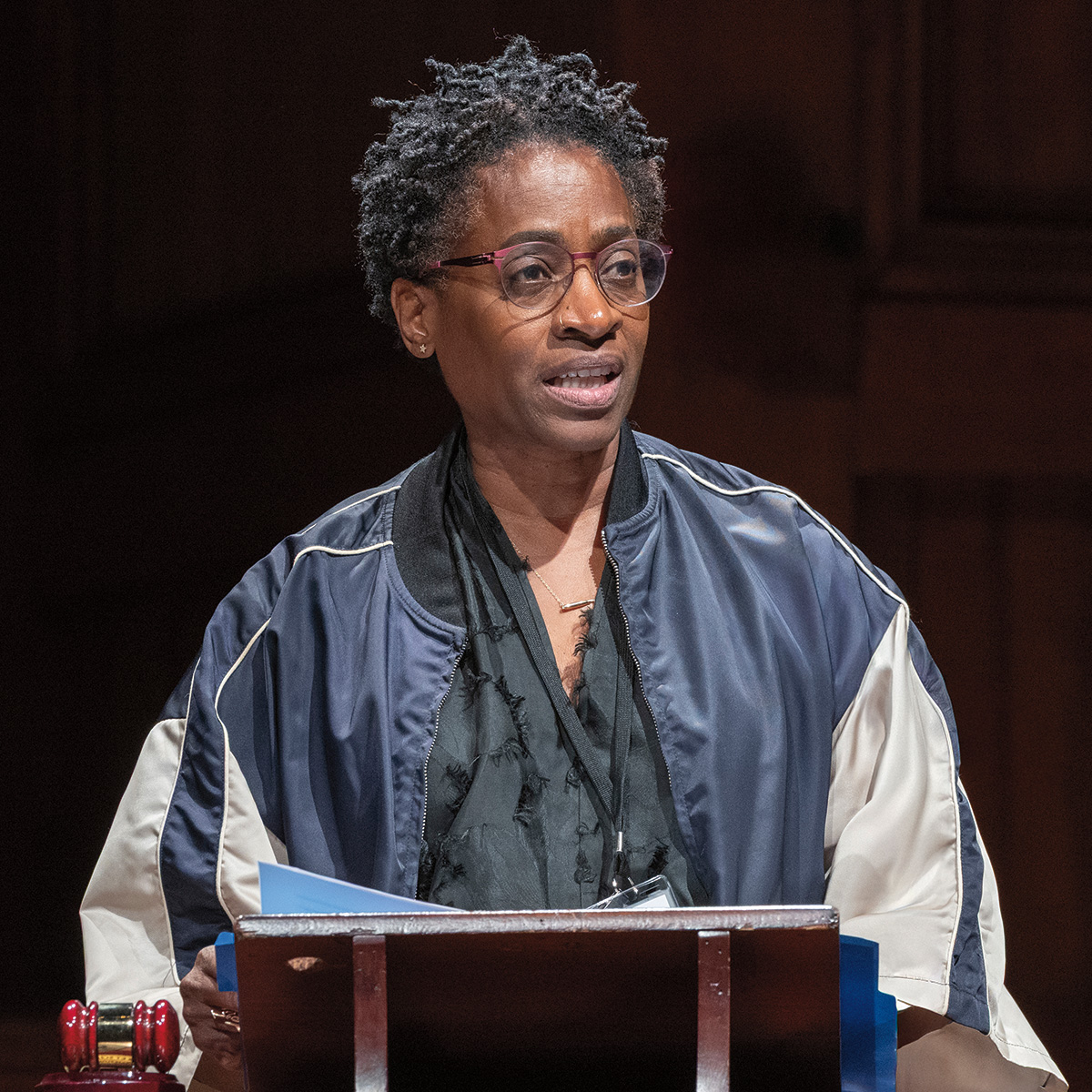
I am so grateful to be here with all of you. Until the late 1990s, the biggest award that I had received was for a poem I wrote in fifth grade as part of a borough-wide tribute to Black History Month. It was Brooklyn. It was the 1970s. The prize was a Scrabble game and the poem began with the lines: “Black brothers, Black sisters, all of them were great / No fear, no fright, but the willingness to fight.” On Sesame Street, Jesse Jackson was telling us to raise our fist in the air and repeat after him, “I am somebody.” There was The Electric Company on PBS, where Morgan Freeman, Rita Moreno, and the beautiful Lee Chamberlin—who, like my childhood self, had a gap-toothed smile—were teaching us phonics and spelling through comedy, song, and African American vernacular. In Ebony magazine and on Soul Train, models and dancers sported Afros so high and weightless, gravity felt like a choice only some of us had mistakenly made.
In this world, I began writing about the people I loved, about the people who were around me and sometimes, thanks to my parents’ curation of our television consumption, on our TV screen. And yet, too often the people who looked like me were not on the pages of the books I was reading. The hole in my literature became a hole in my life. Dr. Rudine Sims Bishop, Godmother to the Multicultural Children’s Literature Movement, said that young people need both mirrors and windows in their literature: Mirrors so that they can see themselves in the narrative, and by extension, in the bigger world; windows so that they can see into the lives of folks not like themselves. Through books, we learned, readers gain empathy and understanding for people that they might never meet. As a child, I had very few mirrors in my books and too many windows into the white world.
Six years after Dr. Bishop’s 1990 article, “Mirrors, Windows, and Sliding Glass Doors,” was published, with Dr. Bishop on the committee, I received a Coretta Scott King Honor Award for my fifth novel, From the Notebooks of Melanin Sun. Like the ones I had written before, this book was a response to the hole in my life. I’m sure many in the room know this hole. We felt it in our bodies and spent years attempting to fill it: with literature, poetry, film, information, human-made technologies. We filled it with what we thought we knew, and what we learned to be true.
The year I won the CSK Award, I invited my mother and grandmother to the ceremony—a lavish breakfast at the American Library Association conference in Chicago. At the time, the Coretta Scott King breakfast ceremony required the purchase of a $75 ticket. My publisher paid for my family’s tickets, and I proudly whispered to my grandmother that they had done so. As she sat through the ceremony replete in a Sunday hat and dress, picking at her food, I watched the displeasure move across her face, then fade again. Later, when I asked her what she thought of the ceremony, one that included a gospel choir singing the Black National Anthem, “Lift Every Voice and Sing,” and the librarian presenting me with an oversized framed award honoring the book, my grandmother leaned close to me and whispered, “That food was all right, Jackie, but it wasn’t worth no seventy-five dollars.” Although I was raised in Brooklyn, I come from a very Southern, very particular, very honest kind of people.
While we are standing here on the shoulders of men who once walked through this country with the teeth of our enslaved ancestors in their mouths—I see you, George Washington—we are also standing on the shoulders of those who loved us, fought for our freedoms, and reminded us that if you’re paying seventy-five dollars for a breakfast in the early 1990s, the food better be amazing. They reminded us that we are amazing. But while they did so, they also let us know about the danger of exceptionalism; that making the circle small and particular leaves out so many voices of people who have a wider field of knowledge about life in the spaces where they’re living it. The elders reminded us again and again that it is our shared humanity, our sense of community, and our ability to see the beauty and brilliance in folks across the lines of what we think we know beauty and brilliance to be that keeps us on a forward path.
Throw stones into the streets of Chicago or Compton, the decimated roads of Gaza, the dark, child-filled mines of Sudan, and you’ll hit all the young Kens and Avas and Majors and Josés and Katoris and Camilles. Across the country and across the world, wherever there are young people, there is brilliance waiting to be seen, heard, and nurtured. And if we are to go down as good ancestors, that nurturing is our work.
Many of you might have followed this story last year from Toronto. While working to restore coastal wetlands, clumps of soil were extracted from the grounds near a waterfront. Scientists wanted to examine this soil for trace elements of the plants that once grew in the area, but when they re-exposed the soil to water and air, a Lazarus of water fleas, worms, zooplankton, and larva that had lain dormant since the 1800s sprung back to life.
Whose bones had rested beside them all those years? What stories have returned with these creatures?
I think of the creative force of art and science. As we move through this era of AI, of great destruction, of the silencing of voices and the elimination of people, and of the banning of books, what part of art and science and us will remain evergreen? How does the work we are doing now serve those coming up behind us, and the ones coming behind them, and them, and them? Will they remember us as the equivalent of someone who walked through this country with their ancestors’ teeth in our mouths? Back then, an innovation, but now, not so much. All of us in this room have proven that we have the ability to think outside of what we’ve been told and shown to be true. So how do we not only widen this circle but extend its life?
Long after we are bones and dust and ash, who will pull from the dormant earth a long-ago memory of us? And what will that memory be?
© 2026 by Jacqueline Woodson
Christine Brennan
Christine Brennan is an award-winning national sports columnist for USA Today, a Professor of Practice at Northwestern’s Medill School, a commentator for CNN, ABC News, PBS News Hour, and National Public Radio, and a best-selling author. She was elected to the American Academy of Arts and Sciences in 2025.
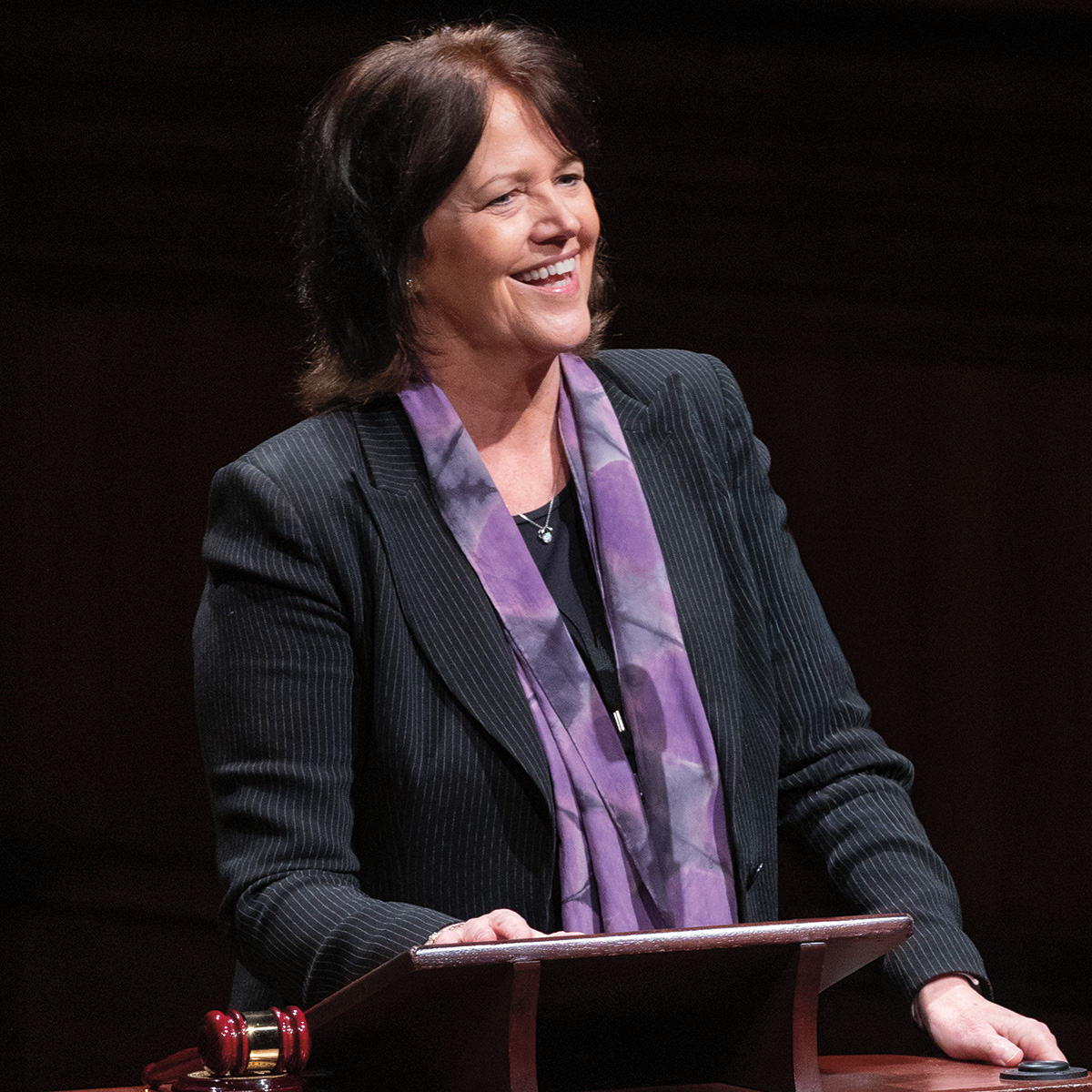
Before I begin, I would like to say how important it is to have role models, to have someone to look up to who looks like you. It’s a common theme here, the diversity and inclusion of this Academy.
Growing up in Toledo, Ohio, we were an NBC News family. We would watch John Chancellor every night, and my hope was that maybe there would be a place for me in journalism, potentially sports journalism or covering politics. I didn’t know then which one. There was a young reporter on the campaign trail with a certain governor from Georgia named Jimmy Carter, and then that reporter was often on the White House lawn, covering Carter’s administration. That reporter was the great Judy Woodruff. Billie Jean King says you have to see it to be it, and that was so true for me. As an eighteen-year-old, about to head off to Northwestern for journalism school, I learned that if I could see it, I might be able to become it.
Judy, I am honored to be here on this stage with you and to be part of this new class of Academy inductees. I wonder what eighteen-year-old me would think of this? And Al Hunt, wherever you are, are you checking the sports scores right now?
A few minutes ago, my watch told me that it was time to stand up, and I think probably all of your watches are screaming at you as well. As the last speaker, I’m going to keep my remarks short. “So in conclusion . . . .” Okay, not quite that short.
There is something that hasn’t received enough coverage in the media—either in the sports media or in the cultural news media—over the last fifty-three years, and it is something that is changing America. It’s happening right under our feet—in our kitchens, on our playing fields—and it is this incredible revolution in women’s sports. Title IX, the law that opened the floodgates for girls and women to play sports, was signed fifty-three years ago, on June 23, 1972.
For generations in this country, we told our daughters, granddaughters, nieces, the girls next door that no, you cannot play sports. You cannot do what your brothers are doing. You cannot learn the life lessons that your brother or the boy across the street is learning. You cannot learn how to win at a young age. Even more important, you cannot learn how to lose at a young age. You cannot learn about teamwork, sportsmanship, physical fitness, and leadership. What were we thinking at the time?
As you can see, I’m quite tall. My mom joked I was born size 6X and kept right on growing. When I was a Girl Scout, she would let the hem out of my Girl Scout dress until it was time to leave Girl Scouts. I wanted to play sports with the boys, and my mom and especially my dad, who had been a football player in high school and college, said, “Yes, honey, sure. Go ahead and play with the boys.” Most women my age were being told no, you cannot play sports. How lucky was I that my mom and dad said yes, that I had the opportunity to have these experiences.
We went to dozens of football games. We grew up as Michigan fans and had season tickets for those games as well as University of Toledo and Toledo Mud Hens games, and we would go to see the Detroit Tigers and the Chicago White Sox play as well. Obviously, sports were a huge part of my life, and I was so lucky to have that. But other than me being out on the field with the boys, there were no other girls. I meet a lot of women my age at book signings, and they all say, “Oh, if only I could have played sports. My life would’ve been different. But I never had the opportunity.”
As I mentioned, Title IX was signed in June 1972, but the law was ignored for about fifteen years. There are some schools, including some that have been honored here today, that may not be following the law even now. But the good news is that there are three prongs to this law, and one of them is that if you’re showing that you are working toward compliance with Title IX, then you are in compliance with Title IX. Unfortunately, we all know that the battles for equality in America continue, and we are facing many new challenges in the Trump administration.
A year and a half after Title IX was signed by Richard Nixon, Billie Jean King beat Bobby Riggs in the Battle of the Sexes. He was a self-described male chauvinist pig. When he was quite ill and close to death, one of the last phone calls he received was from Billie Jean King. They became quite good friends, and Billie was there for him to the end.
Let’s move ahead to the 1996 Atlanta Olympics. At a press conference, swimmer Amy Van Dyken said the following words: “These days it’s cool for a woman to be able to bench press her husband.”
Some of you may remember where you were on July 10, 1999. The Rose Bowl, the football stadium built for men to play football, was filled to capacity, over ninety thousand spectators, to watch the U.S. women’s soccer team play China in the World Cup. We saw the great save by Briana Scurry, a dear friend of mine to this day. She was the first Black superstar on the most famous women’s sports team on the planet. And then, Brandi Chastain makes the famous penalty kick, takes off her shirt, whips it over her head, and reveals the most famous sports bra in history. That started an entirely new era in women’s sports.
These women were wearing baggy shorts, baggy shirts, and tall socks, not sequined figure skating dresses, tennis dresses, gymnastic leotards, or swimsuits. They were dressed like men, and the nation fell in love with them.
Two and a half years after that, a little girl was born in Des Moines, Iowa. Her name is Caitlin Clark. Three years ago, I had barely heard of Caitlin Clark, showing how quickly we are now moving in terms of the opportunities for girls’ and women’s sports. But we’re not there yet, by any means. We have failed miserably in our urban and rural underserved areas. Though we’ve won the Title IX battle in the suburbs, we have not reached so many of the young women and girls who deserve the opportunity to play. I’m speaking about the Black and Hispanic communities. We need to do a much better job in the next fifty years of Title IX to reach those who have so far been unreachable.
And we also have to do a much better job of having women coaching women. While we see men coaching women, we want our daughters, our nieces, our granddaughters to think that they can have a career in sports long after their playing career is over. And how better to do that than to have a female coach who is showing them exactly what leadership looks like. Unfortunately, because women’s sports are now so popular, many of these athletic directors are white men, and they are hiring people to coach women who look just like them. We have to do a much better job in this area.
Let me leave you with one final thought. The girl you see in the kitchen every morning; the girl you wave at as she’s loading the car with her gear for volleyball, softball, or lacrosse; your niece, your granddaughter, your daughter: whatever she becomes—a lawyer, a doctor, a businessperson, a member of this Academy, a teacher, a wife, a mother, a coach, or some combination thereof—she will be better at it because she played sports and learned so many important life lessons.
Despite what’s happening right now, I’m optimistic about the future of this country. I believe we will see women become president of this nation, lead more Fortune 500 companies, serve as university presidents, and hold positions of real power. How do I know this? Because we see them as we drive by the fields every day. Those young women and young girls who are playing sports because of Title IX are learning important life lessons, and they are the ones who are going to lead this country. Thank you.
© 2026 by Christine Brennan
To view or listen to the presentations, visit the Academy’s website.