As of January, less than half of Americans used artificial intelligence tools (AI) to perform each of a variety of common tasks, but a substantial minority used AI for some humanities-related tasks, according to a recent survey sponsored by the Academy’s Humanities Indicators project.
The Indicators fielded a question on the January 2026 NORC AmeriSpeak Omnibus survey, asking a representative sample of American adults how often they use AI to conduct a variety of common tasks.1 Most of the surveyed tasks were humanities-related (including learning about the history of something; writing, revising, and summarizing a text; translating from another language; or considering an ethical problem). For comparative purposes, the survey also asked about some STEM-related tasks (solving a math problem, developing a computer program, or analyzing data) and some artistic activities (generating an image or creating a program or song). A final task, brainstorming a creative idea, potentially encompasses all three fields.2
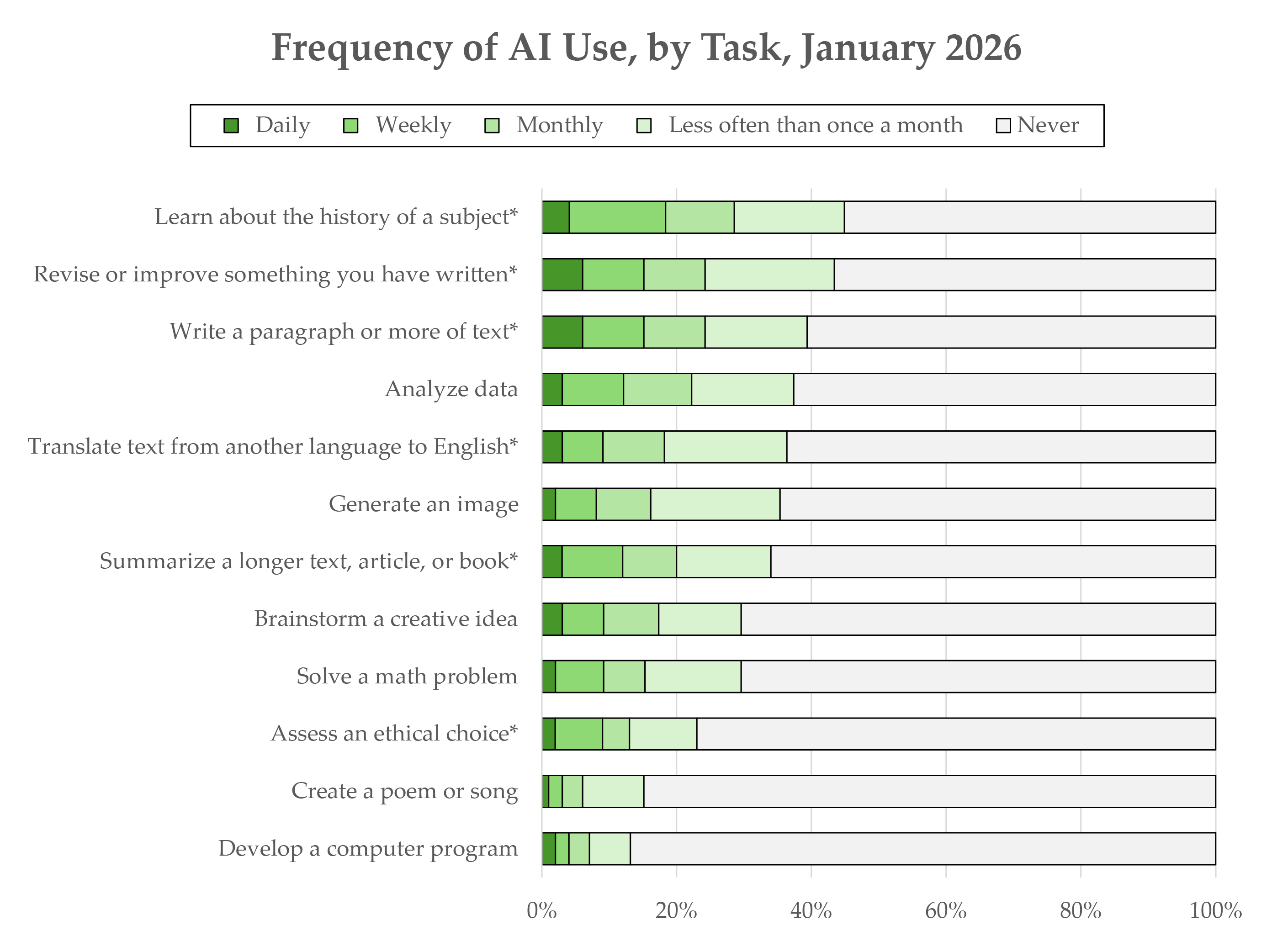
* Humanities tasks
Source:NORC AmeriSpeak Omnibus Survey, conducted January 2026. Data analyzed and presented by the American Academy of Arts & Sciences’ Humanities Indicators Project.
The data reveal that most American adults have not used AI to perform any of the tasks indicated but they were more likely to use AI for humanities-related tasks. Of the twelve tasks included in the survey, Americans were most likely to have used AI to learn about the history of a subject, with 46% having made at least some use of AI for this purpose and 19% reporting daily or weekly AI use to accomplish this task. A substantial share of people used AI for revision of a text (with 44% having done so and 15% doing so at least weekly). A similar share used AI to write a paragraph or more of text (40% at least once, and 15% at least weekly).
Among the other humanistic activities, a substantial share of people used AI at least occasionally to translate text from another language to English (37%) or to summarize a longer piece of text or a book (34%). Comparable shares of Americans used AI to perform other types of tasks, including analyzing data (38%), generating an image (36%), solving a math problem (31%), or brainstorming a creative idea (31%). A far smaller share used AI to create a poem or song (16%) or develop a computer program (14%). Among the humanities-related tasks, Americans were least likely to have used AI to assess an ethical choice (23%).
Across most tasks about which the survey asked, younger Americans were more likely to be daily or weekly users of AI, especially those in the 30–44-year-old age bracket, who were significantly more likely than people age 60+ to regularly use AI to write text or analyze data. Conversely, for every task, older Americans (ages 60+) were the least likely to say they ever used AI. Almost 60% said they never turn to AI to learn about the history of a subject. For all other tasks, more than 70% never used AI.
For most tasks, higher income Americans were more likely to use AI. People with $100,000+ in annual income were considerably more likely than less affluent Americans to use AI to write, revise, or summarize text.
The use of AI for humanities tasks was also positively associated with education level, a linkage not found with other types of tasks. Americans with a bachelor’s degree were approximately twice as likely to use AI to write, revise, or summarize text daily or weekly compared to those without the degree. Twenty-three percent of bachelor’s degree holders reported turning to AI on a daily or weekly basis to revise or improve something they had written, compared to just 10% of those with some college or an associate’s degree and 12% of those with a high school degree or less education. Eighteen percent of bachelor’s degree holders reported using AI to summarize text, compared to less than 10% of those without the degree. Conversely, Americans with a high school were more likely than people with more education to turn to AI to solve a math problem on a daily or weekly basis (13%, compared to 7% of those with at least some college).
For virtually every task, little difference was observed in the shares of men and women using AI on a daily or weekly basis. However, more men (23%) than women (15%) reported using AI to look up the history of something.
Other recent surveys point to widespread public concern about the implications of AI use, but increasing use in the workplace.3 In this survey, only a tiny percentage (from 1 to 6% depending on the measure used to gauge intensity) of the population were high intensity users (people who typically used AI for various tasks daily or weekly). The high-intensity users employed AI for a much greater number of tasks than lower-intensity users. On average, high-intensity users employed AI at least weekly for at least nine of the 12 tasks examined in the survey. People who use AI less intensively (typically only monthly or less than monthly) used it for only two tasks. Those who reported mostly never using AI used it for the fewest tasks.
While it leaves many questions unanswered, this survey provides some perspective on the extent of AI use to explore the humanities compared to other common forms of intellectual activity. If you have thoughts or suggestions as to how this survey could be improved or expanded in the future, please contact rtownsend@amacad.org.