Faculty and Staff
Role of Faculty
The intellectual community fostered by faculty members was cited by chairs as another primary strength of humanities departments. Whether this community was more focused on innovation in research (“We are thought leaders in [our discipline]”) or in teaching (“We’re very progressive pedagogically”) depended on the institution type, but in both cases chairs described the variety of activities their faculty are doing to support students, to promote cross-campus connection, and to advance their discipline. Several mentioned that their faculty are involved in institutional governance or student service initiatives, emphasizing their value as colleagues who provide a relational and programmatic lubricant within the institution.
Share of Department Chairs Reporting a Change in the Number of Tenure-Line Faculty from Fall 2020 to Fall 2023, by Discipline
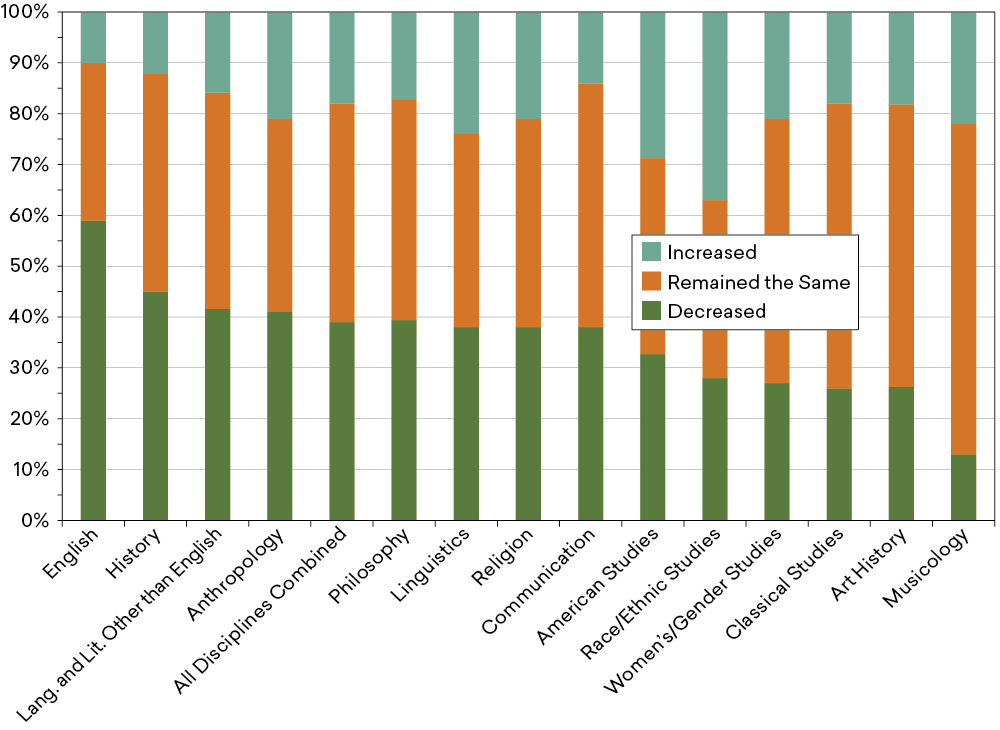
Source: Humanities Indicators of the American Academy of Arts and Sciences, The Academic Humanities Today: Findings from the 2024 Department Survey (American Academy of Arts and Sciences, 2025), 7.
Understandably, given the importance of departmental community, a primary metric used by chairs to assess their department’s health is the ability to keep a consistent number of tenure-track faculty over time—that is, an ability to hire a replacement when a faculty member leaves and to retain the new hire long-term. Chairs frequently cited faculty age as a reason for faculty turnover (primarily through faculty retirements), and nearly half of chairs said they did not expect to see retiring tenure-line faculty members replaced or had already seen tenure lines cut when faculty left. An inability to replace a tenured faculty line was a major source of pessimism among chairs in our sample. One chair at a private baccalaureate institution was given less than five lines to replace double that number of retiring faculty, causing “an issue for continuity, an issue for mentorship.” While about a third of chairs reported they were able to hire, a majority of these noted problems retaining new faculty members, often due to low salaries or unwelcoming working conditions (chairs occasionally noted that these faculty left for better jobs at other institutions). One chair at a private doctoral institution noted proudly, “We have been able to hire.” In our sample of thirty, this chair was one of only three to report being able to hire and successfully retain faculty.
The combination of, on the one hand, departments that provide a high level of care to students and a high level of service to the institution and, on the other hand, a diminishing number of faculty to do that work contributes to another major challenge noted by many chairs: faculty “exhaustion” and “burnout.” “We are extraordinarily underresourced,” explained one; with “a shoestring budget,” noted another. This leads faculty to feel “drained” due to “increasing demands.” One chair explained that their job is to say “no” when administrators ask for more service than they are able to provide, but this puts their department in a difficult position when they need something.
The aftereffects of the COVID-19 pandemic and the adjustment to online teaching are also sources of faculty fatigue. A few chairs felt faculty were less physically present on campus as a result. One chair at a large private research university remarked, “my building feels empty all the time. . . . People go there to teach their classes and then they leave campus.” A chair at a small private college noted that the spring 2025 semester was “the first time since COVID” that they have “had significant student and faculty turnout for those 6 pm events.” In addition, more than a third of chairs reported increased student stress, particularly around the sustained attention needed for reading, and some linked it to the “lingering” pandemic as well: “We are seeing a huge increase in student anxiety and depression. It could be COVID-related or not. Students are so different from five years ago in terms of how they react.” Faculty dealing with their own fatigue may lack the tools to assist these overwhelmed students.
Role of Staff
Chairs were not just concerned about retaining and replacing faculty. About a third of chairs expressed similar concerns related to departmental staff. Chairs reported frequent staff turnover because staff are “underpaid” and because the institutional push for efficiency creates undesirable working conditions. As one chair at a public doctoral institution noted, to “avoid the idea of one office staff person per department, [which] the university sees as wasteful,” institutions use the “secretarial pool idea—the idea that one person will do one task (for example, travel requests) for all departments, and this will be their only job.” Another chair at a public doctoral institution elaborated, “Then they hire this [staff person] who does this one thing all the time for everyone—and they can’t keep this staff person.” Chairs also described how the burden of staff labor falls on faculty when staff leave and are not replaced. According to a chair at a public doctoral institution who shares department staff across four units, “Things fall through the cracks, and faculty take on responsibilities that the staff can’t handle. When staff leave, faculty have to fill in the gaps.” This chair hoped that an upcoming staff reorganization would “[delineate] responsibilities more clearly [and allow] work that faculty have taken on to be taken on by staff.” Though frequent staff turnover and adversarial relationships with advising were mentioned in the interviews, none of the chairs mentioned that frequent turnover of advising staff may also have an impact on departments’ ability to develop relationships with advisors who might direct students to their department.