Students: Enrollment and Majors
Enrollment in Humanities Courses
Humanities chairs saw serving students as central to their departments’ mission, and many described their faculty as passionate about teaching and mentoring. That said, getting students to enroll in their departments’ courses was often a challenge. Offering courses that count toward general education or other institutional requirements (e.g., language and writing-intensive courses) was the most common strategy that humanities chairs mentioned as helping to keep their enrollment numbers up.
While chairs saw inclusion in general education or other requirements as important lifelines for their departments, they also pointed out the attendant pitfalls. First, such requirements can change—forcing departments to pivot. For instance, one chair explained that, when philosophy was taken out of core undergraduate requirements, their department had to start offering courses that contributed to other core programs, such as the honors program. Other chairs also mentioned contributing to honors or other interdisciplinary programs as one of the ways they keep enrollment up.
Another common issue was that many chairs felt their administration—and even some students—saw their department as primarily existing to serve general education or other requirements. In one focus group, participants emphasized the idea of their department being “instrumentalized” to perform this service. As one English chair from this group commented, “We’re perceived as instrumentalized. We just teach you how to write a sentence—that isn’t what we went to grad school for.” A philosophy chair in the same group emphasized that the “intrinsic” value of their discipline might be overlooked due to this kind of “instrumentalization.” “I do think philosophy is instrumentally valuable,” they explained. “For example, in the context of disability studies for education, nursing, or sociology students. But philosophy is not only valuable in this way; all learning has some degree of intrinsic value.”
The Major Selection Process
Most students enrolled in courses offered by the focus-group chairs’ departments are nonmajors. Convincing these students to become majors is a significant hurdle. When we asked chairs about the biggest challenge their department was facing, one history chair summed up the sentiments of many: “When you have a student in a class, how do you turn them into a major?”
The perception that humanities degrees severely limit your employment options as a graduate—especially if you aspire to have a high-paying job—was by far the dominant reason that chairs felt today’s students are gravitating away from the humanities. They saw this discourse around the humanities as inextricably linked to the wider shift in focus toward career preparation at U.S. higher education institutions. As one English chair from an institution serving mostly first-generation students explained, “careers the students are familiar with are ‘professions’—law, nursing, business. So they don’t understand what to do with an English major except be a teacher.” Chairs frequently described their institutions and higher education generally as increasingly “transactional” or “focused on professionalization,” ideas that for many of them clash with the role of the humanities. Another chair commented, “the mission of universities has shifted toward being vocational schools, and this has been hard for the humanities, who are focused on things like ethics, human history, and its lessons.”
Parents were the most frequently cited source for students’ ideas that a humanities degree will not prepare them to get a “good” job: around one-third of chairs described parents as driving antihumanities sentiments. Parents, more so than students, see students’ education as an investment in their future career and want a sure bet. Some chairs were understanding of this position even if they disagreed with it, acknowledging that these parents may not have gone to college themselves and may not be familiar with the types of jobs you can get with a college degree. One English department chair, for instance, described many of their students as arriving in college “curious” about English, “but their parents discourage them. They eventually make their way over to the English major later, once they are a little more removed from family pressure.” Advisors and admissions offices were also mentioned as promoting dominant discourses about the humanities and career readiness.
While interviewees often emphasized that first-generation students are especially concerned by employability upon graduation, they also indicated that the focus on career readiness is widespread among students across institution types. Chairs from large research institutions, medium-size regional schools, and small, private baccalaureate colleges reported that career readiness was a concern for their students. The sole exception was one chair at a small liberal arts college who felt most students choosing to attend their institution “had already rejected the preprofessionalism idea.” However, chairs from other small liberal arts colleges described their students’ concerns about their career trajectories in similar terms to the chairs from other types of institutions. For instance, one chair at a small liberal arts college described their students as “scared to explore intellectual interests if it won’t help them with their future careers.” Another chair at a similar institution described their students as “very professionalized” and “taking classes that are ‘better’ for their career and future.”
Strategies for Boosting Enrollment and Majors
Diversification Initiatives
When discussing methods for increasing the number of majors (and enrolled students) in their departments, chairs frequently acknowledged the need to do better outreach and marketing for the humanities. However, few chairs were able to describe successful marketing or outreach campaigns.
Instead, the strategies that chairs employ could be described as “show, don’t tell” approaches to communicating the value of the humanities. For students who must prioritize practical career-related concerns, simply telling them that the humanities lead to viable career paths is not enough. Chairs succeed when they demonstrate the value of the humanities to students in the here and now, while they are still students, in a way that breaks down the dividing line between the ivory tower and the real world.
The primary “show, don’t tell” approach chairs described for recruiting students was diversifying their faculty and course offerings to better match their student population. Diverse faculty and course offerings show—rather than tell—students that they are welcome in the department. These diversification initiatives teach students that their cultural and intellectual traditions are valuable areas of inquiry and in some cases even allow them to observe a potential career path. For instance, a few chairs—from English, ethnic studies, and gender studies departments—noted that their students appreciated courses that addressed social and political issues they cared about. Additionally, a diverse faculty and student body is better able to provide mentorship and coaching to students new to the discipline; one chair described a successful program founded by a former colleague that was “dedicated to supporting the mentoring of first-generation students.”
Chairs who had implemented these types of diversifying initiatives saw them as moderately to highly successful, but several admitted they still had a long way to go. For example, two philosophy chairs spoke of the enduring legacy of their discipline being white and male, and a gender studies chair said they were still working on getting more men and students of color into their classes—but others had at least seen some signs of success.
Unfortunately, the decline in the number of faculty in their departments, especially the decline of tenure lines, is a significant hurdle to such initiatives. Diversifying the faculty and course offerings is challenging when the department does not have many faculty in the first place. One English chair thought their department was actually “getting whiter over time even if institutions supposedly have a priority for that to not be the case”; namely, “because we’ve lost so many lines and are not able to replace them.” Having fewer faculty means fewer courses are offered, leading departments to serve fewer students, which is an overall negative in the effort to attract potential majors. Additionally, though this was not mentioned in the focus groups, recent federal government actions and guidance may discourage institutions from pursuing formal diversification initiatives. Future efforts to diversify faculty will likely be further curtailed.
Other “Show, Don’t Tell” Strategies: Community Engagement and Financial Incentives
Around half of chairs described how creating an innovative curriculum that highlights community engagement and other high-impact practices helps boost enrollment and major numbers. In this way, students are able to observe (versus being “told”) the “immediate material relevance” of the humanities for themselves in their local (on- and off-campus) communities. As an example, one chair described their department partnering with disadvantaged people in their community on a literary project. This hands-on experience implementing what students were learning in class demonstrated the practical value of their knowledge more than a marketing campaign could. Encouraging students to use their humanities skills in the community also demonstrates respect for students’ need for career security. Both gender studies chairs we spoke to noted an “uptick in interest” and “thriving” linked to their engaged curriculum. Chairs who mentioned departmental initiatives around high-impact practices had a more optimistic outlook overall than those who did not.
Additionally, by providing financial incentives to students, institutions can demonstrate the financial viability of humanities disciplines in the here and now. The three departments in this sample that provided financial incentives to students (through paid internships, paid summer programs, and comprehensive need-based aid) were able to show parity with disciplines in the science, technology, engineering, and mathematics (STEM) fields and demonstrate respect for students’ practical needs rather than expecting them to make financial sacrifices to study the humanities. As one chair put it, these funds show “students the kind of work they could be doing.” One chair described their financial incentive program as “very successful.” Unfortunately, the “defunding of the NEH and the NEA” (the National Endowment for the Humanities and the National Endowment for the Arts) makes establishing such programs even more difficult for most institutions.
Engaging Double Majors
Most students majoring in the humanities opt for double majors, according to chairs, as a way to balance a humanities major with a more “career-oriented” one. Therefore, making the department’s major easier to include in a double major is also an important consideration when trying to attract majors. Two chairs described making their curricula more “flexible” with “modified requirements” so that courses from other disciplines could be included.
“Second” Major at Graduation, by Primary/“First” Major (Fall 2017 Cohort, Status as of Summer 2024)
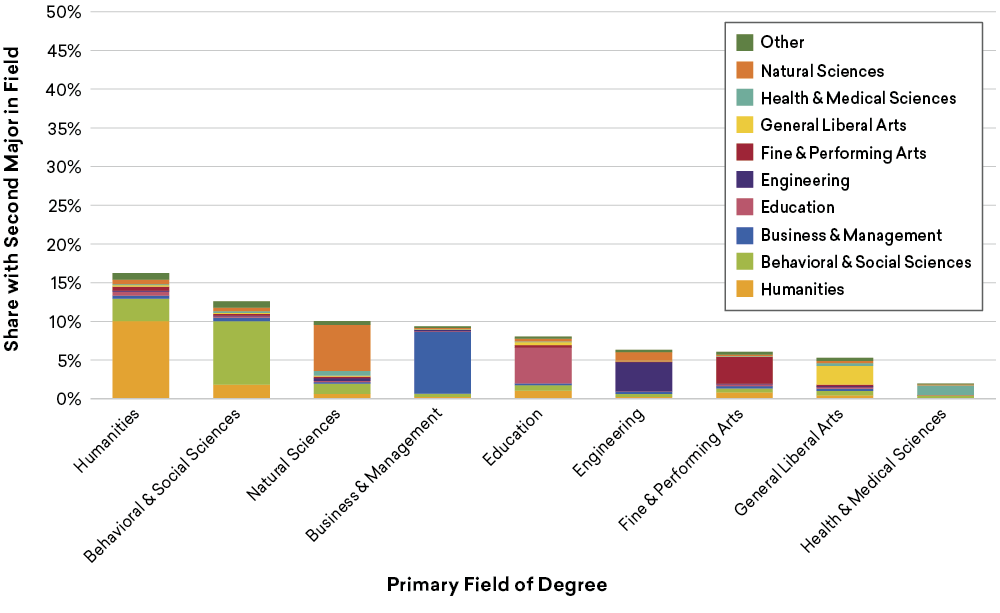
Source: National Student Clearinghouse, special data runs for the Humanities Indicators.
That said, double majors were not a solution for all institutions. One chair at a research university explained that students at their institution declare primary then additional majors, but only the primary majors count for data on the number of majors in their department and budget distributions. The major declared as primary tends to be the more “career relevant” one. Because additional majors do not hold the same weight in the administration’s reporting, this chair felt the system disadvantaged their department. Hearing this, another participant in the group from a small baccalaureate institution remarked, “that system would ruin us.”