Meeting the Moment in a Changing World
“My dream life [would be to] have a really nice brownstone, but in reality, I want to be able to afford groceries.”
—High school student in the Washington, D.C., area
Today’s Learners Face Systemic Challenges
For the last several decades, the American economy has increasingly demanded higher skill levels, especially in the face of constant technological advancement, recently accelerated by artificial intelligence (AI). Increasingly, some form of education or training after high school is necessary to meet the needs of the labor market and thrive in a changing world.2 And yet, many struggle to navigate complex education and workforce systems as they establish their lives and contribute to their communities.
The United States enjoys a 92 percent high school completion rate,3 so this Commission focused on postsecondary pathways. For those who complete a college education, signs that not every program of study guarantees a stable, family-sustaining wage are increasing, especially in the context of growing student loan debt.4 Although college learners continue to see value in their studies, public discourse has questioned the accessibility and affordability of a college education.5 Yet, the “college wage premium”—the amount earned by workers with a college degree as compared to peers with a high school diploma—has shown great and enduring financial and social value to college graduates.6 Pre-pandemic, this premium was estimated at more than $1 million over a worker’s career, and those higher earnings are still realized post-pandemic.7 College graduates are less likely to be unemployed, more likely to participate in a retirement plan, more likely to have health insurance, and less likely to experience poverty.8 These benefits beyond wages have a real and meaningful impact on people’s lives.
“I am a first-generation college student, and I did not have a lot of knowledge about college. I didn’t know much, my family didn’t know much, so there wasn’t many people in my corner who could help me. When it came to narrowing down schools and working out grants and trying to figure all of that stuff out, I literally had to do that on my own.”
—Learner at a four-year public HBCU in Maryland
Many Americans picture ivy-covered brick and grassy quads when they imagine what “college” looks like; however, many learners do not have a residential college experience. In fall 2023, community college learners made up 39 percent of all undergraduates, and only 28 percent of those institutions provide on-campus housing.9 Furthermore, 20 percent of learners enrolled at a community college were dual-enrollment high school students and thus more likely to live at home as well.
Figure 1: Who Are Today’s Learners?
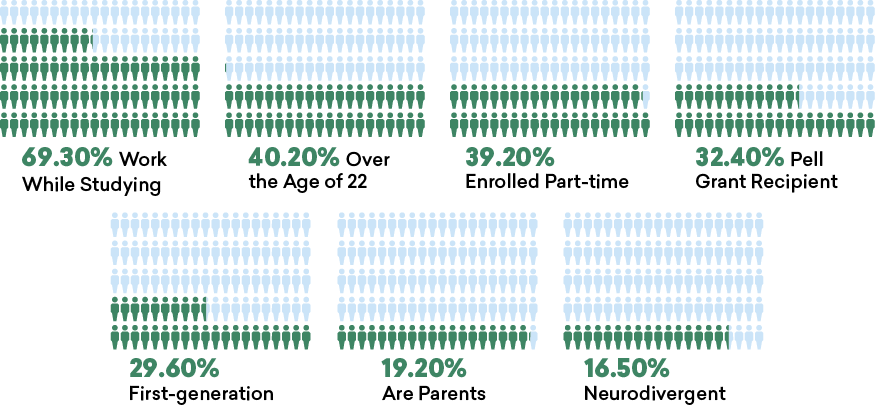
Source: U.S. Department of Education, National Center for Education Statistics, Integrated Postsecondary Education Data System, IPEDS Trend Generator; and Dave Tucker, Jacob Goodwin, and Sam Alexander, The New Majority Learner Report (Genio, 2025).
Learners today face many barriers, and large differences in experience separate students from high poverty and rural high schools when compared to peers who are more likely to matriculate immediately following high school graduation and attend a four-year institution full time.10 Many students are juggling their schoolwork alongside childcare or other caregiving duties and a variable, shift-based work schedule. They may also be eligible for fewer support services, including financial aid, based on their part-time enrollment status.
Some of the challenges students face are rooted in earlier educational experiences. The structure of the K–12 education system and funding in the United States greatly influences which students are prepared for and enroll in college, with almost 55 percent of rural high school graduates immediately enrolling in college compared to almost 64 percent of their suburban peers.11 Although they may face more barriers, these learners deserve accessible routes to postsecondary opportunity and have valuable lived experience and varied perspectives to bring into the classroom and workplace.
Additional structural barriers are created by the fragmentation of the U.S. education and workforce development systems across federal, state, and local levels, with programs often administered through separate agencies, with different funding streams, accountability systems, and eligibility requirements.12 Education, social services, workforce training, and economic development initiatives frequently operate in parallel rather than in coordination, creating a complex landscape that learners and workers must navigate to access financial aid, credentials, childcare, transportation assistance, and employment services like career counseling. These silos can result in duplicative processes, inconsistent guidance, gaps in service delivery, and barriers to credit transfer or credential recognition, particularly for learners from historically underserved communities and for individuals balancing work and family responsibilities. As labor market demands evolve more rapidly, the lack of alignment across systems can also hinder states’ and regions’ ability to create clear pathways that connect education and training programs to quality employment opportunities in high-demand occupations.
In the midst of these many challenges, learners today still have big dreams for their futures. In the Commission’s listening sessions across the United States—from Bismarck to Indianapolis to Los Angeles—high school and college learners repeatedly said that their vision of “the good life” included being able to give back to their communities, feel passionate about their work, and have a better understanding of themselves as people. Learners shared with the Commission that they hoped both to increase their earning potential and develop a sense of purpose and community connection. Unfortunately, these conversations about what a “good life” in ten years might look like were peppered with caveats about needing financial stability, securing safe housing, and taking care of their families.
“I want to give back to my community. I want to have an amazing legacy.”
—Learner at a community college in Texas
“I’ve always wanted to start a business on my own or go into the public or private sector. And the main thing is financial security. I never want to live paycheck to paycheck. I mean, that’s the reality for most Americans. I don’t want [to] do that. It’s a hard life.”
—High school student in the Washington, D.C., area
The Commission also heard a disconnect between what educators and administrators define as success for their high school graduates and what the learners themselves see as possible in their futures. Much of this disconnect comes down to the difference between opportunity and empowerment. Pointing learners in the direction of a door and telling them to open it and walk through is not enough. Across the United States, education and workforce systems offer up hundreds of doors without clear labels or paths to access them and little to preview what might be on the other side. To choose a door only to realize you do not fit in, cannot schedule classes around your work shifts, or are uninterested in the field can be an expensive and time-consuming mistake.
“It would be pretty amazing if every student that graduates from the system, pre-K–12, understands themselves as a learner, understands their passion and aptitude, and aptitude [to reach] their potential.”
—K–12 administrator in Texas
To truly empower learners to make the best choices for themselves, the education and workforce systems must clarify the different postsecondary paths available to learners and how they connect to various careers, while reducing barriers and increasing access for everyone. Policymakers and higher education leaders are beginning to present more transparent data about the future earning potential of programs of study, but much still needs to be done before data about all industries are more accessible to learners. The complexity of many degrees leading to multiple career paths and rapidly changing workforce needs will not simply be solved by increased data transparency; meaningful educator-employer partnerships and development of learners’ durable skills are also needed. Many vital and purposeful professions may earn less but provide critical services, creative outlets, and self-fulfillment that should not be devalued by relying solely on earnings data as an outcomes metric. Agency and autonomy contribute to learners’ motivation and engagement with their education, and system leaders must remember that learners are active participants in their education with the ability to make choices about their futures.13
In the face of big dreams and systemic challenges, higher education institutions and employers need to evolve past a one-size-fits-all model and adapt to better serve today’s learners.
The changing demographics of today’s learners and the country’s future talent pool necessitates an education system that better serves learners who have been underserved by postsecondary education, including learners of color, Indigenous populations, multilingual and immigrant-origin learners, individuals with disabilities, and those from rural and low-income communities.14 There is clear evidence that diverse learning environments have multiple benefits, such as improving the quality of the education provided and advancing critical thinking. The skills learned by working in diverse groups both inside and outside the classroom will help to prepare individuals to work across growing differences throughout their careers and in their communities, making this an essential skill for thriving.
“My biggest concern is that when you finish college it’s going to be hard to find a job because most of the jobs ask for experience.”
—Learner at a community college in Indiana
Investing in Multiple Pathways to Thriving in Education, Work, and Life
In the Commission’s view, a variety of education and training options must be available when referring to opportunities after high school, higher education, or postsecondary pathways, including two-year and four-year institutions of higher education, apprenticeships, workforce development programs, service-year opportunities, and military service. College is also more than solely attaining a credential or acquiring specific knowledge and technical skills. Learners gain valuable experience, interpersonal skills, and other benefits through attending a postsecondary education or training program, which should also be reflected in any credential earned.
The education system’s emphasis on college enrollment and one-size-fits-all solutions designed for eighteen-year-olds matriculating immediately following high school graduation is too reductive and limiting, and learners and families deserve more information and nuance when considering their options. The future of work is unpredictable. Educators and employers must work together to identify and iterate on an updated conception of the skills, competencies, and experiences that will prepare learners for future success and empower them to adapt to an ever-changing economy.
The skills that employers across all sectors value, from technical skills to durable skills like communication and critical thinking, can be developed in classrooms and through experiences outside the classroom, such as military service and service-year programs. Evidence shows that military veterans are more likely to earn postsecondary degrees, to stay in their jobs in the first six months, and to have eight of employers’ top ten most-needed skills.15 Alumni of service-year programs are more likely to go on to pursue a bachelor’s degree and enter a variety of careers with higher salaries than their peers.16 Whichever path they choose, to realize agency in the choice, learners are well served to have early and persistent exposure to and experiences in a variety of career fields, postsecondary paths, and valuable skills.
“College opens a lot of opportunities. You can build connections, meet people, and learn the subjects you want to pursue.”
—Learner at a community college in Colorado
Even when degree programs have clear, demonstrable value, many learners do not complete a degree and do not reap the full benefits of higher education. Among part-time or full-time students at degree-granting postsecondary educational institutions in the United States in 2019, 61 percent completed their degree program in six years.17 This completion rate has remained stagnant for four cohorts. Several colleges and universities have initiated efforts to support more learners in completing their degrees.18
One of the largest barriers to completing a college degree and seeing the subsequent economic and social benefits is the total cost of attendance and the many hurdles in place that complicate receiving financial aid. Many learners, especially first-generation college goers, may not think college is an option if they believe they cannot afford it. Though recent trends show that the net price—the price learners pay out-of-pocket for their education—has decreased, higher education institutions have not done a good job of communicating the true cost of attendance to learners and their families.19 The steady rise in the sticker price of a college degree, combined with the opacity and complexity of financial aid information, can discourage some individuals from pursuing a postsecondary education that could help them achieve prosperity.
Potentially influenced by affordability narratives or a clearer line of sight to emerging job opportunities, in fall 2025, the increase in undergraduate enrollment was primarily driven by increases in community college and public four-year college enrollment.20 As learners and their families “vote with their feet” and continue to invest in postsecondary education, institutions of higher education need to endeavor to provide the best possible value for that investment.
While college graduates usually outearn their peers with only high school diplomas, recent college graduates face increasing rates of unemployment and underemployment.21 Another sign of a changing world is the increasing rarity of employees spending their entire career, or even a decade, working for the same employer.22 In light of persistent barriers to degree completion and the unpredictable nature of postgraduation job outcomes, educators and employers must collaborate to provide learners with multiple accessible and affordable paths to secure industry-validated credentials and develop employable technical and durable skills to thrive throughout adulthood. Examples of such partnerships can be found among the promising practices highlighted on the Commission microsite.23
This shift across the labor market calls for much greater collaboration between employers and educators to build systems of preparation and professional development that will support learners and workers as they navigate an increasingly unprecedented and unpredictable job market.
As AI and other technological advancements continue to make waves throughout the American workforce, potentially replacing entry-level workers in white-collar or knowledge-based jobs, there is widespread and increasing concern that the unemployment and underemployment rates for college graduates in certain fields may continue to grow.24 Such employment trends have consequences for the preparation and development of future employees, because employers are likely to expect more from their incoming workers. These historic shifts, however, also present an important opportunity for employers and educators to partner closely to define the human-centered, durable skills that will endure, iterate on program design, and create more entry points to both higher education and the workforce.
An employer in Texas shared the benefit of internships in preparing candidates for permanent positions:
“My hit rate of recruitment [85–90 percent from internships] is so much better than just showing up at a career fair. . . . I’m making a business decision to spend a chunk of my budget and I’m not getting immediate return, but the long-term play for us is really positive because these folks are ready to go when they come out [of the internship].”
As the pace of change accelerates in workplaces and society, the most valuable attributes will include adaptability and resilience. Employees will increasingly be expected to learn new skills as they look to progress in their careers in a workplace that is adapting to technological advances, demographic changes, and a shifting global economy.25 The process of lifelong learning by which employees adapt to changes to the skills most valued in their occupations is sometimes referred to as “upskilling” or “reskilling.” Our education system should offer multiple options and easily accessible entry points for workers interested in gaining a new credential and recognize the skills they have already gained through prior work and life experience.
What Do Learners Need to Reach Their Potential?
The goal of education is both to prepare learners for their future careers and to give them the durable skills and civic competencies to actively engage in their local communities and a democratic society. Education systems provide education, training, and preparation for healthy engagement in society and success in the workplace; these social and economic aims are complementary goals of education. The return on investment made in learners’ education and training should be defined by factors that contribute to their social and economic well-being, including but not limited to their wage and other job-related benefits. Commissioners heard from learners that they desire a life of purpose in service to their families and communities in addition to financial stability. In the performing and visual arts, success can be measured in financial sustainability, but artists also stress the importance of staying true to their vision, impacting their audience, and finding joy in the creative process.26
Higher education in the United States plays a significant role in preparing learners for civic engagement by cultivating the knowledge, skills, values, and opportunities necessary for participation in democratic society and community life. Many two-year and four-year colleges and universities articulate commitments to public service, democratic participation, and the common good as core tenets of their missions. Through programming on campus and partnerships within their surrounding community, colleges and universities function as important sites for civic learning and democratic practice and can assemble multiple parties to debate solutions to pressing challenges.27 As places of inquiry, colleges and universities also train learners in the critical skills needed to contribute to a healthy democracy and understand a changing world.
Alongside civic skills, education from kindergarten through college provides learners with opportunities to develop many other critical skills for success in their careers and lives. Literacy, numeracy, and proficiency in the scientific method are foundational to future pursuits, and durable skills are transferable to all industries. Building on the work of America Succeeds, this Commission uses the term durable skills to refer to transferable, nontechnical, interpersonal, and relational competencies, including adaptability, collaboration, communication, creativity, critical thinking, fortitude, growth mindset, leadership, mindfulness, problem-solving, reliability, systems thinking, time management, and working across differences. When taught or structured intentionally, these skills can be acquired through a wide range of disciplines and activities, including the liberal arts, creative pursuits and the arts, and experiences such as community service, sports, and clubs.
“I did a lot of tech theater and student government or event planning in high school, and I think those are really important for the reason that you learn to work with staff. . . . In tech theater, you learn discipline as a student, being on time and following stringent safety protocols, so you learn a lot more nitty-gritty skills.”
—Learner at a four-year private college in Massachusetts
Our education system should aim to prepare learners not only for their first job but also for subsequent opportunities. Likewise, learners should gain the skills and mindset to continue their learning and growth even after completing a credential, in recognition that lifelong learning is essential. The broadening of the central outcomes of education to include durable skills alongside academic proficiency is an important first step in preparing the next generation to be adaptable to quickly shifting labor markets. Industry leaders agree that durable skills are essential for employees at all levels to thrive in a workplace augmented by AI.28
A growing number of examples illustrate how learners are using AI tools to support deeper engagement with academic content, particularly through structured “study mode” features that emphasize guided inquiry over answer delivery. For instance, Khan Academy’s AI tutor, Khanmigo, is designed to scaffold student learning through Socratic questioning, prompting learners to explain their reasoning, reflect on mistakes, and work through problems step by step. Early studies and pilot implementations suggest that such approaches may support reasoning processes and student engagement, though evidence of measurable gains in critical thinking or problem-solving remains limited.29 Intentionally designed AI tools could encourage more active, inquiry-based learning to help develop learners’ durable skills and prepare them to work alongside AI throughout their educational and career journeys.
Of course, it is not enough to simply name the skills that are valued by employers and are important to a life of thriving. Educators and employers need to come together to validate measures and assessments of these skills that will allow learners and employees to communicate their skills and competencies. A prevailing narrative claims that educators are not interested in working with or hearing from employers and that employers regularly complain that graduates are not adequately prepared for their jobs. Yet, in an August 2025 survey by Morning Consult, 85 percent of surveyed executives and hiring managers responded that colleges and universities are preparing learners well for the workforce.30 As workers aim to progress in rapidly changing workplaces in the face of technological advances, demographic shifts, and an evolving global economy, educators and employers must continue to partner to maximize the opportunities and impact of lifelong learning.