The Academy’s project on the Alternative Energy Future is working to identify societal barriers to the widespread adoption of new energy technologies and to assess how these barriers might be better understood and managed.
Giving by private foundations to the humanities more than doubled during the past decade, according to a new study conducted and published by the Foundation Center in collaboration with the American Academy of Arts & Sciences
On May 18, 2017, the American Academy, in partnership with the Carnegie Institution for Science, hosted a meeting at the Carnegie Institution in Washington, D.C., on “Communicating Science in an Age of Disbelief in Experts.”
There is no resource more central to life on Earth than water. It is essential to the survival of people, organisms, and economies; its availability is inextricably linked to humanity’s need for security, energy, food, and community. The Summer 2015 issue of Dædalus moves beyond the failures of our tried approaches to water management.
The crafters of the Constitution expected the size of the House to grow as the U.S. population increased. Citing the American Academy report on “The Case for Expanding the House of Representatives,” Kevin Kosar calls for Capitol Hill to consider the proposition.
Building on America’s 250-year-old commitment to knowledge, the American Academy of Arts & Sciences announces the leaders in academia, the arts, industry, journalism, philanthropy, policy, research, and science elected in 2026.
Residents of Alabama are asked “Is America headed in the right or wrong direction?” and reporter Tim Lockette wonders if the Academy’s recommendations for reinventing democracy could be a way forward.
The pace of scientific and technological change means all adults must be prepared to learn and evaluate new science information after they leave schooling. The Academy’s latest publication, “Science and the Educated American: A Core Component of Liberal Education,” explores whether American colleges and universities are providing students with the foundation necessary for lifelong scientific learning.
A new book from the American Academy of Arts and Sciences, examines the impact of providing high-quality education to every child in the world between the ages of 6 and 16.
As climate-driven extreme weather events continue to impact communities around the globe, researchers and policymakers are growing more interested in understanding connections between climate change and conflict. An interdisciplinary Academy discussion on global conflict and climate resulted in points of agreement, areas of caution, and suggested topics for future exploration.
Lawrence Goldstein moderated a panel discussion about scientific advances and their impact on society with J. Craig Venter, Lisa Madlensky, and John H. Evans at the Sanford Consortium for Regenerative Medicine in La Jolla, California.
This fall the Academy Archives embarks on a new project to clean, repair, rehouse, and digitize many important documents from the Academy's early years, as well as a unique collection of records to related to the family of Benjamin Thompson, Count Rumford.
Microsoft Research Corporate VP Wing calls for implementation of Academy recommendations for long-term sustainability of U.S. science & engineering research enterprise
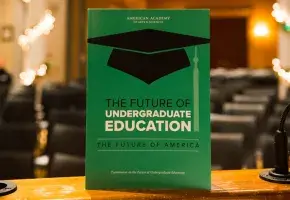
Major study by American Academy of Arts and Sciences seeks change in curriculum and assessment, commitment to funding public higher education, new ideas about the faculty role, and more.
The Academy's first new members were elected in 1781 and today the Academy announced members elected in 2024. The newest members are being recognized and celebrated for their excellence, and invited to join the Academy in connecting across disciplines and divides to advance the common good.